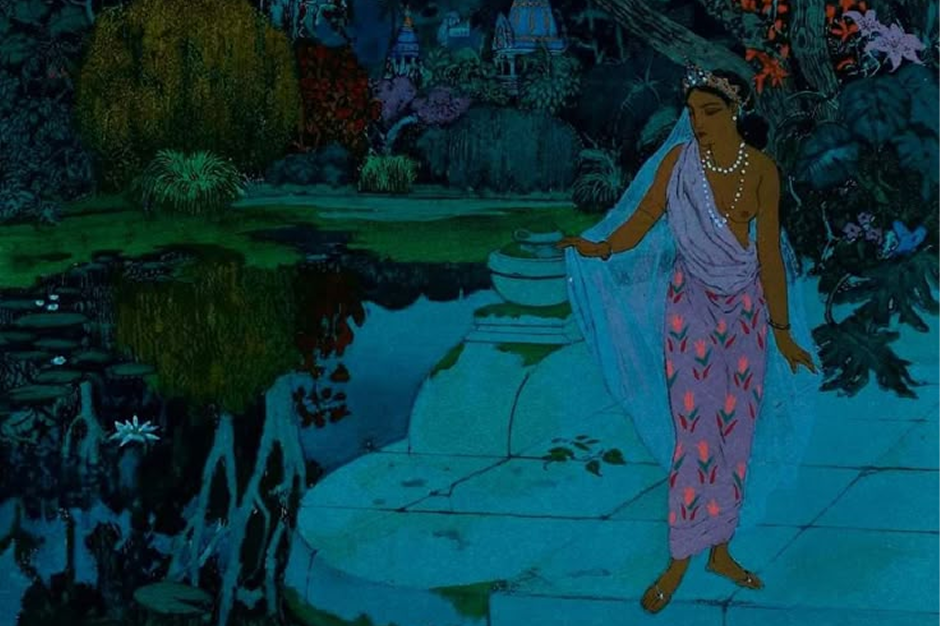


.jpg)
This aesthetic isn’t unique to Chamatkar. Its over-the-top melodrama, heightened performances and unapologetically gauche visual language belong to a particular strain of Hindi cinema that flourished in the 1980s and carried into the early 1990s. The 1980s, following what is often described as Bollywood’s “Golden Age”, are frequently remembered as a low point for Hindi cinema. But, as Avijit Ghosh writes in When Ardh Satya Met Himmatwala, “The Eighties were essentially a decade of contradictions in Hindi films.” The period saw an increase in production value, star power and access to larger cinema-going audiences alongside what was perceived as a decline in the quality of storytelling. The rise of television, the increasing popularity of films from the South and changing audience tastes all contributed to this transformation.
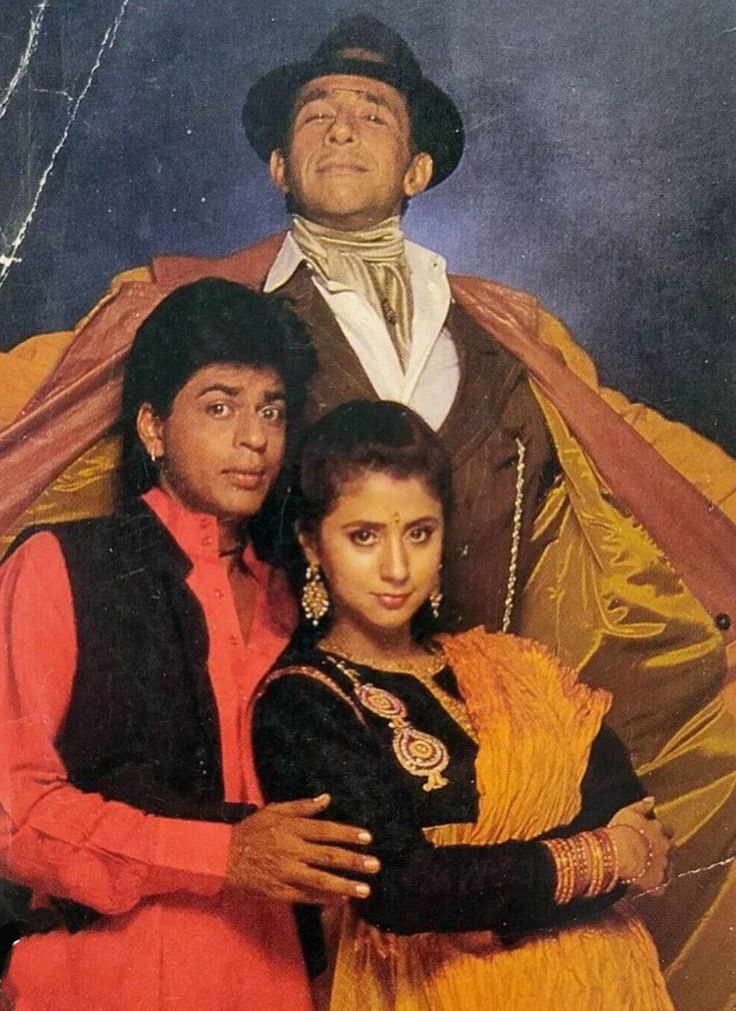
The decade was also marked by an increasing emphasis on family melodramas and heightened emotional narratives. Films such as Karz, Khoon Bhari Maang and Shaan turned the action-driven conventions of earlier decades into more heightened, often intensely sentimental spectacles. Many of these films also reinforced the ideal of the Hindu joint family, placing familial loyalty and sacrifice at the centre of their stories. Chamatkar arrives at the tail end of this cinematic moment. It contains many of the saccharine elements associated with 1980s Bollywood, while also possessing a strange excess that seems to anticipate the more self-conscious absurdity of what would follow.
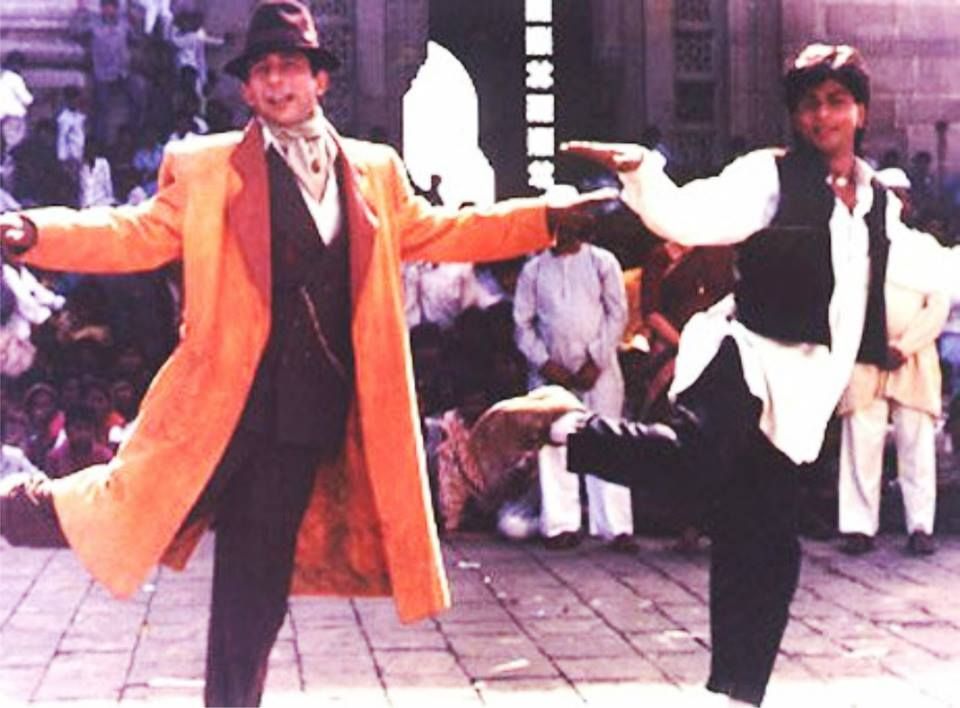
Despite starring Naseeruddin Shah, one of the best actors of his generation, and a young Shah Rukh Khan, riveting in almost any role, the film made little impact at the time and is barely remembered today. Its plot follows Sundar (Shah Rukh Khan), a naive village schoolteacher who travels to Mumbai at the behest of a close friend. After being betrayed by him and other con men, Sundar ends up broke and friendless in a graveyard on his first night in the city. There, he meets the ghost of Amar Kumar, aka Marco (Naseeruddin Shah), a former gangster who had gone straight only to be murdered by his own associates on his wedding night. After 20 years of waiting, Sundar is the first person who can see and interact with Marco. The two team up to seek revenge against Kunta, the henchman responsible for Marco’s death. What follows is a series of mostly zany antics as they attempt to bring Marco’s killers to justice.
What, precisely, makes this film camp rather than simply absurd? In her seminal essay “Notes on ‘Camp’”, Susan Sontag describes camp as a way of appreciating the failure of an artistic attempt rather than simply being frustrated by it. Chamatkar, then, becomes camp in retrospect. It did not quite succeed on its original terms, but its excesses have acquired a different kind of appeal with time. Its strange visual choices, melodramatic performances, gender play and spectacularly cartoonish villains become more enjoyable precisely because the film takes itself so seriously.
While the premise is absurd enough to invite a camp reading, the film leans into this quality through its songs, characters and sheer theatricality.
Sundar and Mala (Urmila Matondkar), Marco’s daughter and Sundar’s love interest, first meet during his train journey to Mumbai, when he accidentally wanders into the ladies’ compartment. Mala assumes the role of ringleader, joining the other women in preventing him from leaving. She tells him that the only way they will let him remain in the compartment is if he dresses as a woman for the rest of the journey. During the song “Bichoo O Bichoo”, they taunt him and transform him into a woman — one of two occasions on which Shah Rukh Khan appears in drag.
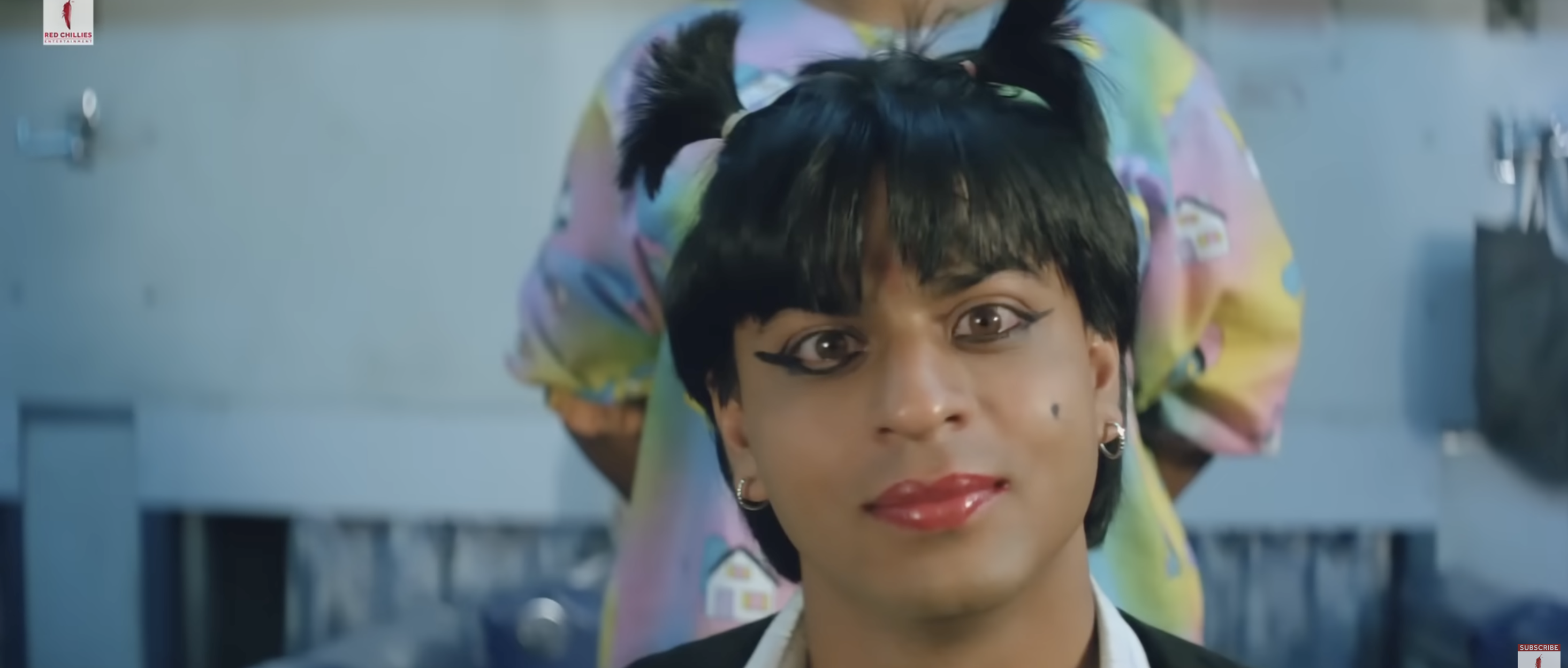
The sequence reverses the gendered power dynamics normally associated with public transport. Sundar, a naive male traveller, becomes the vulnerable outsider in a space designated for women. He is subjected to the kind of teasing, surveillance and threat that female travellers have historically had to navigate in public spaces. The scene plays this reversal for comedy, but its visual excess makes it unmistakably camp: Sundar is dressed in eyeliner, pigtails and a dupatta while a group of women gleefully torment him. The joke depends on the temporary destabilisation of gender itself.
The film continues to play with gender in ways that remain unusual for mainstream Bollywood. Although much of this gender play is presented as a joke, there is often something revealing beneath its melodramatic and zany surface. Marco’s status as a ghost allows him and Sundar to develop a particularly intimate relationship, one that occasionally approaches the homoerotic without ever becoming explicitly sexual. Their closeness is made possible precisely because Marco is no longer a living, heterosexual man.
Ghosts have long provided cinema with a way of representing forms of longing that cannot be physically fulfilled. Think of the iconic sequence in Ghost (1990), in which Patrick Swayze’s character sits behind Demi Moore at the pottery wheel and touches her without quite touching her. The eroticism comes partly from the impossibility of physical contact. The ghostly body can occupy a space between presence and absence, allowing desire to exist without being fully realised.
Something similar, if less intentionally, happens between Sundar and Marco. They share a closeness that the conventions of heterosexual masculinity would otherwise make difficult to express. Their friendship is affectionate, trusting and emotionally intense, but the film can contain that intimacy because one of them is already dead. There is no need to name this relationship queer for it to be interesting through a queer lens. Its emotional excess creates space for a different kind of male intimacy. But the film’s queer possibilities become even more interesting when we turn to its villains.
Camp has a complicated relationship with queer representation. It is often associated with humour, exaggeration and absurdity, but its history is also entangled with exclusion and marginalisation. Queer audiences have frequently had to find pleasure in representations that were not created for them, including stereotypes that reduced queer people to comic relief, villains or objects of ridicule.
One of the most influential histories behind this is Hollywood’s practice of queer coding. The Hays Code, introduced in the United States in the 1930s, restricted the representation of homosexuality and other forms of sexuality deemed unacceptable. One consequence was that filmmakers developed ways of signalling queerness without explicitly naming it. Characters could be coded through mannerisms, clothing, gender nonconformity or sexual ambiguity. Villains in particular became a common site for these traits, allowing films to associate deviation from gender norms with moral corruption.
The practice did not begin or end with Hollywood, nor can Bollywood’s representations simply be attributed to the Hays Code. But the history provides a useful framework for thinking about the relationship between queerness, gender nonconformity and villainy in popular cinema. The association between effeminacy, gender transgression and moral danger has appeared across film industries in different forms.
Bollywood has its own long history of characters whose departures from conventional masculinity and femininity are used to signal villainy, comedy or both. By the 1990s, some villains had become increasingly theatrical and gender-nonconforming, a departure from the more conventionally masculine villains of earlier decades. Lajja Shankar Pandey in Sangharsh, for instance, uses feminine clothing and mannerisms as part of his frightening persona. These characters are not necessarily queer, but their departures from conventional gender performance become part of what makes them threatening. Chamatkar is full of such figures.
Midway through the film we meet Monty, Kunta’s nephew, a rapist and an all-round awful human being. He is accompanied by two henchmen: She-Girl and Gunga. Both are dressed in theatrical black and are presented as violent, exaggerated extensions of their commander. Their gender performances are strikingly different from those of the film’s heroes.
She-Girl, the film’s only female villain, is conspicuously masculine. She dresses like an exaggerated 1980s action villain, pairing masculine clothing with red lipstick and dark blue eyeshadow. She also appears to be sexually interested in Mala, repeatedly threatening and attempting to abduct her. Her gender presentation and desire are both positioned against Mala’s conventional femininity. The contrast is played for comedy as much as menace: She-Girl is larger-than-life, physically aggressive and visually excessive in a way that makes her feel almost like a parody of the male action villain.
Gunga, meanwhile, is the strong, silent type — literally unable to speak — but his masculinity is similarly exaggerated and distorted. He is muscular and often bare-chested, yet his mannerisms and clothing are conspicuously theatrical and effeminate. He looks less like a conventional Bollywood henchman than a hyper-stylised fantasy of one. Neither character is explicitly identified as queer. That distinction matters. What makes them interesting through a queer reading is the way the film uses gender nonconformity as part of their villainous spectacle. Their bodies and performances sit outside the film’s preferred ideas of masculinity and femininity, and that difference becomes part of the joke.
Another notable figure is Moti, a hotel bellhop who informs Kunta about a secret room containing Marco’s hidden treasure. Moti presents in a visibly gender-nonconforming way and uses feminine language to refer to herself. In one brief exchange with Kunta, Moti asks him to come to her room. When Kunta responds irritably, Moti replies, “woh baat nahi hai” — “it’s not about that” — in a flirtatious tone. The implication is deliberately suggestive: the exchange hints at a sexual or romantic familiarity between the two characters without ever spelling it out.
Moti’s gender presentation, flirtatiousness and position outside conventional masculinity make the character legible through a queer lens. But the film does not give us enough information to definitively identify Moti as transgender, gay or any other specific identity. What it does make clear is that gender ambiguity itself is part of the character’s comic construction. The film treats these characters as jokes: amusing side characters whose difference is equal parts ridiculous and threatening. Their gender nonconformity is not incidental to their villainy; it helps produce it. She-Girl is not simply a female villain but one whose masculinity and attraction to another woman are presented as threatening. Gunga’s effeminacy sits alongside his violence. Moti’s ambiguous gender presentation is accompanied by sexual innuendo and criminal association. In other words, the film repeatedly positions gender and sexual differences on the side of the villains.
This is where a queer reading of Chamatkar becomes more interesting than simply calling its villains queer coded. The film may not understand these characters as queer in the contemporary sense, but queer audiences can recognise something familiar in the way they are pushed to the margins of the narrative. Their differences make them funny, frightening and excessive all at once. This is also where Camp becomes useful.
Susan Sontag writes that “The whole point of Camp is to dethrone the serious.” Camp allows viewers to take things that were intended to be serious and discover pleasure in their excess, artifice and absurdity. It changes the relationship between the viewer and the work. Instead of accepting the hierarchy the film gives us — heroes at the centre, villains at the margins — a camp reading can become interested in precisely those marginal figures. The queer-coded villains of Chamatkar are arguably more visually memorable than many of its heroes. Their clothes, bodies, gestures and relationships are exaggerated to the point of absurdity. The film wants us to laugh at them, but Camp gives us another option: we can laugh with them, or at least enjoy the spectacle they create. This does not mean pretending that the representation is progressive. It isn't. The characters are stereotypical, and their queerness — or perceived queerness — is bound up with villainy, violence and ridicule. A queer reading should not erase that history. Instead, Camp creates a way of taking control of it.
In his essay “It's Being So Camp as Keeps Us Going”, British film historian Richard Dyer argues that Camp can become a way for gay men to recognise themselves within a culture that does not necessarily represent them positively. Camp emerges, in part, from a history in which queer people had to find pleasure in the scraps of representation available to them. It turns visibility into something that can be played with, rather than simply endured. Dyer also argues that Camp reminds us that art and media are not neutral reflections of reality but constructions: particular ways of talking about and imagining the world. That is what makes a camp reading of Chamatkar productive. It allows us to look at the same film differently without pretending that its original intentions were different. There is already a long history of queer audiences rereading popular cinema in this way. Gayatri Gopinath, writing about queer readings of popular Indian cinema, has argued that gender and sexual play in Bollywood can become sites of queer identification when viewed from perspectives that differ from the heterosexual and patriarchal assumptions under which the films were produced.
Chamatkar is particularly suited to this kind of rereading because it is so excessive. Its animated credits, ghostly friendship, drag sequence, melodramatic romance and spectacular villains all operate at a level of heightened unreality. The film is already playing with the boundaries between the ordinary and the ridiculous. Camp simply pushes that logic further. Reimagining Chamatkar as a Camp classic does not make its queer representations good. It makes them available for another kind of viewing. The characters the film places at the margins can become the most interesting part of it. Their clothes become costumes; their mannerisms become performances; their villainy becomes theatre. Perhaps that is the queer pleasure of Camp: not finding yourself perfectly represented on screen, but finding a way to make something out of the representation you were given.
Chamatkar is both awful and amazing. Its excesses are sometimes clumsy, sometimes uncomfortable and frequently ridiculous. But that is precisely what makes it so much fun. It fails at being the serious, straightforward Bollywood fantasy it seems to want to be — and, three decades later, that failure gives us something else to enjoy. It is good because it is awful.
That, after all, is Camp.