

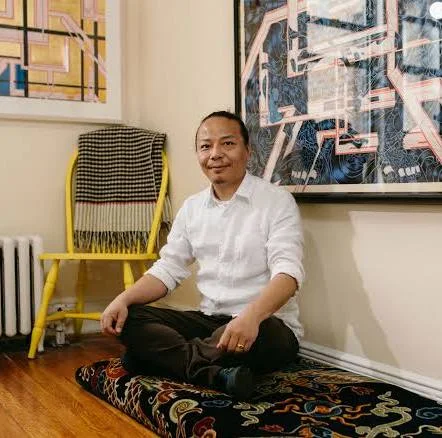
At the centre of Mandalas: Mapping the Buddhist Art of Tibet, a major exhibition of Himalayan Buddhist art, was a new installation by Tibetan artist Tenzing Rigdol. Around it were centuries-old Buddhist works, but Rigdol's mandala turned towards the concerns of the present - ecosystems, human behaviour, social responsibility and the fragile connections between them. The artist described the mandala through the idea of interdependence: everything is connected to everything else.
It is an unexpected use for an art form that has travelled across centuries. But perhaps that is precisely what makes the mandala so enduring. It has never belonged to one fixed meaning.
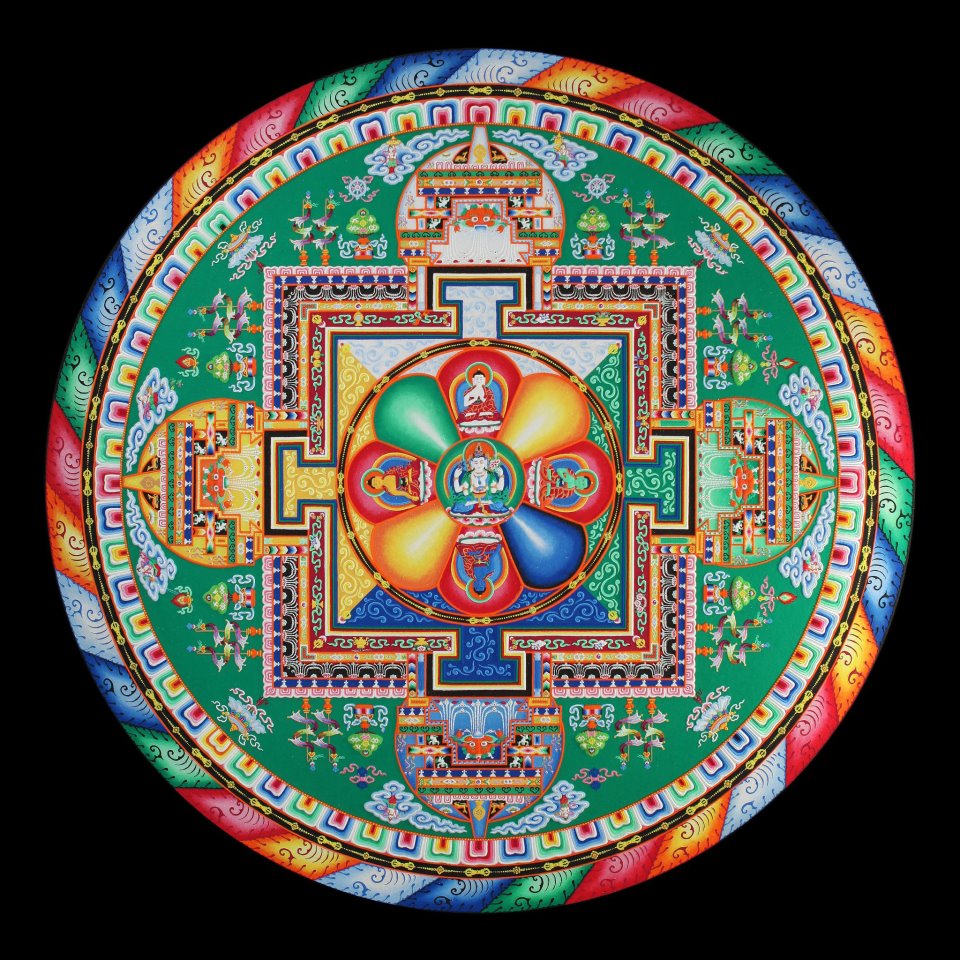
The mandala is usually understood as a geometric diagram organised around a centre. In different traditions, that centre can represent a deity, the cosmos, the structure of existence or the mind itself. Its forms and uses have changed as it has travelled across regions and religious traditions, particularly through the movement of Buddhism across Asia.
The story of the mandala, then, is not simply the story of an image. It is a story of how an idea can travel, change and still remain recognisable.
THE SEARCH FOR A CENTRE
One of the most important places to begin is Buddhism. The historical Buddha lived in the fifth century BCE in the region of present-day India and Nepal. His teachings centred on the problem of suffering and the possibility of overcoming it. In the centuries following his death, Buddhism spread across Asia, developing into different traditions and taking on new forms.
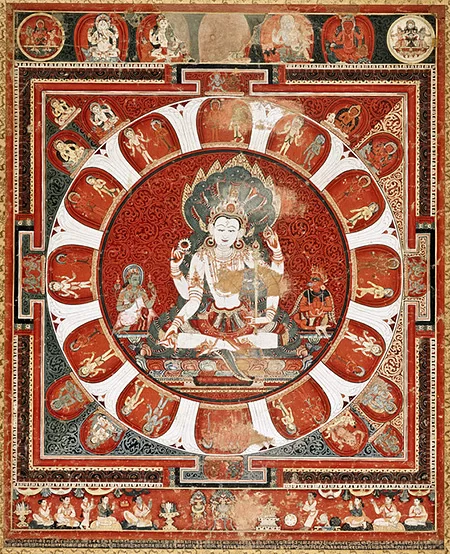
Within Esoteric and Vajrayana Buddhism, the mandala became an important part of this spiritual practice. It could function as a cosmic diagram and a meditative tool, allowing practitioners to contemplate the relationship between the individual, the divine and the universe. In Tibetan Buddhism, mandalas could be used alongside ritual practices as part of the path towards enlightenment.
The form itself often leads the eye towards a centre. From there, layers of figures, symbols and geometric structures radiate outward. The mandala can therefore be understood almost as a map: a way of giving visual form to a reality that cannot otherwise be easily seen. This idea travelled with Buddhism.
In Japan, for example, mandalas became central to Esoteric Buddhist traditions. The Diamond World and Womb World mandalas represented different aspects of the Buddhist cosmos, with the Cosmic Buddha Mahavairochana at their centre. They were used during meditation and ritual, demonstrating how a form that originated within Indian Buddhist traditions could be transformed within a distinctly Japanese religious context.
In China too, Tibetan Buddhist mandalas were adapted from Tibetan prototypes. A fifteenth-century mandala now held by the Metropolitan Museum of Art, for example, was produced in China in a Tibetan style, showing how artistic forms continued to move between cultures rather than remaining confined to their place of origin. The mandala was travelling, but it was not necessarily remaining the same.
IMPERMANENCE AS ART
Perhaps nowhere is this transformation more striking than in the Tibetan sand mandala. Unlike an artwork intended to survive, a sand mandala is created with its destruction already built into the process. Monks spend hours or days carefully placing coloured grains of sand into intricate geometric patterns. Once the mandala is complete, it is ritually dismantled. Its disappearance is part of the meaning.
The temporary nature of the sand mandala reflects the Buddhist understanding of impermanence: that everything changes and that attachment to things as permanent causes suffering. The work does not become meaningless when it is destroyed. Its destruction completes the work.
This makes the mandala an experience of making, contemplating and letting go. The same principle can be seen in other South Asian traditions, although the forms and meanings are not identical.
SACRED GEOMETRY
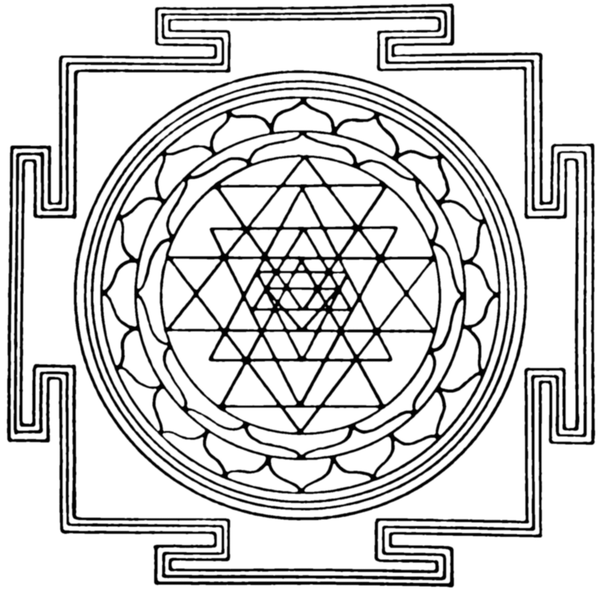
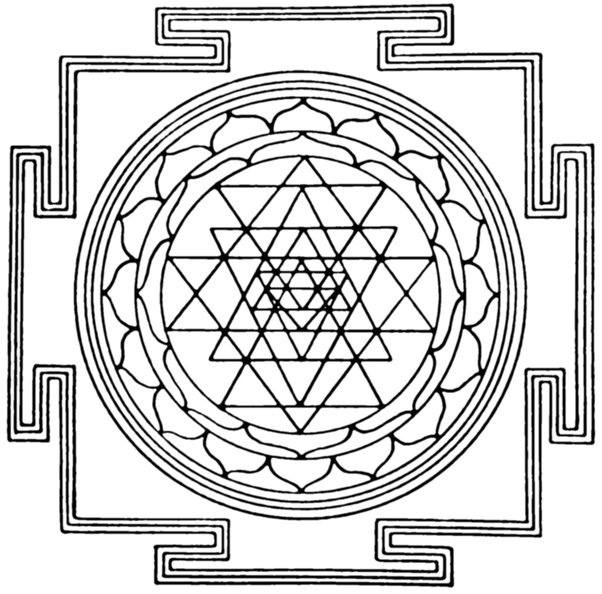
Within Hindu traditions, geometric diagrams have long been used in ritual and worship. One important example is the Sri Yantra, a complex arrangement of interlocking triangles organised around a central point, or Bindu.
It is important to distinguish a yantra from a mandala, even though the two are often discussed together. A yantra is a ritual diagram used as a tool for meditation and worship, while “mandala” is a broader term for a sacred diagram or representation of a cosmic order.
The Sri Yantra brings together geometric forms and Hindu philosophical ideas. Its intersecting triangles are associated with Shiva and Shakti, while the Bindu at its centre represents a point from which the rest of the form emerges. Here, as in the Buddhist mandala, geometry becomes a way of making the invisible visible. The cosmos is given structure through lines, circles, points and symmetry.
A COSMOS IN HUMAN FORM
Jain traditions offer another way of imagining this cosmic order. Jainism developed alongside Buddhism in ancient India, with Mahavira and the Buddha traditionally understood as near-contemporaries. Jain religious art developed its own cosmological imagery, including representations of the universe through highly structured diagrams and figures.
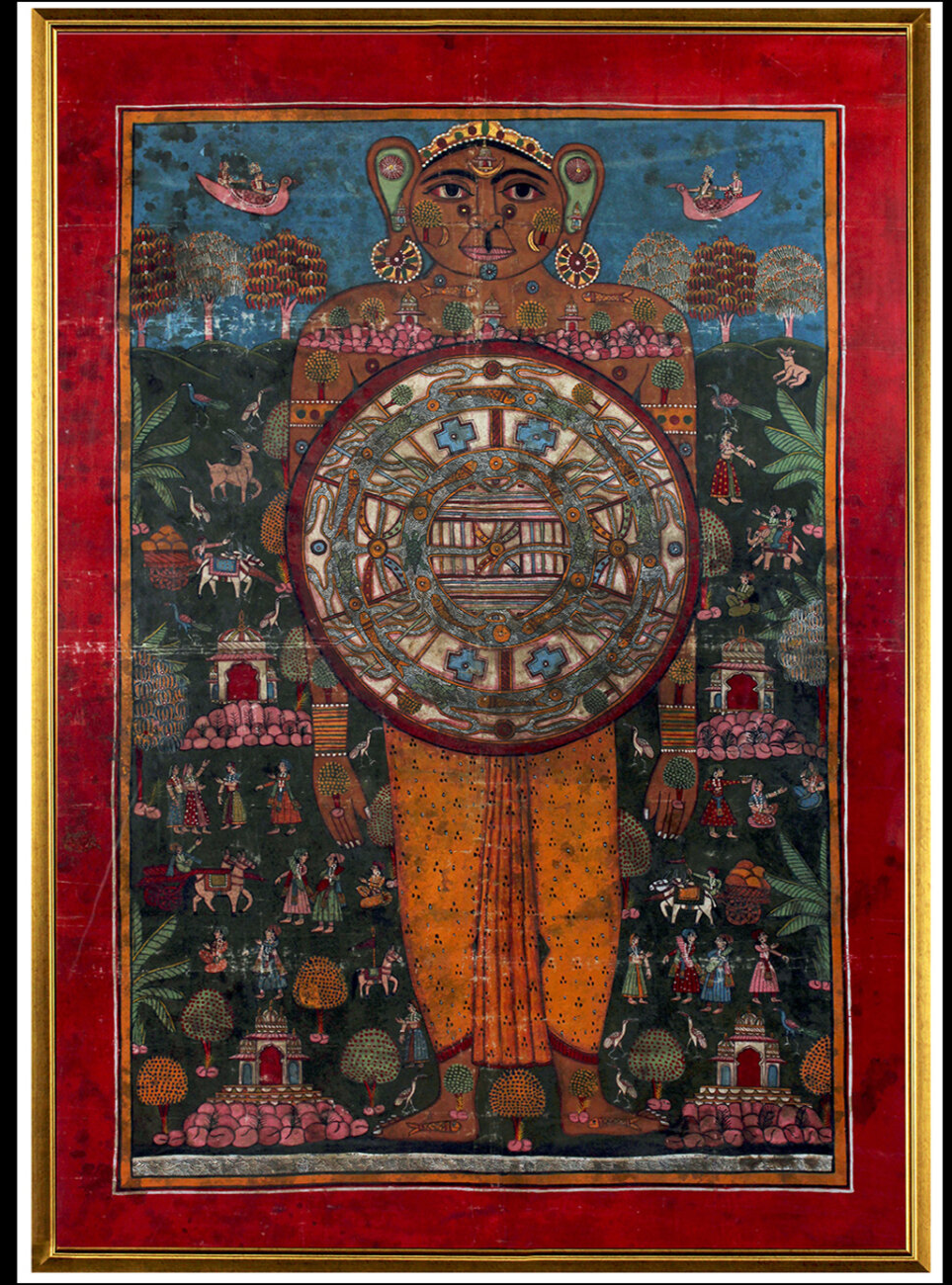
The Lokapurusha, or cosmic man, is one such representation. The human form becomes a map of the Jain universe, allowing an immense cosmological structure to be imagined through the body. Other Jain cosmological paintings, including the Adhaidvipa Patta, represent the structure of the world and the places associated with Jain cosmology.
Across these traditions, the specific meanings are different. Yet there is a recurring impulse: to take something vast and difficult to comprehend and give it a structure that can be seen.
WHEN FORMS MEET
As religious and artistic ideas moved across Asia, they encountered other visual traditions. This movement should not be understood as a simple process in which one culture copied another. More often, similar ideas were adapted, translated and given new meanings. This is particularly important when looking at Islamic art.
Geometric patterns, circles, symmetry and repetition became highly developed within Islamic art and architecture. These patterns can create a sense of order and seemingly infinite extension. But this should not be described as Islamic art being derived from the mandala. Islamic geometric traditions have their own histories and mathematical foundations.
The more interesting connection is one of visual convergence. Across very different religious traditions, geometry became a way of thinking about order, infinity, creation and the relationship between the part and the whole.
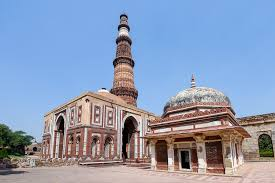
The circle can therefore appear in very different cultural contexts without carrying exactly the same meaning. The history of the mandala is full of such encounters.
INDIA, NEPAL AND THE MANDALA'S MANY LIVES
India and Nepal became important centres in the development and transmission of Buddhist mandala traditions. From the Indian subcontinent, Buddhist teachings and artistic practices travelled through Tibet and further into China and Japan. Nepalese artists and artistic traditions also played an important role in the production and movement of Buddhist imagery across the Himalayan region.
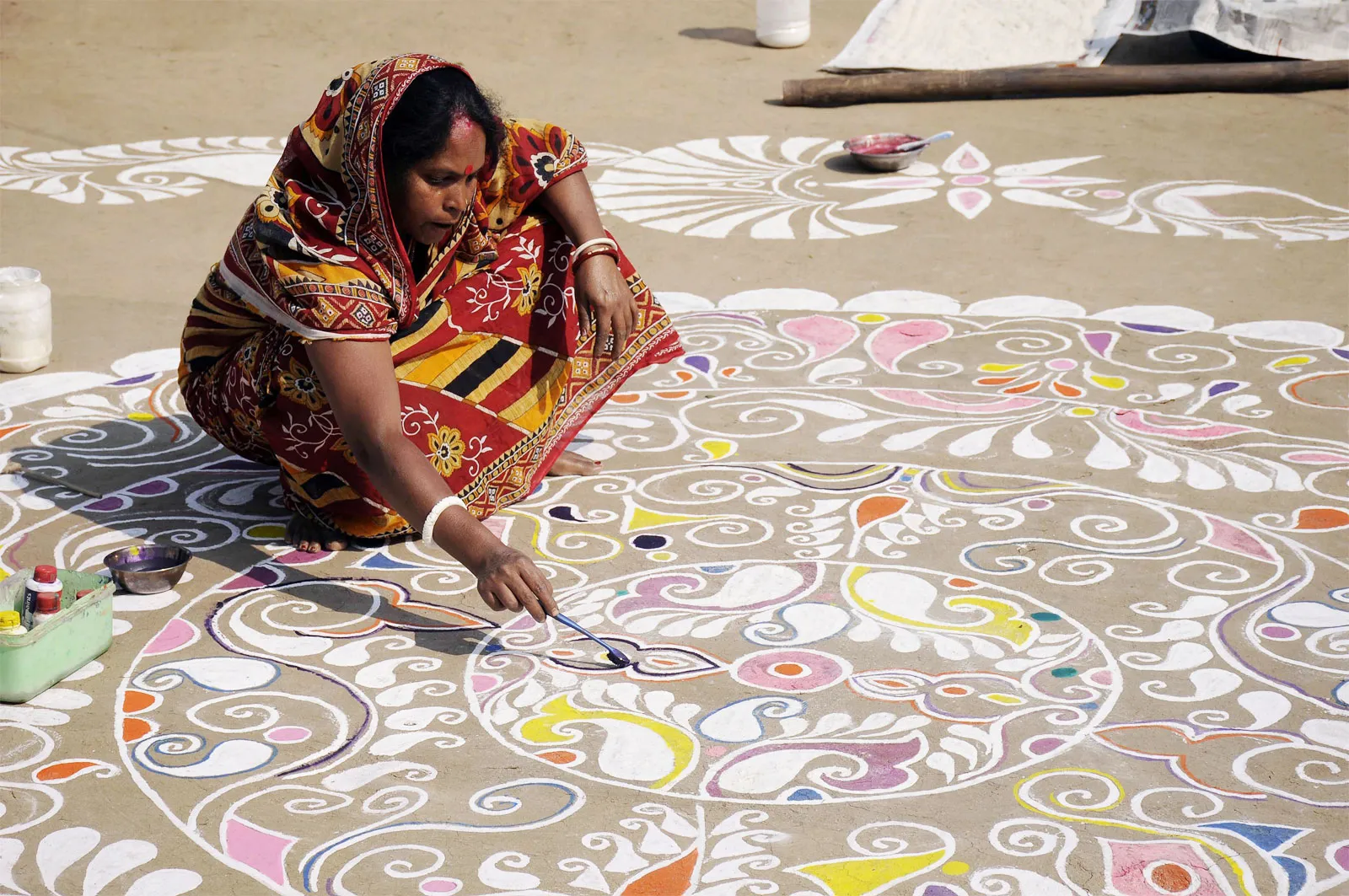
The mandala's relationship with South Asian visual culture can also be seen in practices such as rangoli, Kolam and Muggulu. These geometric designs are made by hand with coloured powders or other materials and are often associated with ritual, auspiciousness and protection.
They should not simply be described as descendants of Buddhists and mandalas. Their histories are distinct. But the visual parallel is striking: something is carefully constructed on the ground, given meaning through its pattern, and eventually allowed to disappear. The act of making becomes as important as the finished image.
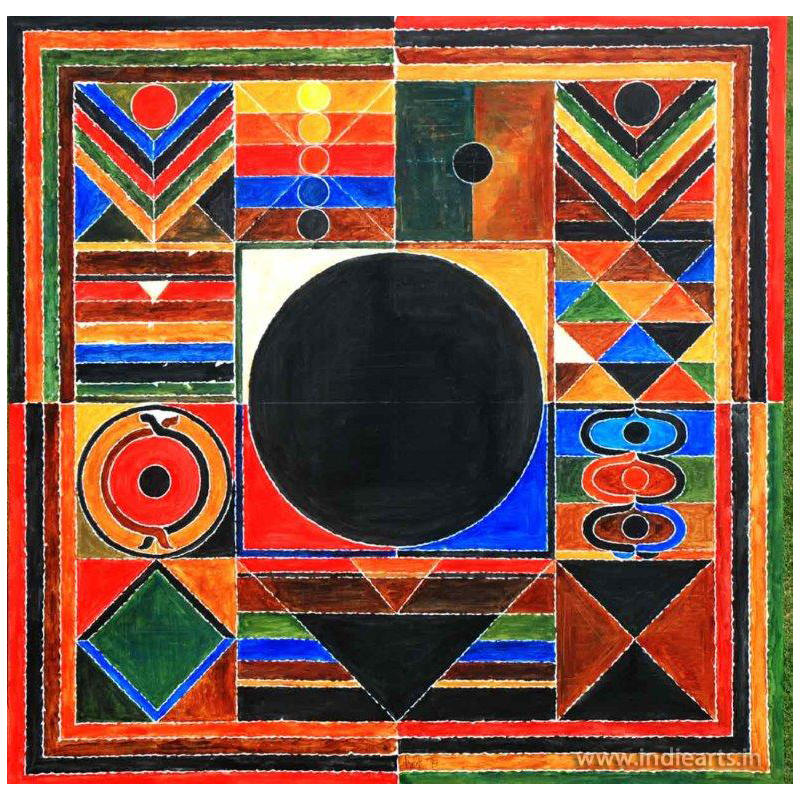
The mandala also found another life in modern Indian art through S.H. Raza. His Bindu became one of the most recognisable images of his work. Raza recalled how, as a child, a teacher drew a black dot to help him concentrate. That image stayed with him and eventually became a central element of his paintings.
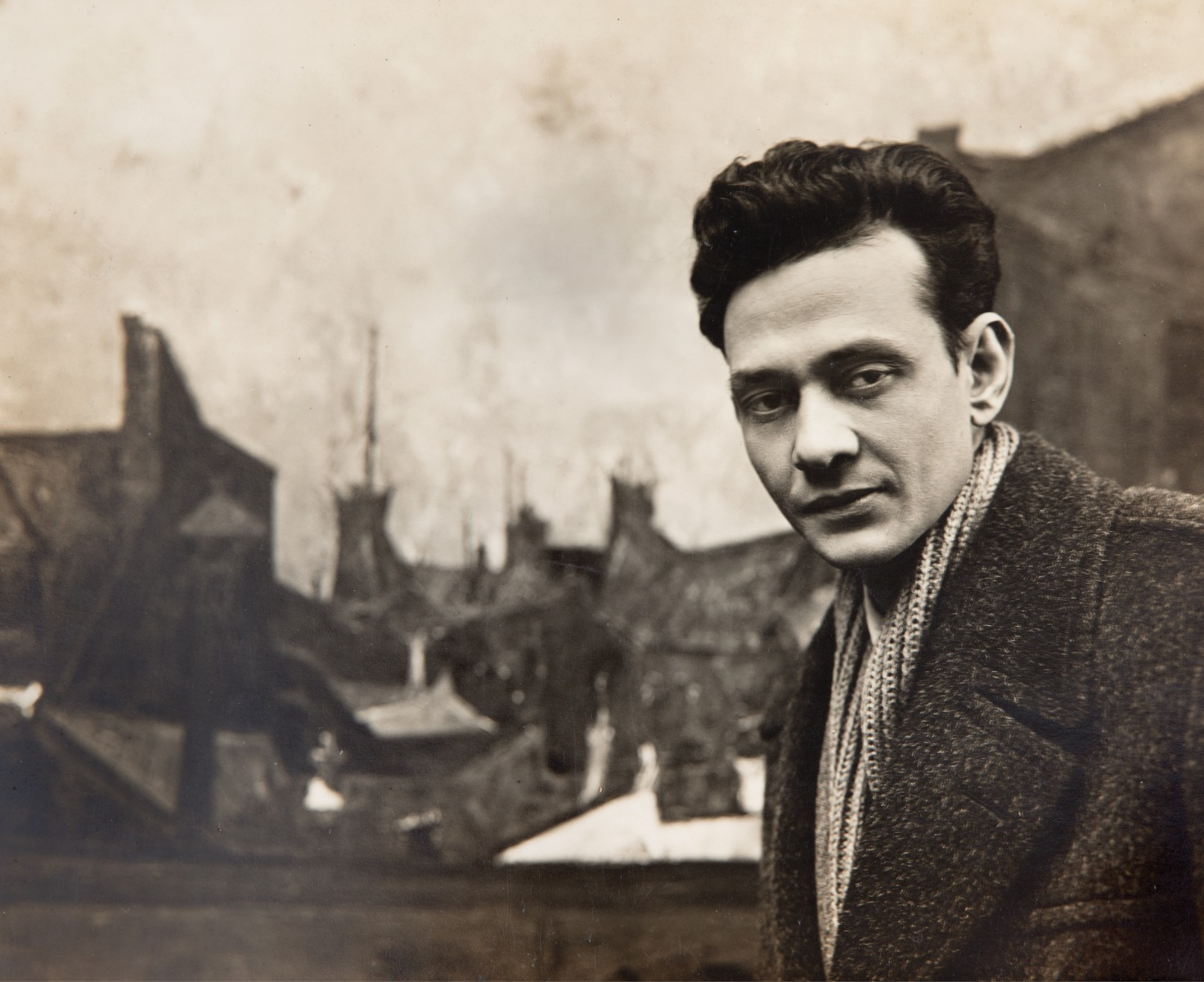
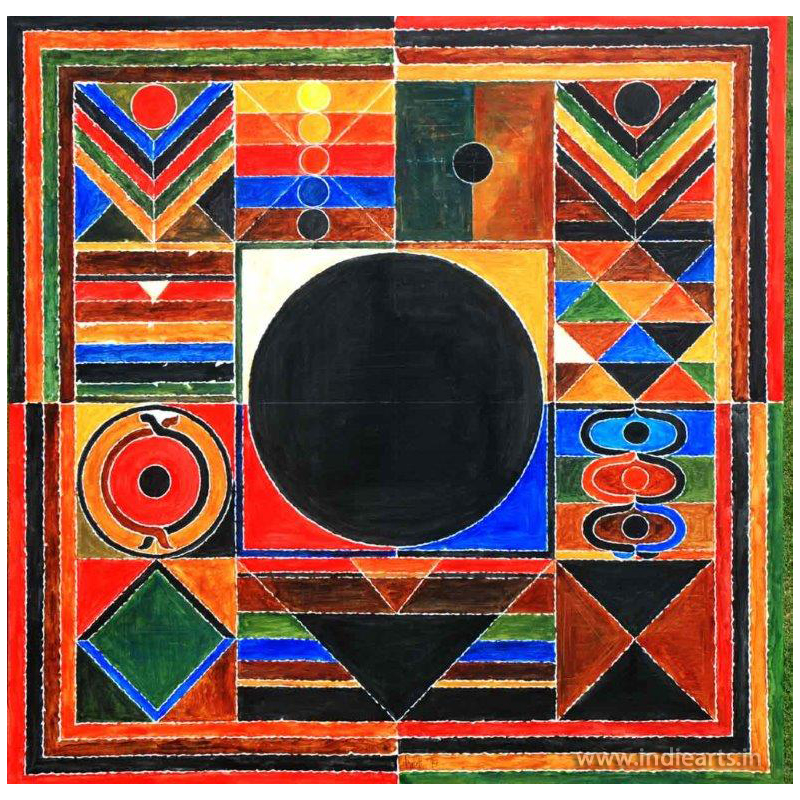
The Bindu allowed Raza to explore ideas of space, time, energy and consciousness through geometric form and colour. Rather than reproducing a traditional religious mandala, he translated ideas associated with Indian philosophy and Tantra into a modernist visual language. The old form had found a new language.
FROM SACRED DIAGRAM TO CONTEMPORARY WORLD
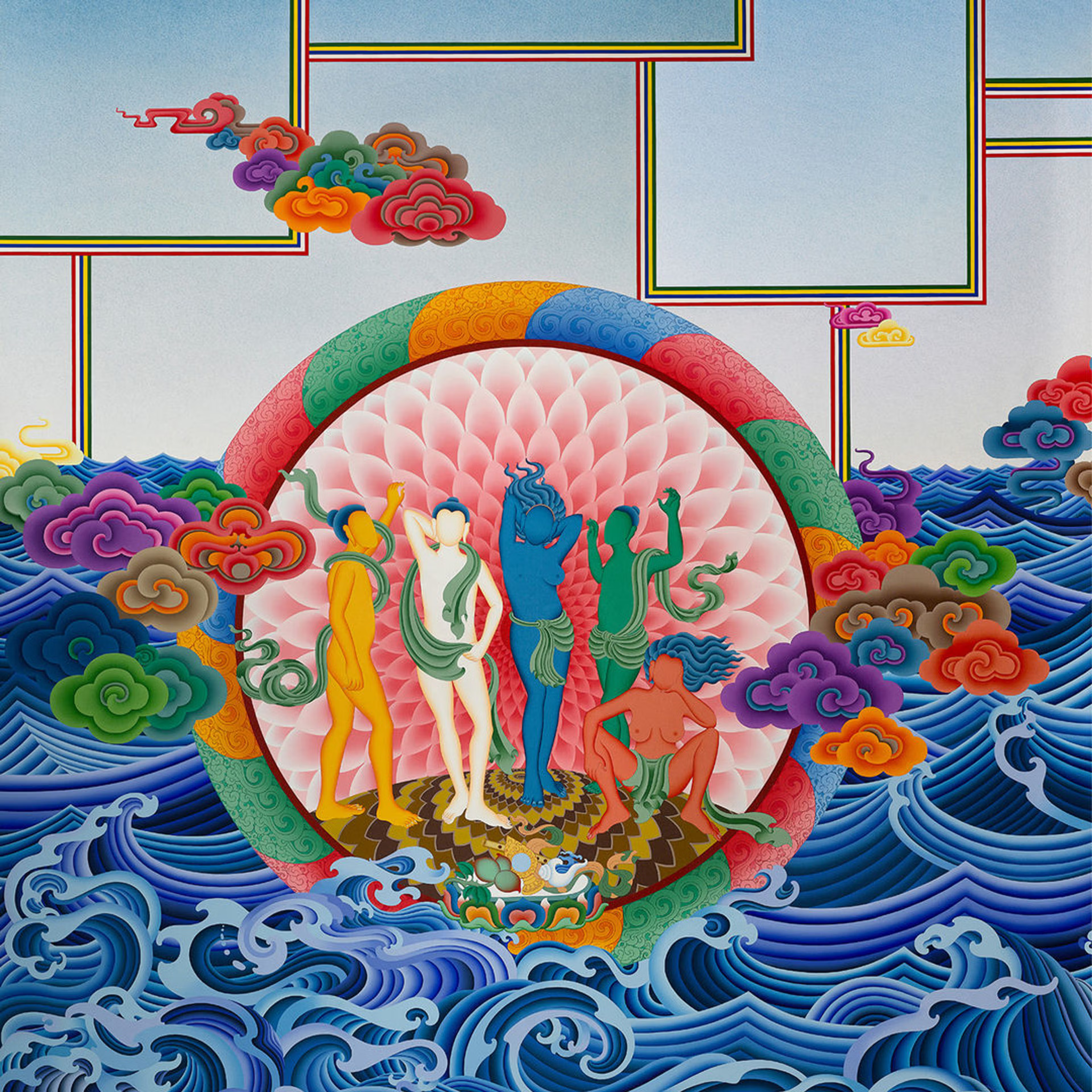
This process continues today. Tenzing Rigdol's Biography of a Thought, commissioned for the Met's 2024 exhibition, places the mandala in direct conversation with contemporary life. Although it draws on Buddhist imagery, Rigdol describes the work as secular and uses the mandala to frame questions about behaviour, ecosystems, virtue, peace and the world around us.
The work is particularly revealing because it does not treat the mandala as an object frozen in the past. Instead, it asks what the form can hold now. That question brings us back to the mandala's longer history.
Its journey has never been a straight line from one religion to another. It has moved through different places, artists and belief systems, acquiring new meanings while retaining certain visual ideas: the centre, the circle, symmetry, interconnectedness and the relationship between the individual and the larger whole. Perhaps this is why the mandala continues to find relevance.
It began as a way of mapping realities that could not easily be seen. Over centuries, it has been used to imagine gods, universes, states of consciousness and the structure of existence. It has been painted, built from sand, drawn on the ground and reinterpreted through modern and contemporary art.
Today, it can even become a way of thinking about a world facing ecological and social crises. The mandala survives not because it has remained unchanged, but because it has not. Its history is a reminder that cultural traditions do not always move in straight lines. They travel, encounter one another, adapt and return in unfamiliar forms. Sometimes what connects different places is not a shared origin, but the possibility of finding new meaning in an old idea. The centre remains. Everything around it keeps changing.