


For more than 250 years, Christie's has built one of the world's most influential businesses around selling art. It could have devoted another summer to blue-chip evening sales and record-breaking prices. Instead, it opened a non-selling institutional exhibition drawn from the Kiran Nadar Museum of Art (KNMA), bringing together 180 works by 67 South Asian artists alongside lectures, guided tours and educational programming. It is not that Christie's has suddenly become a museum. Its business remains what it has always been. What is interesting is that a museum has been able to bring its own collection, its own curatorial thinking and its own institutional voice into a space so closely associated with the movement and valuation of art.
For much of the twentieth century, the architecture of cultural authority felt relatively settled. Museums preserved collections and produced scholarships. Universities interpreted artistic movements. Auction houses authenticated, valued and sold works that had already entered history. Their responsibilities often intersected, but the lines between them were easier to recognise. Today, those lines are beginning to blur. The Meeting Ground offers an unusually clear example of what happens when they do. The more interesting question is not simply why Christie's chose to host KNMA, but why KNMA chose to bring this particular collection here, and what becomes visible when it does.
A collection is never just an accumulation of objects. Somewhere along the way, someone has decided what deserves to stay, what belongs beside what, which histories are worth carrying forward and which conversations should not be allowed to disappear.
A retrospective tells you about an artist. A collection tells you how an institution sees the world.

Man and Woman Grinding Their Teeth, 1957
Oil on board, 152 x 121 cm, (59.8 x 47.6 in.)
Collection: Kiran Nadar Museum of Art (KNMA)
Image courtesy: Artist and KNMA
And a collection reveals itself most clearly, perhaps, in the company it keeps. Take the wall where F. N. Souza's Man and Woman Grinding Their Teeth sits beside three landscapes by S. H. Raza: Paysage Barbizone, Village en Provence and Jaipur. Souza brings the restless human figure; Raza brings the landscape. India and France, agitation and stillness, the body and the world around it begin to sit beside one another without needing to resolve themselves. Geography, which could so easily have remained in the background, suddenly has a presence of its own. Nothing here needs to resolve into a single reading. The works are allowed to complicate each other instead.
That is one of the pleasures of The Meeting Ground. Its interconnected “scenes” move across histories, geographies, materials and forms of belonging, but they do not always tell you in advance how those things are supposed to relate. You discover the relationship by looking. Sometimes, the pleasure is in not quite knowing where one work ends and another begins.

Image credit: CHRISTIE’S IMAGE LTD. 2026
A similar chemistry appears in the grouping of Gauri Gill and Rajesh Chaitya Vangad's Factory and River II, Mayur and Tushar Vayeda's Kaal Chakra: When Time Walks the Lands and Manjunath Kamath's Alternative Layers. The works come from very different artistic worlds, yet their proximity gives each one a new neighbour to contend with. Rather than smoothing out those differences, the exhibition lets them remain visible. South Asian art, so often made legible through tidy oppositions such as modern and traditional, urban and indigenous, contemporary and historical, begins to look considerably less tidy, and considerably more alive.
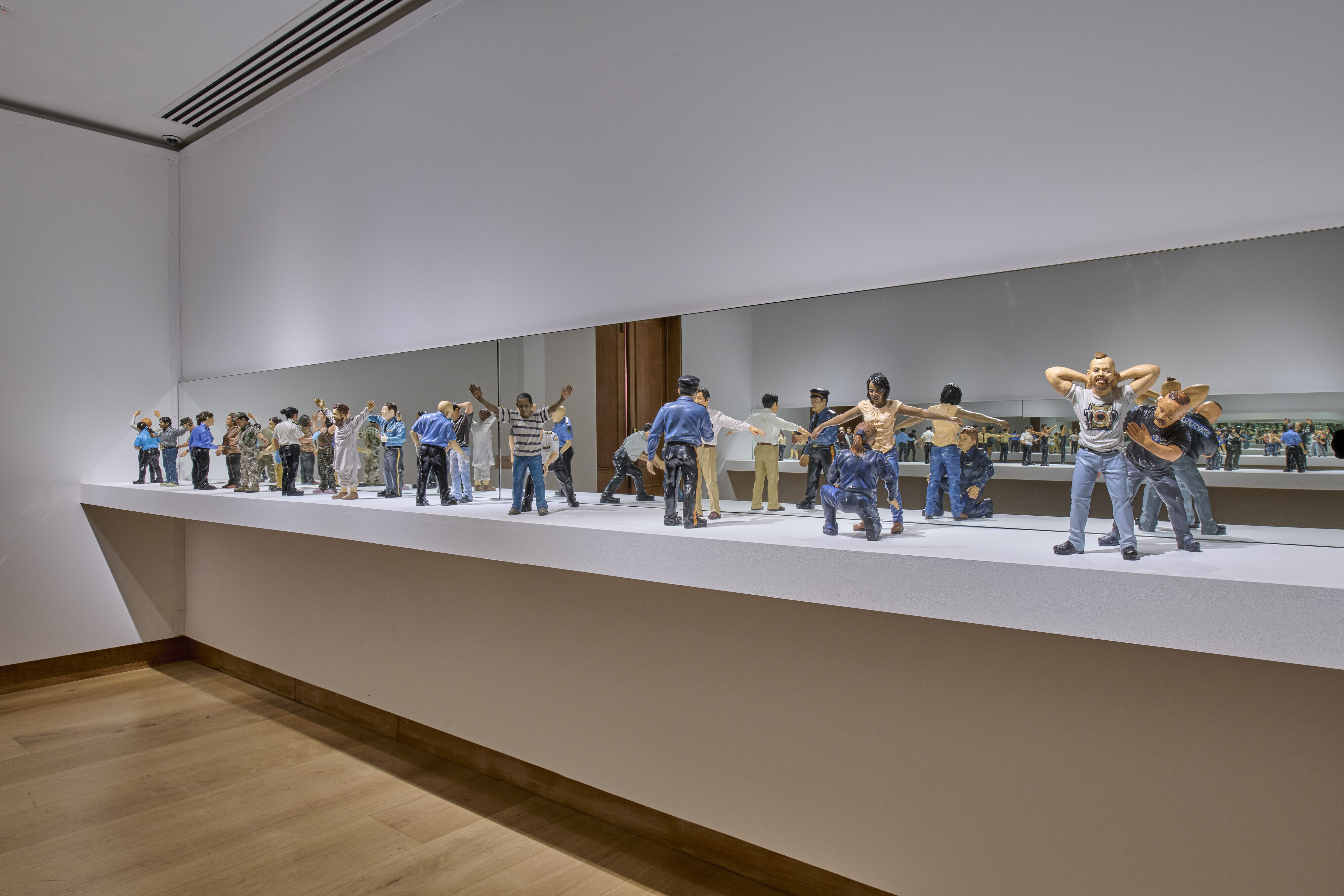
Circadian Rhyme, 2012-2013
Image credit: CHRISTIE’S IMAGE LTD. 2026
Looking through the exhibition images, Jitish Kallat's Circadian Rhyme immediately caught my eye. Its tiny resin figures are scaled with such uncanny precision that they seem almost too believable for their size. They have the familiarity of people you might recognise in a crowd, except the whole world has been reduced to miniature. I found myself looking at them longer than I expected to. There is something wonderfully disorienting about being made to peer into a world that feels complete, only smaller. Suddenly, the anxieties the work carries, surveillance, borders and the repetitive rhythms of modern life, become almost intimate. You are not just looking at an idea. You are peering into a little portal..
That kind of encounter is part of what makes this collection feel alive. It is not always the grand historical statement that stays with you. Sometimes it is a peculiar object you keep looking at because you have not quite decided what to make of it. It is also how the exhibition presents homeland that this becomes especially compelling.
South Asia has never been a fixed artistic geography. Its histories have been shaped by migration, partition, displacement, exile and the movement of artists between cities and countries. In The Meeting Ground, artists including Zarina Hashmi, Anwar Jalal Shemza, Zainul Abedin, F. N. Souza and Bani Abidi appear within a broader constellation of artists whose lives and practices refuse the neatness of a single homeland. Here, migration is not a biographical footnote attached to an artist after the fact. It becomes part of the way the collection understands South Asian art itself. “South Asia” begins to feel less like a geographical label and more like a history of movement: artists leaving, returning, carrying places with them, losing places, finding new ones and sometimes living between several at once.
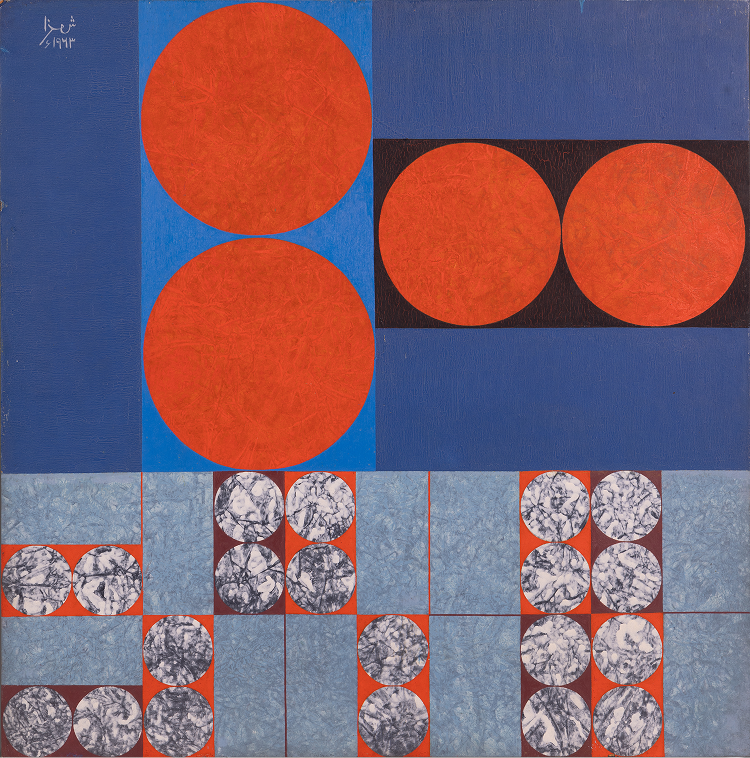
Square Composition 2, 1963
Oil on board, 61 x 60.8 cm (61 x 24 in.)
Collection: Kiran Nadar Museum of Art (KNMA)
Image courtesy: Artist and KNMA
There is something telling in the language KNMA itself uses to describe this outward movement. Kiran Nadar speaks of creating “new frameworks for dialogue and scholarship” and placing South Asian artistic practices within “broader international conversations.” It sounds, at first, like institutional language. But looking through The Meeting Ground, the phrase begins to feel rather literal. The museum isn't simply sending works abroad. It is sending the conversations it has built around them. Akansha Rastogi, the exhibition's lead curator, describes The Meeting Ground as an expression of “how we think about the museum and the possibilities within the collection.” The sentence is revealing precisely because the collection is doing more than demonstrating what KNMA owns. It demonstrates how KNMA thinks.
And yet, it would be easy to read The Meeting Ground as another milestone for South Asian visibility. It is certainly that. Yet it also asks a different question. South Asian art has been travelling internationally for decades. What feels different here is not simply that London is looking at South Asia. It is who is doing the framing. The exhibition arrives not as a selection of South Asian art assembled for a Western audience, but as a museum bringing its own collection, its own relationships between artists and its own reading of the region with it. KNMA is not handing London a finished definition of South Asian art. It is allowing a South Asian institution to decide what belongs in the conversation, what histories can sit beside one another and what its collection says about the region itself.
That difference can be easy to overlook when the individual works are already familiar. International recognition of South Asian art has often been narrated through artists themselves: the auction record, the museum acquisition, the biennale appearance, the gallery representation. Those moments matter, but they can also make the institution behind the art disappear. The Meeting Ground brings that institution back into view.
KNMA is not exporting a single masterpiece. It is exporting a collection. More importantly, it is exporting a way of seeing.
Christie's becomes most interesting here not as the protagonist, but as the stage. The auction house provides the international setting, audience and infrastructure through which this collection can enter another cultural context, while the collection arrives carrying its own institutional voice. There is a quiet confidence in that exchange. Christie's does not have to reinterpret KNMA's collection for London in order to give it an international stage. It can simply make the stage available.
That is why the exhibition feels different from a conventional international survey. Christie's is not introducing London to South Asian art. London has encountered South Asian artists through museums, galleries, biennales and cultural institutions for decades. What arrives differently here is the confidence of a South Asian museum bringing not merely artists to be admired, but a history it has chosen to put into conversation. The move extends beyond this particular partnership. Private museums increasingly shape scholarship. Auction houses host public programming. Foundations commission research. Cultural institutions cross into one another's territory, not because they have become interchangeable, but because cultural authority is increasingly built through the contexts they create and the conversations they are able to convene.
The Meeting Ground is compelling precisely because it does not make that shift feel abstract. It lets you see it happening. A Souza can meet a Raza landscape. An indigenous visual tradition can find an unexpected companion in contemporary practice. An artist separated from another by decades can make an older work look newly unsettled. A history of migration can sit beside a history of place without either one having to explain the other away. Walk through the exhibition, and the most compelling thing is not that a London audience has been shown South Asian art. It is that the work has been allowed to rearrange the way South Asian art can be seen.

When the Thing with Feathers Turned Red (after Tintoretto), 2021-2022,
Acrylic liner and enamelon birch wood, 79 x 60 cm, (31.1 x 23.6 in.)
Collection: Kiran Nadar Museum of Art (KNMA)
Image courtesy: Artist and KNMA
The collection makes those relationships visible because someone chose to preserve them. And perhaps that is one of the more interesting things a museum can do: not simply decide what deserves to be remembered, but decide what deserves to keep happening between things. The significance of The Meeting Ground therefore extends beyond a successful partnership between Christie's and KNMA. It offers a glimpse of a cultural landscape in which institutions may no longer distinguish themselves only through the collections they own, but through the conversations they are able to convene. For decades, collections were understood as things institutions protected within their own walls. Increasingly, they are becoming ways institutions speak to one another across borders.
The future of cultural authority may not lie only in who owns the greatest collections. It may lie in whose ideas travel the furthest.