


Who Gets to Imagine the Future?
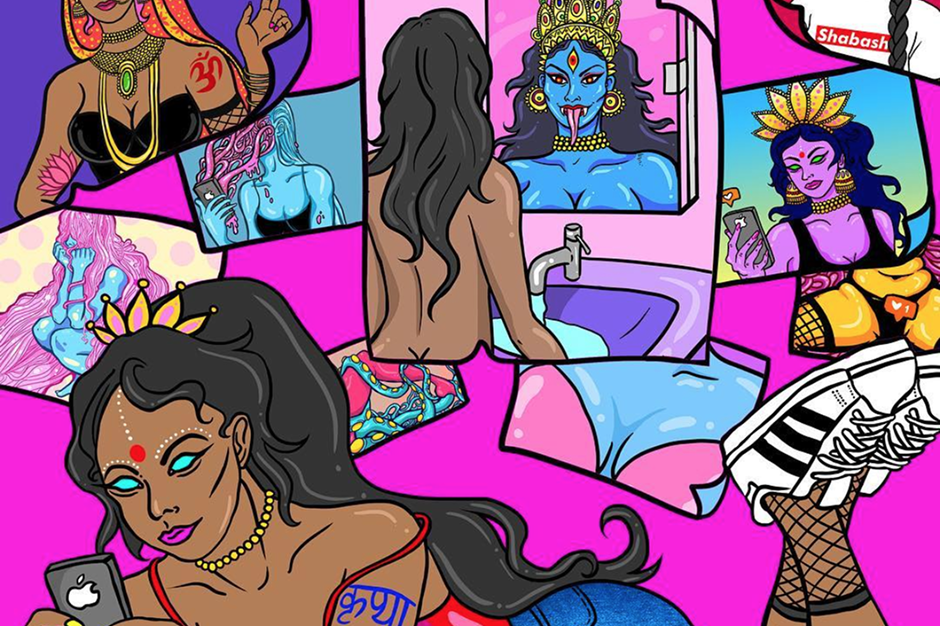
When we think of science fiction, we think of cybernetic bodies, artificial intelligence, exceptional technologies, cities that inhabit worlds beyond our own. But do we think enough about the people who get to inhabit these imagined futures? When we think about existing science fiction films, books and other media, how often do we see a South Asian person leading the narrative? Do we truly resonate with the image of the “future” portrayed in these narratives?
Most mainstream futuristic narratives and science fiction have been shaped and narrated through Western perspectives. This creates a gap between what we know in the present and what we could have known if we had similar access to technology and lifestyle in a futuristic setting. It really makes me wonder what makes us and our culture unworthy of these futuristic worlds. Is it the “backwardness” of our beliefs, the stunted growth of our economy and development, or is the “uncleanliness” of the South Asian identity that does not fit the futuristic vision of science fiction?
What would really happen if South Asian identities not only survived in this futuristic world but actively engaged in shaping it? This is the main idea explored through the artistic concept of Desi-Futurism. An attempt at reshaping how South Asian culture and identities are viewed in futuristic settings, away from the preconceived notions.
This emerging form of artistic expression within the South Asian community employs speculative fiction to blend aspects of science fiction with South Asian histories, reimagining narratives that challenge Eurocentric ideas of progress. Desi-Futurism is an emerging framework rooted in South Asian diasporic and colonial experiences. It reinterprets history, mythology and identity through a futuristic lens, challenging stereotypes while also addressing historical marginalisation.
By blending mythology, art and culture, this artistic movement seeks to reclaim South Asian identity and resist colonial narratives. It also envisions a hopeful future by incorporating regional traditions, aesthetics and technology.

8 Jan. 2020
Reclaiming the Future: Defining Desi-Futurism
For the purpose of this article, the term “Desi” is chosen over “Indo” to reflect a broader South Asian identity and avoid narrow associations. The term is used here as an editorial choice; it does not mean that all South Asian communities use or identify with it in the same way. Desi-Futurism presents a way to explore and preserve cultural heritage while confronting historical oppression. Through this medium, speculative fiction creates realities that bring together history, culture and the future. It depicts worlds that transcend oppression and colonialism, focusing on building new cultural forms relevant to that world.
This utopian hope envisions possibilities for the future and challenges assumptions of Eurocentric narratives to make them relevant to specific communities while distancing itself from preconceived notions. It is still a genre that South Asian underground artists are in the process of developing. This medium gives artists space to explore their identities within a postcolonial framework. It not only challenges Western ideologies in speculative fiction but also addresses South Asian migration, oppression and diaspora, highlighting the complexities of race, ethnicity and cultural preservation while positioning itself against Eurocentric influences.
Desi-Futurism could extend beyond art and literature, potentially influencing broader cultural and social discourse. In a more technologically assisted future, this could serve as a backbone for many artists to broadcast their cultural history and identity to a worldwide audience. These narratives, created through speculative fiction, allow readers to view their own world from a different perspective and reflect on their society more critically. Artists employ visual media and other aids to convey their messages.
Imagining Otherwise: From Afrofuturism to Desi-Futurism
Mark Dery’s essay “Black to the Future”, published in 1994, helped establish the term Afrofuturism in discussions of speculative fiction, technology and African American histories and experiences. Dery describes speculative fiction that addresses African American concerns in the context of twentieth-century technoculture. His essay asks how communities whose histories have been erased can imagine possible futures (Dery 1994, 179–222). Desi-Futurism is similar to other cultural futurisms in its aim to gain autonomy over narratives pertaining to South Asian identities through futuristic speculative realities.
A related discussion of the intersection of race and technology appears in TechniColor: Race, Technology, and Everyday Life, a collection edited by Alondra Nelson, Thuy Linh Nguyen Tu and Alicia Headlam Hines and published in 2001. The collection examines how people of colour use technology and challenges assumptions about race, identity and technological innovation (Nelson, Tu and Hines 2001).
In Afrofuturism, new realities are conjured by empowering marginalised communities to subvert Eurocentric perspectives and challenge neocolonial structures, often invoking ancestral powers and cultural practices to explore alternative realities. Drawing from these works, Desi-Futurism can be understood as a framework that reclaims South Asian identities through the experiences of colonialism and diaspora, imagining futures where the cultures of these communities shape technological advancement and are central to narratives of the future.
To Imagine the Future, We Must Confront the Past
It is important to acknowledge that South Asia's contemporary identities emerge from extraordinarily diverse cultural, linguistic and religious histories, subsequently shaped by empire, colonialism and postcolonial transformation. This raises an important question: If colonial power influenced how South Asia understood its history and modernity, who gets to decide what South Asian modernity or its future essentially looks like?
British colonial rule did not create caste divisions, but colonial administration classified, codified and reshaped them. In the case of caste, census operations and other administrative practices helped turn diverse social identities into more fixed official categories (Dirks 2001). The 1835 education policy placed greater official emphasis on English education and European learning than on Sanskrit and Arabic learning (Macaulay 1835). The economic effects of colonial rule remain a subject of historical debate, including questions of taxation, famine, industrialisation and the drain of wealth (Washbrook 2012). This is where Desi-Futurism plays an important part, as it offers a space for South Asian artists to reclaim their history and the associated suffering.
Speculative fiction aims to depict a world based on native communities and culture that transcends the history of colonialism and oppression. It is an attempt to move beyond representations of their culture through a Eurocentric lens and create empowering racial and cultural representations by people of the same ethnic origin.
Artworks in this context address the misrepresentation of South Asians in mainstream media, seeking cultural autonomy to reclaim past narratives. They assert visibility and agency for South Asian artists in futuristic representations, challenging the invisibility of non-Western identities or an exoticised understanding of culture.
For instance, gods or goddesses from mythologies can be reinterpreted or reimagined from a futuristic fictional standpoint. This interweaving addresses contemporary social issues and challenges Western values in their futuristic visions. Characters, communities and worlds that have been silenced, suppressed or erased are provided with agency to shape their own narratives through these imagined futures. Through these artworks, one can address issues like racism, casteism and other forms of oppression, offering relatable experiences regardless of education.
The limitations of our own world encourage artists to reimagine and create a new world in which to situate their ideas, which are embodied through their art. The narratives and works created under the genre of Desi-Futurism are also situated in a reality divergent from ours to counter the socio-political limitations of being South Asian in a postcolonial society or in a diaspora.
To approach this style of Desi-Futurism, it is essential to understand its core themes and recognise its potential as a tool for social change, cultural resistance and identity formation.
Diaspora: Reimagining Home from Elsewhere
While it is easier to access cultural identity and heritage when you are living in your motherland, what happens to “home” when you no longer live there? What connects you to who you think you truly are?
When it comes to South Asian migration and diaspora, different streams have occurred under radically different circumstances, making their connections with their homelands distinct from one another. A person in the diaspora may neither completely belong to their homeland nor their host country; they occupy a liminal space between cultures, trying to find a space for themselves between their former home and the new one. Speculative fiction similarly occupies a liminal space between realities; it cannot let go of elements from the real world, yet wants to hold on to the imagined world, eventually creating an amalgamation of both.
South Asia has a rich history that fosters diverse cultures, languages and religions. Shaped by empires, invasions and colonial and postcolonial periods, this history is vital for understanding current South Asian identity and the global diaspora. Understanding the diaspora is crucial, as much futuristic art is created by diasporic artists. Desi-Futurism allows for engagement with cultural pasts while reimagining alternative futures, enabling artists to explore their identities and address social issues.
Themes of hybrid identities, migration and cultural displacement are crucial in shaping Desi-Futurist works. Like the identity of South Asians in the diaspora, this genre navigates liminal spaces between reality and speculative worlds. Desi-Futurism emphasizes the dichotomy between empowerment and suppression of power, and how autonomy can be reclaimed by creating alternative futures.
Through Desi-Futurism, people in diaspora can revisit and reclaim lost traditions, historical events, and practices that were previously buried by dominant ideologies. This not only aids in reclaiming the past but also in asserting South Asian cultural identity within a futuristic context.
The misalignment caused by diaspora and the loss of cultural heritage through colonialism encourage artists to create a world where they can experience their identity in a new environment. This enables a form of environmental storytelling in this genre that allows viewers to interpret the outcome based on the way this secondary world is depicted.
South Asian diasporic experiences contribute to Desi-Futurism in two ways: a “global” approach, where diaspora communities engage with their native culture through Futurism, and a “local” approach, where Futurism is interpreted within South Asian nations. These perspectives foster dialogue on diverse identities and highlight the value of the diaspora’s contributions to culture and art. Diasporic identity formation blends heritage and host culture, reflecting the complexities of assimilation.
This transformation illustrates the interplay between heritage and adaptation, providing a foundation for exploring Desi-Futurism.
These are selected streams, not four fixed or universally applicable waves. They overlap, and migration patterns differ across South Asian countries and communities. The dates and descriptions above draw on scholarship and migration research focused primarily on India and post-war Britain.
Each stream depended heavily on the economic status of the people, but one major factor that bound them was their displaced identity, which is often denied from both sides of the world. These futuristic worlds serve as a way to explore anxieties regarding home, belonging and identity, reimagining experiences of migration and the opportunities that could be explored through embracing fluid cultural identity and understanding displacement. This reflects the anxieties and experiences of people in the diaspora.
Desi-Futurism addresses displacement, migration and the complexities of maintaining a sense of homeland, allowing diasporic communities to express evolving cultural identities by blending heritage with influences from host countries.
Speculative narratives reimagine belonging in a homogenised world, balancing heritage with the host country's cultural context, bridging past and future, tradition and modernity, homeland and host nation. This fusion of mythological elements with futuristic concepts fosters a speculative future while maintaining connections to cultural heritage.
What Might a Desi-Futurist Future Look Like?
South Asian identity is strongly intertwined with tradition and culture. When we think of modernity, we assume that traditional elements need to disappear in order to embrace the future. This idea is explored through the various art forms of this genre. Desi-Futurism addresses the historical erasure and marginalisation of cultures, incorporating traditional motifs and folklore into speculative narratives that challenge dominant viewpoints.
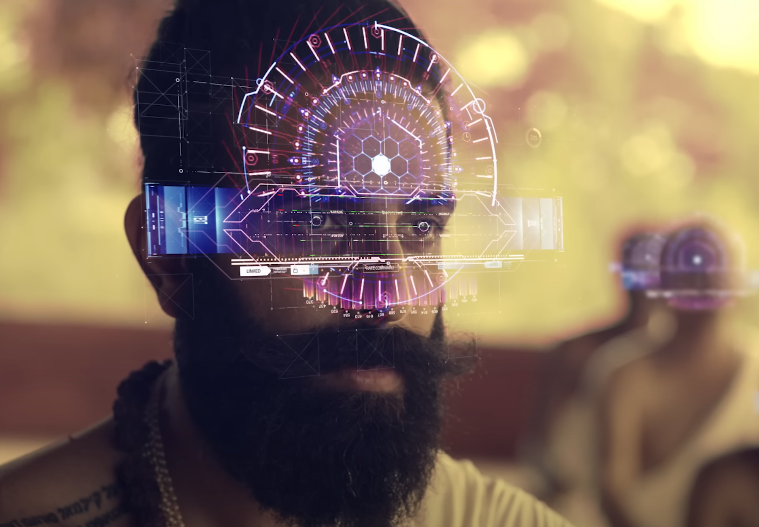
It offers a platform for envisioning new futures and alternative cultural identities, drawing on mythology, cultural elements and diasporic experiences to create alternative realities that challenge colonial and postcolonial suppression.
The artistic depictions combine technology with spirituality to reflect a worldview that connects science with religion. In many Eurocentric narratives, technology serves as a foundation to portray narratives related to domination and progress or control through human rationality. These evocations serve as a form of resistance and cultural preservation in a world where cultural homogenisation threatens the relevance of South Asian traditions. For example, Osheen Siva reimagines Tamil and Dalit identity through science fiction, mythology and futuristic imagery. Their Tamil Futures works draw on Tamil and Dalit heritage, ancestral traditions and futuristic characters (ACMI 2024; Wijekumar 2025). Raveena’s Asha’s Awakening imagines a space princess from ancient Punjab who transcends time, combining spirituality, femininity and cosmic exploration (Sachdeva 2022).
Raveena has described Desi-Futurism as a way for people in the diaspora to connect different points of heritage, influence and culture (Sachdeva 2022). Similarly, architect Adhavan Sundaramurthy describes Tamizh Futurism as an architectural vision that draws on Tamil history, philosophy, literature and language to imagine possible futures (SCI-Arc 2019).
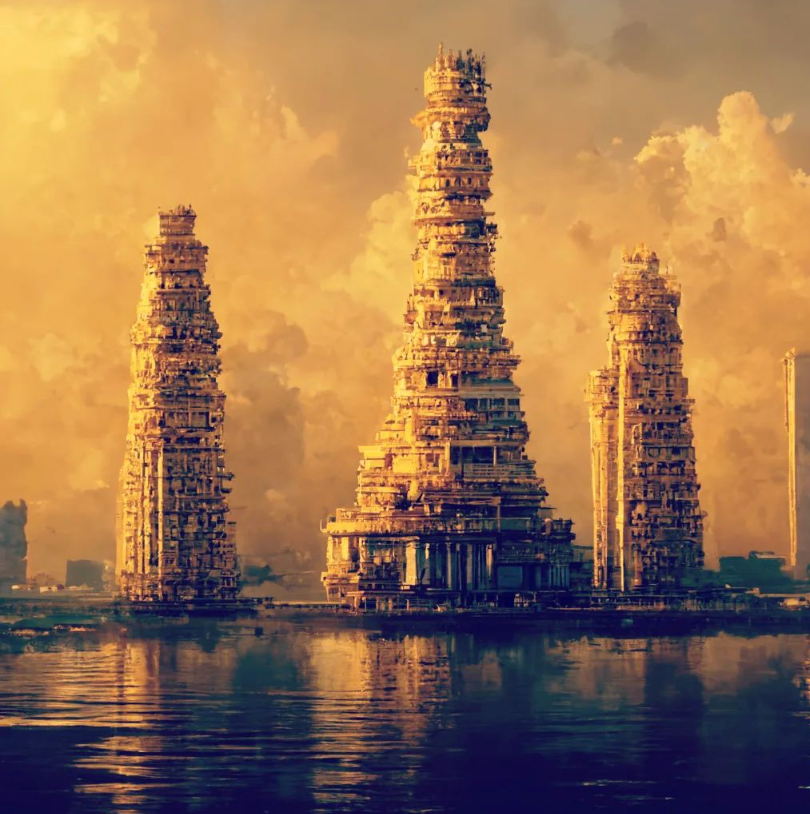
Instagram, 22 Sept. 2022
We will explore the artistic depictions of Desi-Futurism in subsequent articles, which will encompass various art forms. These articles will explore the work of Osheen Siva, Raja Kumari and Raveena’s music, and Adhavan Sundaramurthy’s spatial futures explored through architecture.
References
Bates, Crispin, and Ashutosh Kumar. 2024. “Introduction.” In Girmitiyas and the Global Indian Diaspora: Origins, Memories, and Identity. Cambridge University Press. https://doi.org/10.1017/9781009342605.001.
Chishti, Muzaffar. 2007. “The Phenomenal Rise in Remittances to India: A Closer Look.” Migration Policy Institute. https://www.migrationpolicy.org/publication/phenomenal-rise-remittances-india-closer-look.
Dery, Mark. 1994. “Black to the Future: Interviews with Samuel R. Delany, Greg Tate, and Tricia Rose.” In Flame Wars: The Discourse of Cyberculture, edited by Mark Dery, 179–222. Durham, NC: Duke University Press.
Dirks, Nicholas B. 2001. Castes of Mind: Colonialism and the Making of Modern India. Princeton, NJ: Princeton University Press.
Macaulay, Thomas Babington. 1835. “Minute on Indian Education.” 2 February 1835. British Library, India Office Records, IOR/F/4/1846/77633.
Nelson, Alondra, Thuy Linh Nguyen Tu, and Alicia Headlam Hines, eds. 2001. TechniColor: Race, Technology, and Everyday Life. New York: New York University Press.
Peach, Ceri. 2006. “South Asian Migration and Settlement in Great Britain, 1951–2001.” Contemporary South Asia 15 (2): 133–146. https://doi.org/10.1080/09584930600955234
Sachdeva, Maanya. 2022. “Raveena: ‘I Had No Idea That I Would Be This Gay, and This Loud about Who I Was.’” The Independent, 17 April 2022. https://www.independent.co.uk/arts-entertainment/music/features/raveena-interview-coachella-ashas-awakening-b2057358.html
SCI-Arc. 2019. “SCI-Arc Alum Adhavan Sundaramurthy on Thesis and Tamizh Futurism.” https://www.sciarc.edu/news/2019/alum-adhavan-sundaramurthy-tamizh-futurism
Washbrook, David. 2012. “The Indian Economy and the British Empire.” In India and the British Empire, 44–74. Oxford University Press.
Wijekumar, Vyshnavee. 2025. “Osheen Siva Draws Cosmic Creations from Ancestral Echoes.” ACMI, 20 March 2025. https://www.acmi.net.au/stories-and-ideas/osheen-siva-interview/
ACMI. 2024. “Tamil Futures.” Artwork record for Osheen Siva, 2024. https://www.acmi.net.au/works/122884--tamil-futures/