
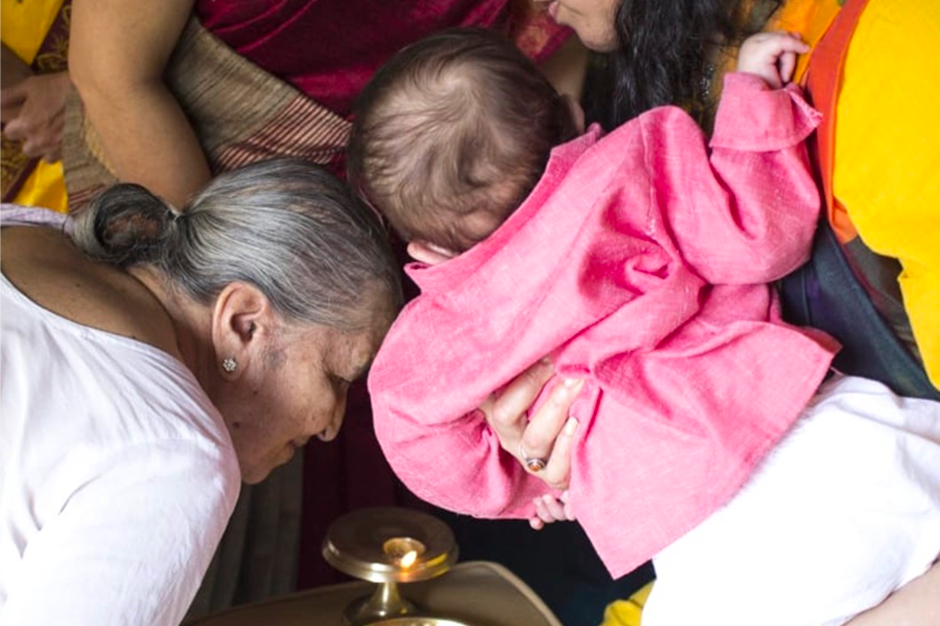
In our family, this is called Panti Vaati. It marks the first meeting between a great-grandmother and her great-grandchild. The elder sees the child first through reflection, then directly.
I had grown up around this ritual without questioning it. Later, when I tried to find it online, I found nothing—no documentation, no reference in archives or ethnographic writing. It exists, as many such practices do, within families, carried through memory rather than record. To get more details, I spoke to my mother, who is 70 years old. “I did not see the practice when I was growing up, perhaps because the great-grandchild and great-grandmother situation never arose in my immediate family. However, I remember it being spoken of with great admiration by cousins who witnessed it in their families. They would always say it was beautiful to see the four generations in the same room performing such a symbolic ritual of carrying on the lamp of the family, helping in its preservation and continuity,” she said.
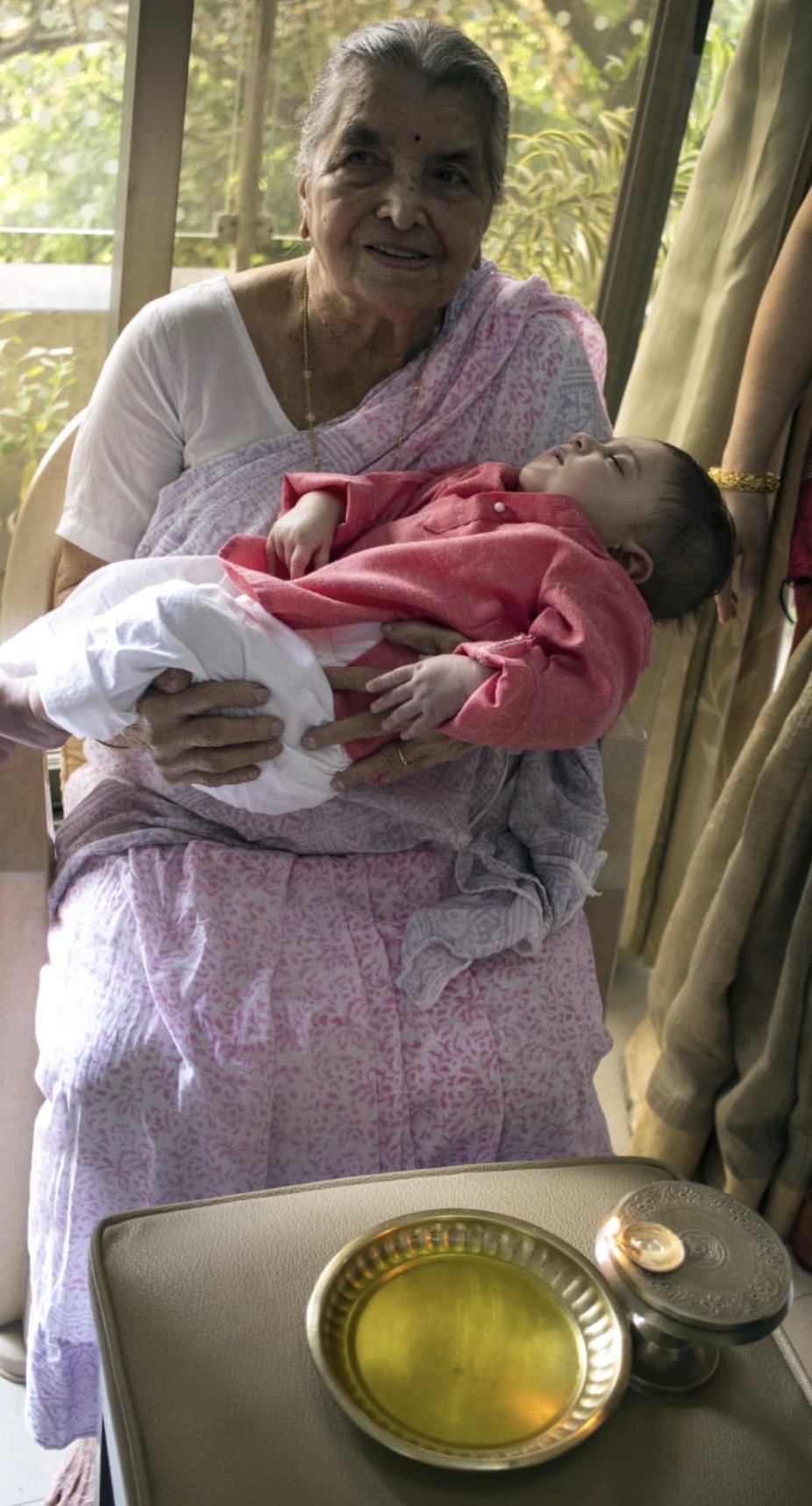
This led me to explore further, and I spoke to an elderly relative in the family, a 92-year-old, who said, “Panti Vaati was a very special ritual, especially because of the evolving bond of the first and fourth generation. Nobody had seen anything written in religious texts as far as I know, but we knew how it was done by observing our elders. The pandit ji would, of course, chant some mantras in order for the divine to bless the occasion, but I remember it was essential to use a brass plate and not a stainless steel one to mark the occasion. The reflection is clearer too in that plate. Also, we were always reminded to use good quality oil—not the one that we used daily for cooking and such.”
Repetition as cultural transmission
Practices like Panti Vaati survive not because they are written down, but because they are repeated. Cultural theorists have long argued that repetition is central to how traditions endure. Anthropologist Paul Connerton, in How Societies Remember (1989), distinguishes between “inscribed memory” (written, recorded) and “incorporated memory” (performed, embodied). Rituals like this fall into the latter category—they are remembered by doing.
This is visible across Indian domestic life. Gestures—how to light a lamp, how to welcome a guest, how to conduct a naming ceremony—are passed down in the same way. Women, in particular, have historically been central to this process, maintaining everyday cultural practices within the home (Chakrabarty, Provincializing Europe, 2000; also see Patricia Uberoi’s work on family and kinship in India).
Panti Vaati operates within this structure. No one in my family ever explained it formally. It was performed, and through repetition, it was learned. It was simply known.
A broader grammar of protection
The logic of the ritual is not unique, even if its exact form is. Across South Asia, newborns are introduced to the world gradually, often through practices designed to protect them from harm.
More uniquely, this is the idea of nazar (the evil eye) and is widespread. Infants are marked with kajal behind the ear, kept out of public view for a fixed period, or introduced to extended family through controlled rituals. Anthropologist Alan Dundes (1992) notes that belief in the evil eye is one of the most widely distributed cultural phenomena globally, often tied to moments of vulnerability—birth, marriage, or sudden success.
In this context, Panti Vaati can be read as a form of mediation, meant to protect from external forces. The reflection in the oil creates distance between the elder and the child. The flame introduces a protective element. The act delays direct sight, softening what is believed to be an intense emotional or energetic exchange.
Oral traditions and their limits
UNESCO defines intangible cultural heritage as practices, expressions, and knowledge systems that communities recognise as part of their cultural inheritance but that are not necessarily documented. These include oral traditions, rituals, and social practices. Crucially, UNESCO also identifies them as particularly vulnerable because their survival depends on continuous transmission.
This vulnerability becomes visible in everyday gaps. A ritual can be remembered in one branch of a family and forgotten in another. A practice can survive in one region but not in another. Without repetition, it disappears.
The absence of documentation is not accidental. As scholars of South Asian history have pointed out, much of what is considered “culture” in the region—especially domestic and gendered practices—has historically not been archived (Veena Das, Critical Events, 1995). What survives does so unevenly. Panti Vaati exists in this fragile space. It is neither rare nor widely recorded. It is simply unarchived.
Migration and the weakening of transmission
Migration changes how such practices are passed on. When families move across cities or countries, the conditions that allow rituals to be performed, shared space, proximity to elders, and a common language are disrupted.
Sociologist Jan Assmann’s work on cultural memory (2011) notes that memory is sustained through “communicative frameworks” shared contexts in which knowledge is exchanged informally. When those frameworks weaken, so does transmission. With my generation having migrated away from India, holding on to the exact practice of Panti Vaati in terms of timing has changed primarily because of constraints involving time, distance, inability to visit the extended family during the postpartum phase, etc. In my personal case, after the birth of my second child, the pandemic and associated lockdowns delayed my visit to India, thereby preventing us from truly observing this practice. It was unreasonable to expect my grandmother to wait for a year until she saw my son, so although we did carry out the ceremony after we visited her (1.5 years after birth), it was ceremonial only. However, it was more meaningful in reference to the birth of my older child, as although my grandmother saw him over a video call, I visited her three months postpartum.
In the diaspora, language shifts from Konkani or Marathi to English alter the meaning of specific terms. Some practices are simplified; others are abandoned because the context that made them meaningful no longer exists. For example, this is a major shift in practice that needs to be highlighted. Originally, the practice would be followed only for the male heir of the family, but with education and progressive thinking, this patriarchal norm has been abandoned, with the practice being followed for all great-grandchildren irrespective of gender. So in a way it is not loss but reformation. Diasporic communities often adapt and retain key practices. However, smaller, less formal rituals like Panti Vaati are more likely to fade because they depend heavily on embodied knowledge and timing.
Writing about a ritual like this serves a purpose. It creates a record where none exists. It allows the practice to be recognised beyond the family.
A small ritual, a larger pattern
The moment itself was brief. The oil trembled slightly as the baby moved. The flame flickered. My grandmother looked, then looked again.
Nothing about it felt like an event. There was no announcement, no formal structure. But the act carried meaning because it had been repeated before, and because it would likely be repeated.
This is how most cultural practices survive. Not through institutions or archives, but through small, repeated acts within families. They do not always have names that circulate widely. They are not always recognised as “heritage.” But they form part of how continuity is maintained.
Panti Vaati is one such practice. It exists because it has been done, and because someone remembered to do it again.
My aunt, at 67 years, summed it up well. “It is not essential these days to do these things, but if we don’t do them, the tradition will be lost. Panti Vaati, more so, is special and beautiful because it is practised only in our community, so we must carry on; otherwise, it will fade away just like our Konkani, but that’s another matter altogether.”