


At the origin of Ashes & Architecture was a simple but persistent question: what happens when music is no longer treated as a finished product, but as one component within a wider authored environment?
In contemporary culture, sound is commonly produced, released and then separated from the visual, textual and material conditions surrounding it. A recording becomes an isolated object, encountered through listening platforms and detached from the wider creative circumstances from which it emerged. This project began as an attempt to challenge that separation and to explore what becomes possible when a musical work is allowed to remain connected to its original material.
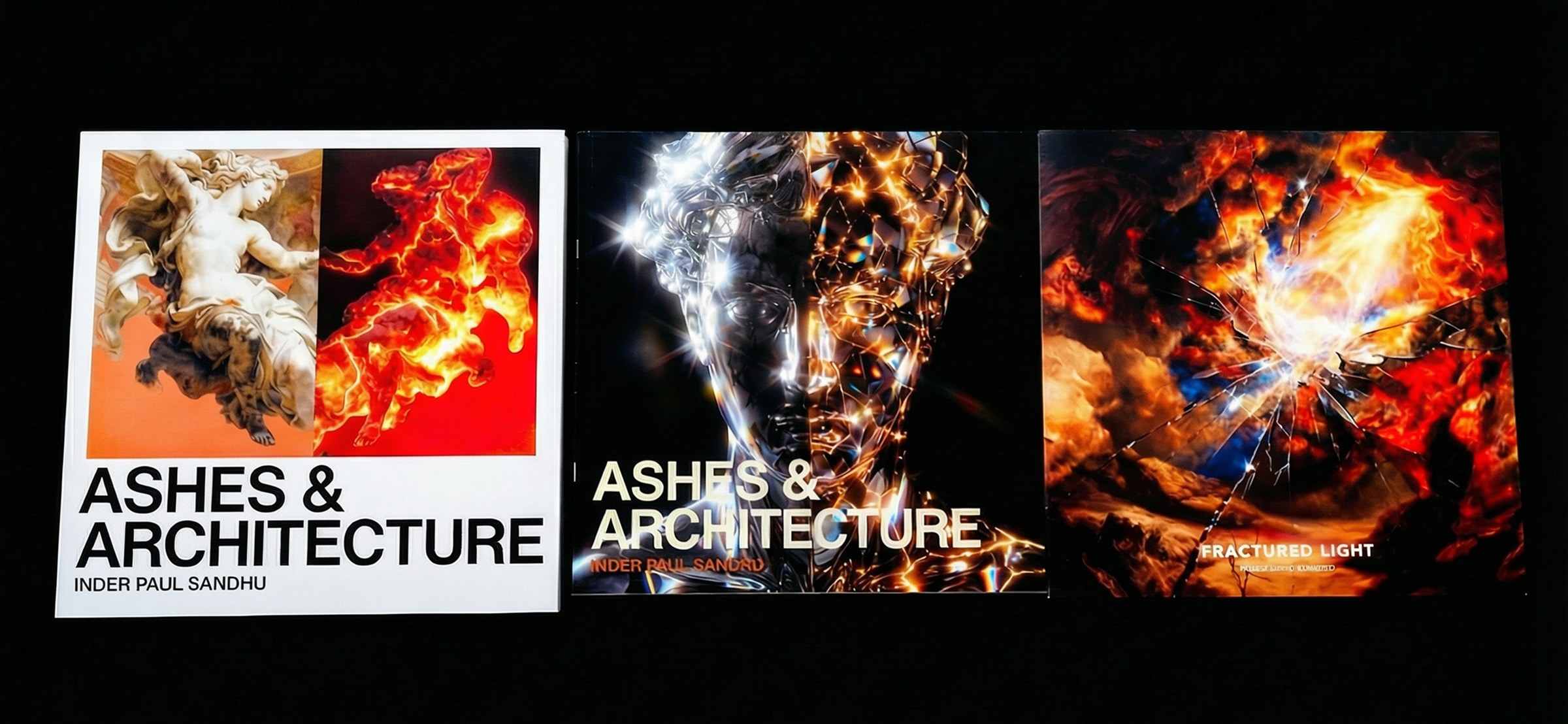
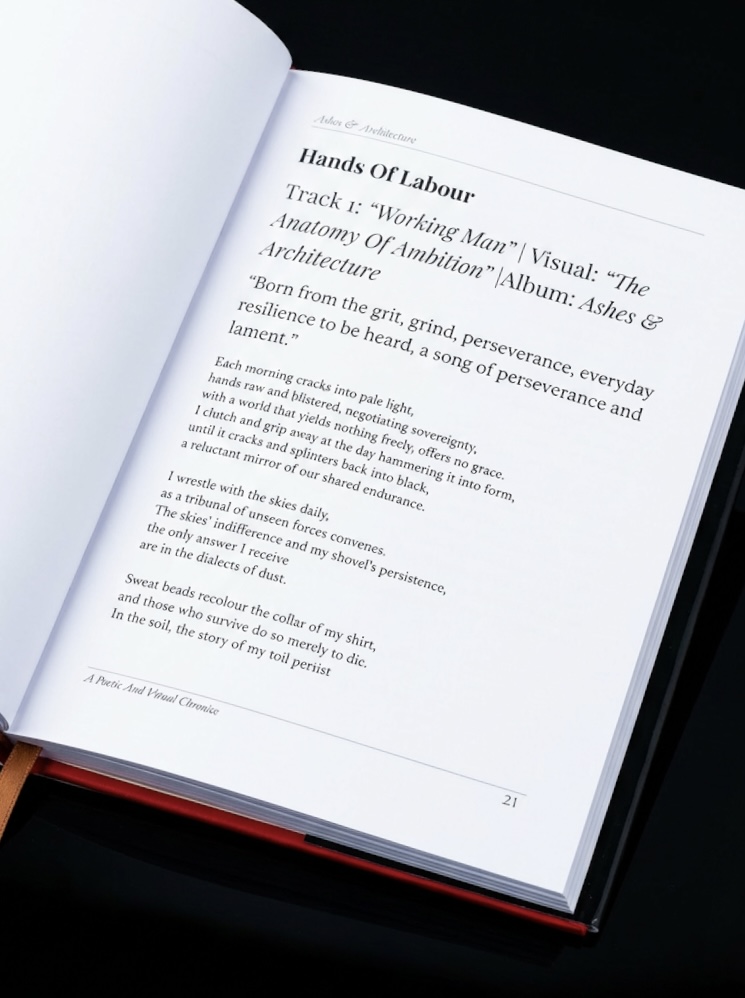
What began as a body of recorded material subsequently developed into a wider archive system. Fifteen original compositions formed the sonic foundation of a body of work that incorporated companion poetry, visual artworks, a printed monograph, physical editions, and fashion objects. The monograph, Ashes & Architecture: A Poetic and Visual Chronicle – Inspired by the album by Inder Paul Sandhu - pairs poems with images as a literary and visual counterpart to the sonic work, with each poem corresponding to a track and each artwork offering another interpretation of its emotional architecture.
The components were not created as separate outputs and assembled afterwards. Sound, writing, image and physical design developed in parallel, influencing the evolution of the others. The result is a body of work that does not behave as a single object, but as a layered structure that can be entered through multiple forms. The work therefore operates less like an album and more like a navigable environment.
A navigable environment does not reveal itself entirely at once. It changes according to how it is entered, what is encountered and how long one remains within it. Ashes & Architecture operates through this movement between forms. Sound can lead into text. Text can lead into an image. Image can lead into an object. Objects can lead into garment or spatial experience. Each component retains its own integrity while contributing to a larger authored structure.
The archive is organised around three internal states: Ashes, Transition and Triumph.
Ashes represents fragmentation: pressure, constraint, instability and the conditions from which the work begins to form.
Transition occupies the unstable middle space, where meaning is still being assembled rather than resolved and where the relationship between sound, language and image remains in motion.
Triumph is not positioned as conventional closure. It represents reconstruction: the point at which fragmented material begins to regain structure, coherence and form.
These states emerged through the process of making the work itself, through repeated cycles of writing, recording, editing, visual development and reworking. The framework is therefore descriptive rather than imposed: a language that emerged from the internal logic of the archive.
The physical dimension of the project is central to this methodology. The monograph provides a literary and visual counterpart to the sonic work. USB-cassette editions translate the archive into a tactile listening object, extending the experience through additional spoken and reflective material. Vinyl editions give the fifteen-track sonic work another physical structure through which its internal movement can be encountered. Garments extend the visual and conceptual language of the archive into the body, allowing elements of the work to exist through movement, presence and public space.
These formats do not simply reproduce the same material. Each provides a different interface through which the wider archive can be encountered.
The intention is therefore not for the work to be consumed in a single sitting or through a single platform. It is designed to be entered gradually, revisited and interpreted through different material forms. Meaning accrues rather than resolves.
This principle has increasingly moved beyond the studio and into physical cultural circulation. The gold-foiled monograph and physical editions have entered London literary and cultural spaces including Hatchards Piccadilly, Foyles Charing Cross Road, Waterstones Piccadilly and Reference Point at 180 Studios. The work has also developed a direct relationship between publishing, garment and spatial practice through EXODUS PDCM, while visual and physical installations have extended the archive beyond the conventional presentation of a book or recording.
The spatial dimension has become increasingly important. The work has been explored through immersive and multi-channel sound development, examining how vocal fragments, spoken-word elements and ambient layers can be separated and repositioned within spatial environments. This shifts the sonic material from something experienced solely as a fixed recording towards something that can operate architecturally, with sound distributed through an environment rather than confined to a conventional listening field.
Alongside this physical and spatial development, Ashes & Architecture has entered an expanding institutional and cultural dialogue.
The work has generated engagement across national collections, museums, libraries, universities, cathedrals, cultural organisations and specialist creative institutions. These include the British Library, Library of Congress, Smithsonian Institution, Yale University, University of Cambridge, Guildhall School of Music & Drama, The Vatican Museums, Westminster Abbey, Salisbury Cathedral, St Albans Cathedral, The Huntington Library, Arts Council England, Heritage Collections (UK Government) and other cultural and archival contexts.
The project's wider trajectory has subsequently extended into further international and specialist contexts, including The Louvre, The Getty, MoMA, Antony Gormley Studio, National Gallery of Victoria, BMG, ATC Management, Dubai Culture, Robert Lepage and other leading figures and organisations across contemporary art, performance, music, design and cultural practice.
These encounters are significant not simply as a list of institutions, but because the work is increasingly being approached through different professional languages. Libraries encounter questions of archive and material culture. Universities encounter relationships between theology, imagination, language and artistic research. Cultural institutions encounter questions of interdisciplinary practice and contemporary programming. Music organisations encounter the expansion of recorded work into physical and spatial forms. Designers, artists and creative practitioners encounter the question of how an authored world can move between disciplines without becoming fragmented into separate projects.
The archive has therefore begun to operate beyond the boundaries of the music industry through which it originally emerged.
Its development has also clarified the relationship between Ashes & Architecture and EXODUS PDCM. EXODUS provides a wider studio framework in which sound, fashion, image, publishing and physical design can be treated as materials within a shared creative methodology. The fashion work does not sit externally to the archive; it provides another physical language through which its visual and conceptual systems can be extended.
The same principle applies to spatial development. A composition can become an environment. A poem can become an image. An image can become a garment. A book can become an object of cultural circulation. A recording can become material for immersive presentation.
The medium changes, but the authored relationship between the parts remains.
This is ultimately what Ashes & Architecture is concerned with: not simply producing multiple objects, but examining how meaning changes when a work is distributed across multiple interdependent systems of expression.
The archive is simultaneously a body of work and a methodology.
It proposes that a creative work does not necessarily become less coherent when it moves between disciplines. Under the right conditions, it can become more coherent, because each form reveals something that another form cannot.
Sound carries one kind of memory; text carries another; image, the physical object, and space each introduce their own conditions of remembering and encountering. When brought together, these forms do not simply accumulate - they alter one another, creating a wider field of interpretation in which meaning emerges through their relationships.
Ashes & Architecture has developed from a musical project into a multidisciplinary cultural archive that moves across sound, poetry, visual art, publishing, physical editions, fashion and spatial practice. Its future remains open to further translation into other forms, but its underlying proposition remains constant: to construct an authored world in which meaning is not contained within a single medium, but emerges through the relationship between its parts.
It is therefore not a collection of separate outputs, but one body of work - encountered through multiple forms, each carrying a different fragment of its memory.