
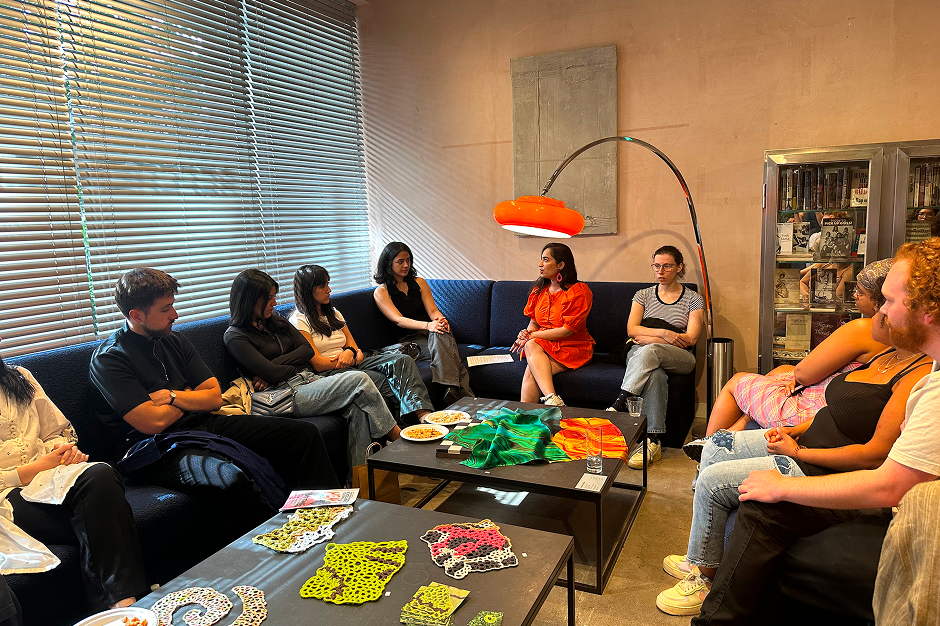
In its early form, it emerged through informal acts of connection - introducing artists across cities, hosting small gatherings, and building a network that resisted geography as its limit. Over time, it developed into an editorial and archival space, from the belief that South Asian narratives must be authored from within, rather than interpreted from outside.
To mark South Asian Heritage Month, Ravista Mehra speaks to Saachi D’Souza, Lead Editor of South Asian Salon, about the origins of the platform, the politics of naming and archive-building, and the tensions of diaspora, authorship, and belonging.
1. South Asian Salon is defined both as an archive and a community. Can you think of a moment when you realised this platform needed to exist, or did it emerge slowly over time?
The question of belonging has been with me for a long time. I grew up in India, moved to the US at 18, and then to the UK at 22. In none of these places did I feel fully at ease. I found myself on the edges of different communities rather than inside them.
By the time I moved to the UK, discussions around decolonisation were much more prominent, especially within British South Asian communities. While I could engage with and appreciate those conversations, I didn’t quite feel I fit into the spaces in which they took place.
I’m very people-oriented. I grew up in a joint family in India, which meant living with grandparents, uncles, aunts, and cousins under one roof. There were always people around, and I’m used to that. I like being in spaces with others, and I also like creating connections between people.
By training, I’m a graphic designer and visual storyteller. The archive began only as a desire to create a space where South Asian creatives could come together. I was very intentional about South Asian framing because, after living outside India, I realised how much familiarity there was across South Asian identities - something I hadn’t fully understood growing up in India itself.
My identity was also shaped by my family history. My grandparents crossed the border during the Partition in 1947 from Lahore, so ideas of nationhood and belonging were always present in the background. But my sense of being Indian, or brown, was also significantly impacted by living in the West.
The idea stayed with me for years, and eventually, around March or April 2024, the name came to me. Naming things is important to me - I’ve always loved writing and reading - and it felt like the moment when the idea became real. Once I had the name, I knew it was something I had to build, even if I didn’t yet know its full form.
I designed the logo myself and set up an Instagram page. That was enough to begin. At that point, I had already been connecting people informally for years - introducing people across cities and contexts when I saw overlaps in their work or thinking. I enjoy meeting people, but I also enjoy making people meet each other.
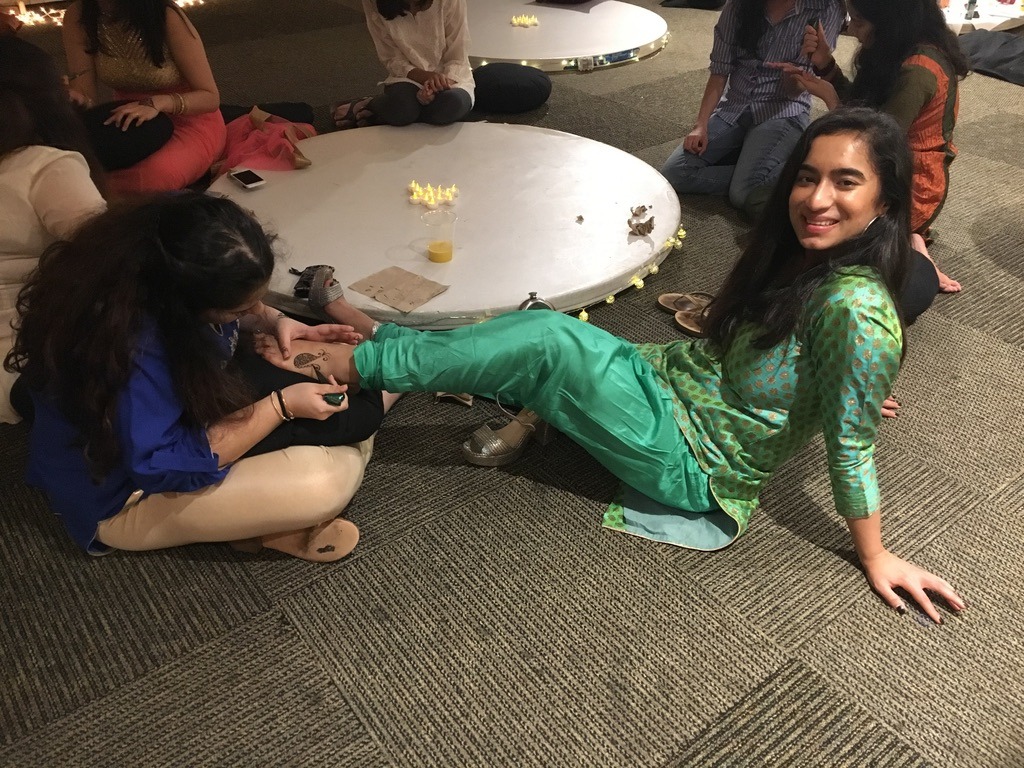
That interest in connection is also why the “salon” aspect of the name felt right. I love small gatherings and intimate conversations - spaces where something meaningful can emerge and stay with you afterwards.
When I launched it on 7 July 2024, it was at a market-place event I was already hosting for my other business at the time. We began with a film screening, and people showed up. That was the moment it became tangible, because I suddenly had to explain what it was.
I initially described it as a community for South Asian creatives globally. Global framing was important from the start. After living in different countries and going through COVID, it became clear that creative and personal connections are no longer bound by geography. People I’m close to are spread across the world, and that kind of distributed community is normal now.
I also wanted to make space for people like me - people who don’t fully fit into any single national context. Not fully “from” one place or another, but impacted by movement across them. At the same time, it also needed to hold people who have never left their region. Both experiences felt equally valid within the same space. A lot of what I built came from lived experience rather than fully mapped-out decisions. It accumulated over the years I spent living outside India.
The archive aspect developed more organically. I’ve always needed to give things structure and meaning. I studied publication design, so working with stories, systems, and documentation is central to how I think. I wanted to use those skills in a way that felt socially and culturally useful, particularly in relation to how South Asian histories and creative practices are recorded.
At first, it was just visual posts on Instagram. But people began asking to join, and I let them in even though there wasn’t a fully defined structure yet. It became a collective process very quickly.
Over time, we formalised it into editorial work - features, spotlights, and cultural writing that looks at South Asian creativity across past, present, and future. About six months in, it became clear that it needed to exist in article form as well, especially because many of the people involved are trained writers and researchers.
A core principle for me is that stories should be told by those closest to them. That commitment to authorship and ownership is central to how the platform has developed.
2. You've described your work as being concerned with decolonising narratives. I know you’re concerned with other people telling our stories, as you’ve often mentioned in our conversations. Was there a particular story, experience, or project that first made you challenge the narratives you had inherited?
It started when I moved to the US. I was no longer read as Indian but grouped with Pakistani, Bangladeshi, and Sri Lankan peers under the same label. That was the beginning of an unlearning process.
At the same time, I was coming from a post-Partition household. My grandparents had migrated from what is now Pakistan, and the dominant narrative I inherited was one in which Pakistan was framed as responsible for Partition. Proximity to whiteness was treated as proximity to value. Better English, “proper” behaviour, assimilation - these were markers of being taken seriously.
In the US, meeting South Asians from different regions shifted that for me. I had friends from South India, from Pakistan, from Bangladesh. The similarities were obvious, but so was the way we were all positioned beneath whiteness in a shared structure. W.E.B. Du Bois’s idea of the “colour line” became very legible in lived terms.
When I went back home during breaks, I started speaking differently about what I was noticing - about colourism, about the idea that lighter skin was treated as preferable. I also began recognising forms of racism and bias I had previously normalised because I didn’t yet have the vocabulary or distance to identify them.
Over time, I also became disillusioned with the idea of the American Dream. It felt like a system that demands extraction before it offers anything back, and even then, the cost was not something I was willing to accept. I am very community-oriented; I grew up surrounded by extended family, cousins, and multiple households functioning together. I am the eldest sibling as well, so individualism as a dominant mode of living never felt intuitive to me.
I appreciated what the US taught me in terms of creative possibility - the sense that you can build or imagine almost anything - but I couldn’t locate a sense of home within it. It felt too isolating.
I then moved to the UK, but by that point, I also knew I couldn’t stay within commercial design. I couldn’t see myself continuing to produce work that was primarily about servicing brands or improving their appearance. My final thesis at RISD focused instead on interviews with my didis and their lives, which made it clear where my interest lay: storytelling.
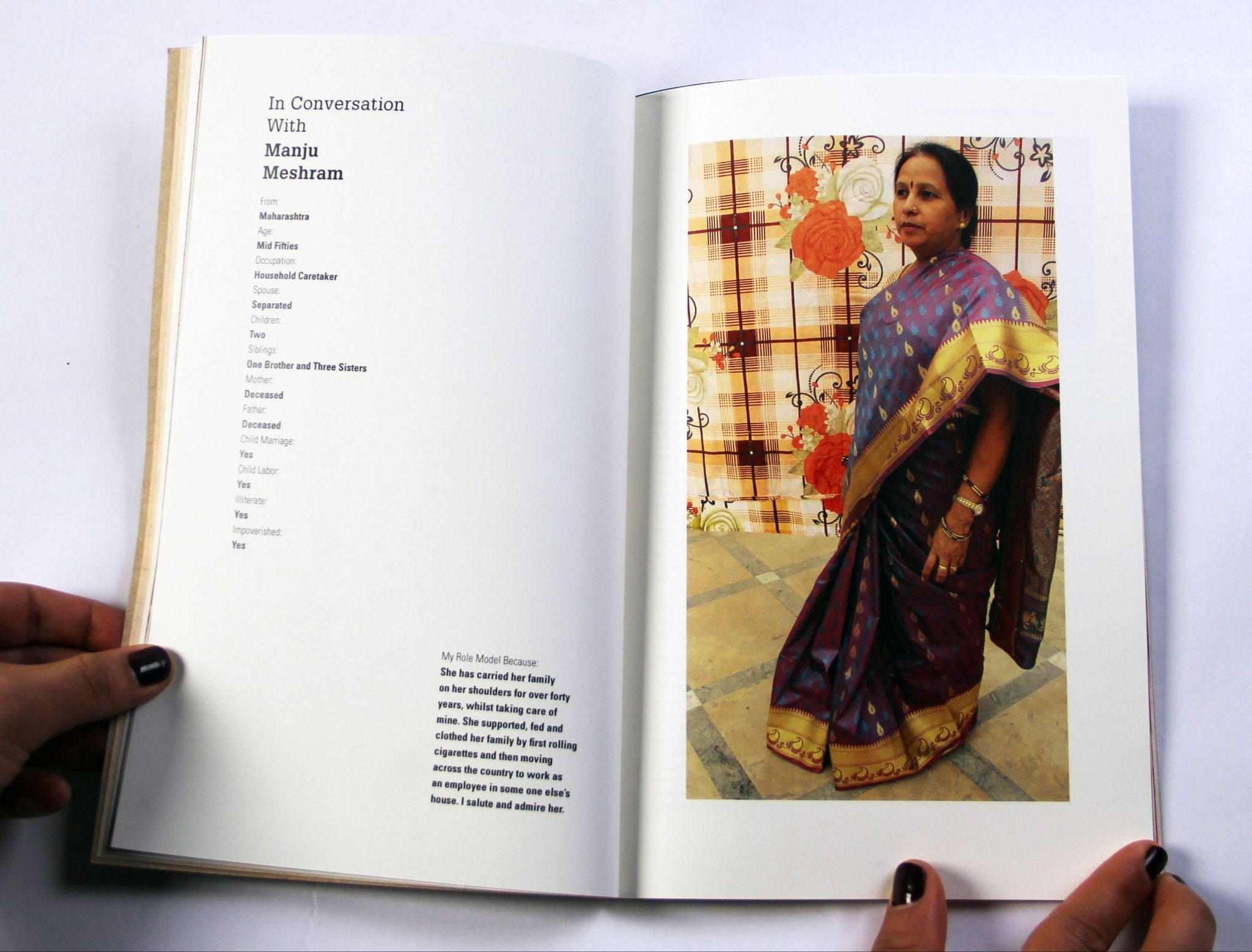
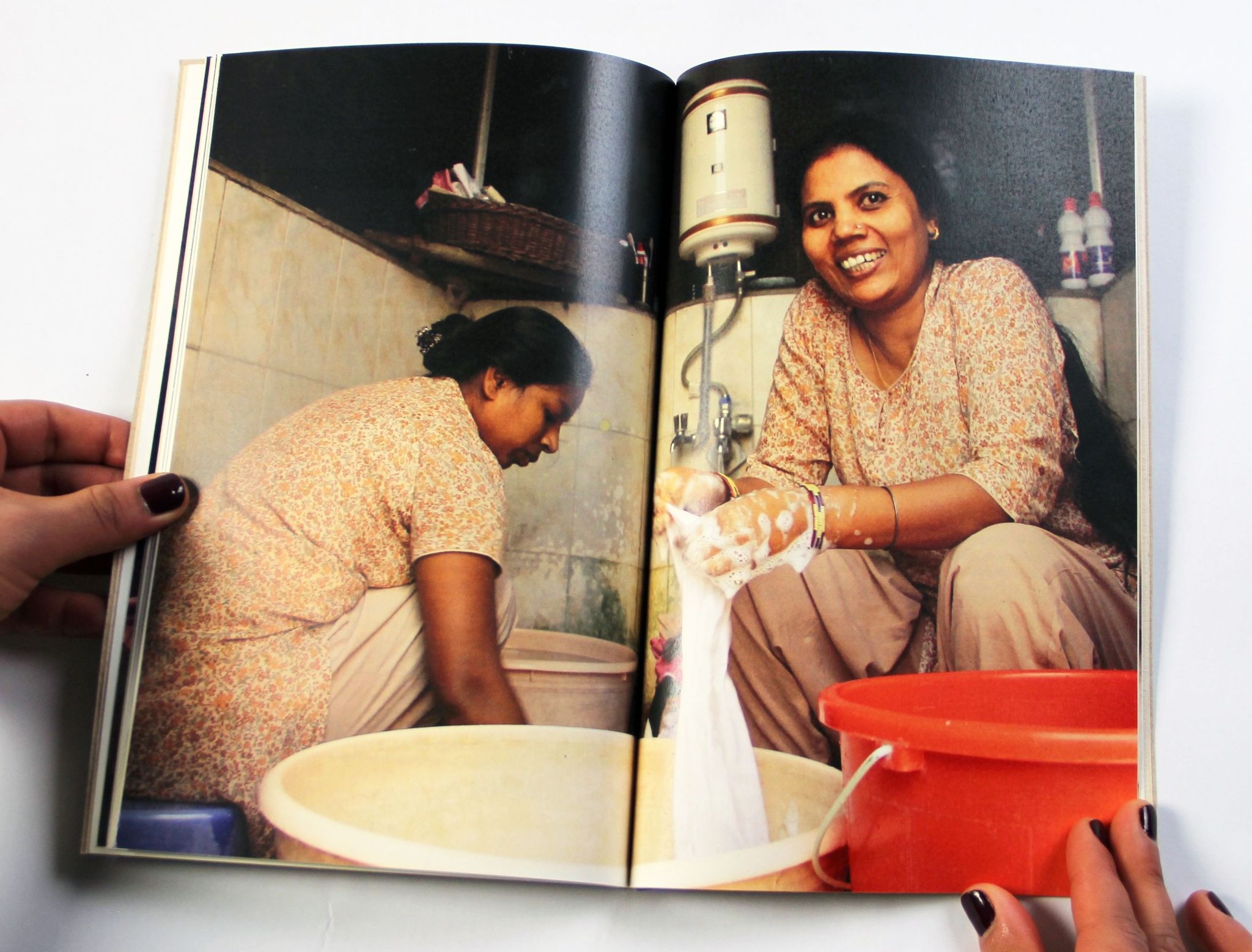
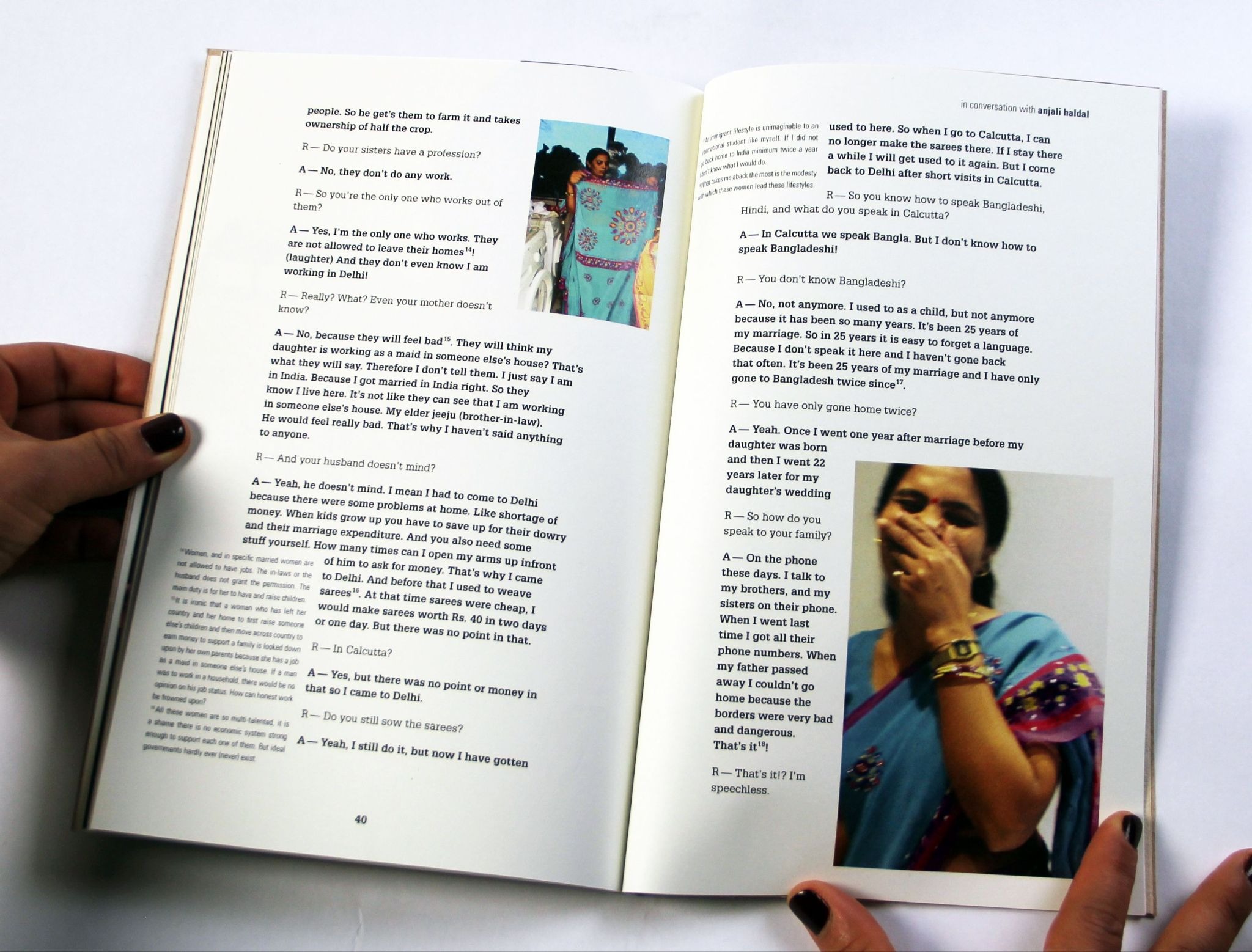
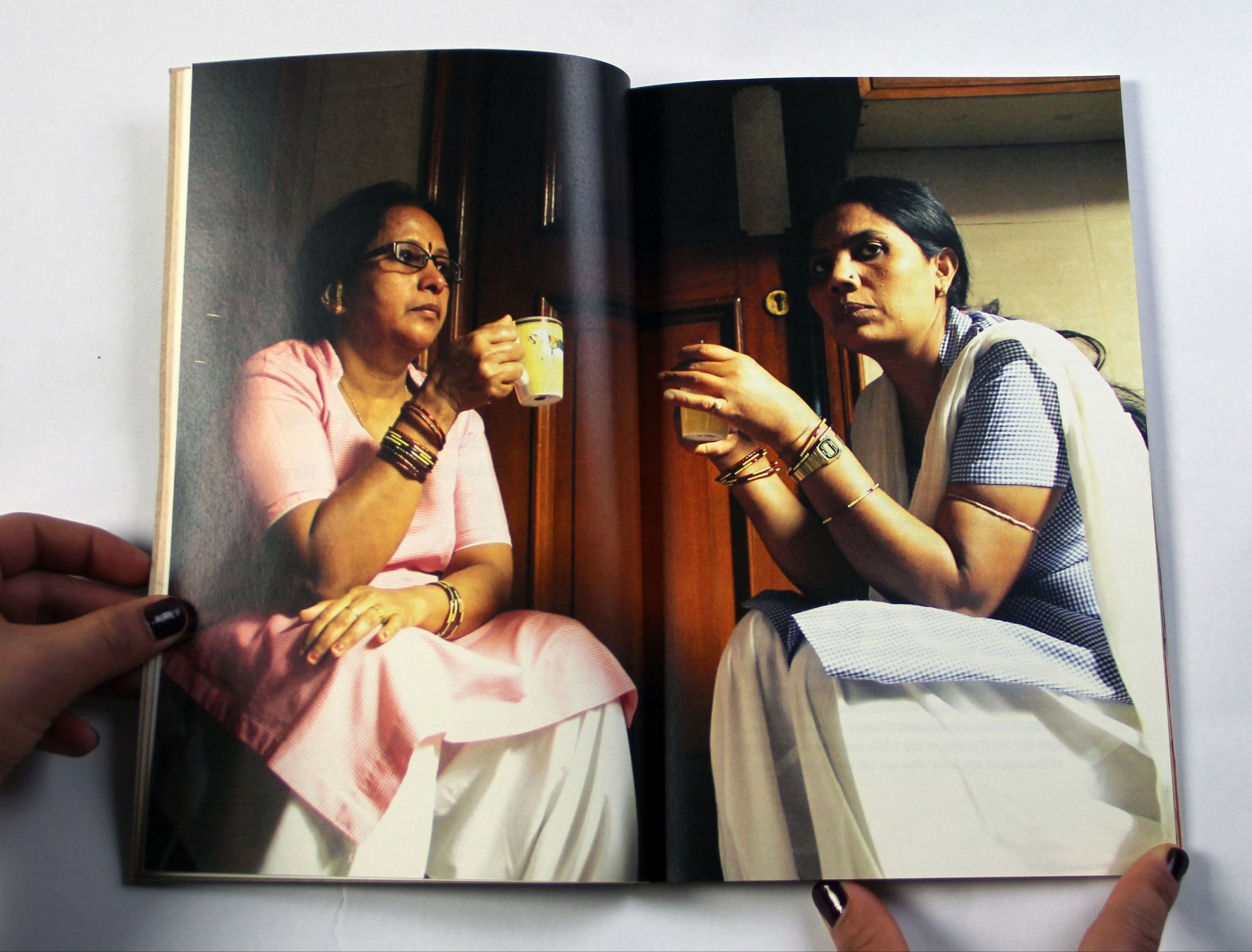
That direction became more defined through later projects, including working with transgender communities in New Delhi and Providence. I designed a bilingual publication intended for exchange, where both communities could access each other’s stories. That project clarified the importance of multilingual storytelling in my work.
By the time I left RISD, my practice had started to take shape more clearly. Even earlier, my interests had consistently returned to questions of gender, violence, and representation - starting from high school work on women’s rights and the girl child, and later shifting through design training into questions of form, hierarchy, and visual language. What I didn’t initially see was how directly those design decisions are tied to politics.
At the Royal College of Art, I encountered the term “decolonise” more formally for the first time. I looked it up and found it defined as something closer to military withdrawal. At the same time, the conversation around decolonisation was becoming more visible in academic and creative spaces. But what I saw in practice felt inconsistent - spaces where conversations were being led without structural change, and where representation felt tokenised.
That led me to rework my thesis into a set of questions rather than a single position. That’s what eventually formed Broken Englizh. It emerged from trying to understand what “decolonising” actually means in practice.
It now holds over a hundred stories in multiple languages, focused on lived cultural experience rather than trying to define a fixed framework of decolonisation.
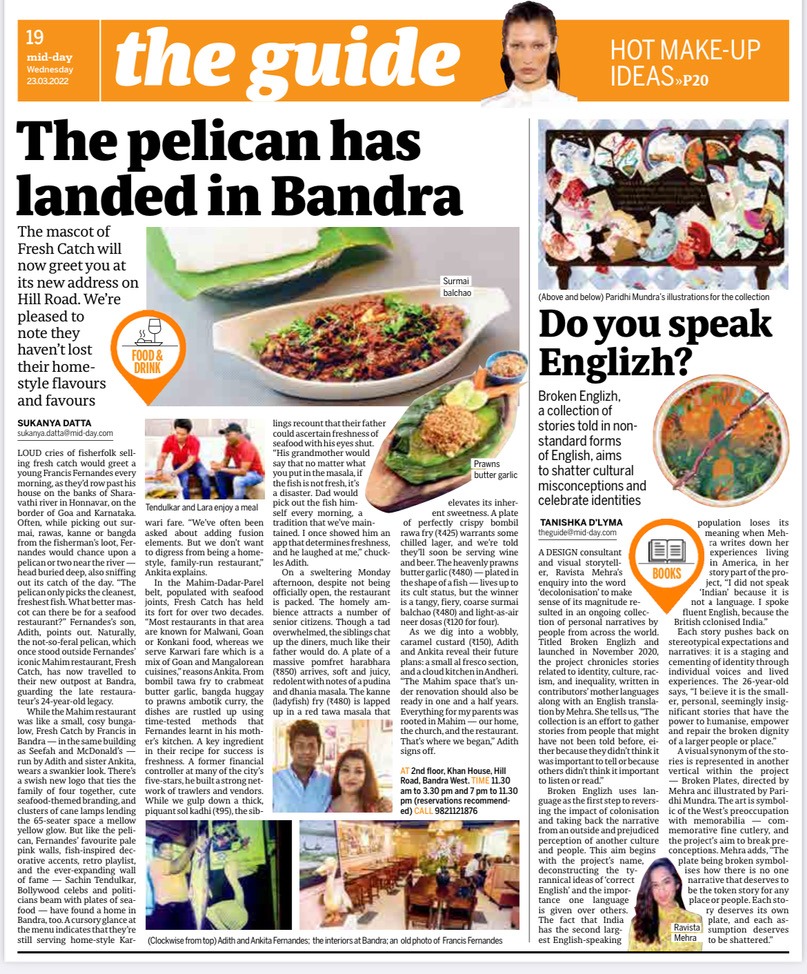
From there, I became more collaborative. Traditional graphic design often positions the designer as the primary author of meaning. I wanted to undo that, especially the assumptions embedded in language, cropping, translation, and visibility. For instance, why is English treated as the default, and other languages as secondary?
In Broken Englizh, the structure is reversed. The mother tongue comes first, followed by translation into English. I don’t correct grammar, either in others’ writing or my own. Over time, I stopped adjusting my spelling between American and British conventions. That shift became less about language preference and more about refusing to standardise identity across contexts.
At this point, my practice is focused on enabling people from South Asia to tell their own stories, while using my position to support visibility and access. The aim is not to speak for those stories, but to create conditions where they can be seen and heard directly.
That is also where SAS comes in. The intent is to support decolonial storytelling in a practical sense: shifting who gets to produce narrative, and how those narratives circulate.
SAS is also deliberately collaborative across South Asia, while remaining aware of geopolitical tensions between the countries involved. The choice has been to prioritise shared creative and cultural work over reproducing those divisions in the space itself.
3. You often reference growing up in a joint family as how you relate to others and how you approach your work. I want to connect that to what you’ve built with South Asian Salon. Many creatives aim to build individual visibility or personal brands, but you’ve put significant energy into creating infrastructure for others instead. I know you also left your job in the UK to focus fully on this, which is a substantial shift, especially given how much of it is unpaid or community-driven work. What pulled you toward building a shared platform rather than focusing primarily on your own practice or visibility?
I think it started at RISD, where I was surrounded by people who were incredibly talented. It was a humbling experience. But I also noticed many of them struggling to circulate their work beyond the studio.
I also realised I’m very comfortable behind the scenes. I don’t like being in front of the camera. Even doing this conversation now, it wasn’t something I naturally thought of doing, but I felt it was important for people to understand how this came together and what it’s trying to do.
With SAS specifically, it’s not really about building a personal brand. If anything, the aim is the opposite: to make myself replaceable at every level so that what remains is the structure, not the individual. That, to me, is what successful infrastructure looks like.
There’s also a personality aspect to it - I like systems. I like organising things and thinking about how things hold together. Individual stories are powerful, absolutely, but in this world, attention moves so quickly that they often get lost in the noise. A structure allows those stories to exist beyond.
That’s part of why I’ve always been drawn to archives, to publication, to anything that makes things last in a more durable form. I’ve also moved through different phases of activism and witnessing movements - from Black Lives Matter to broader decolonial discourse -, and I’ve heard the argument that people shouldn’t have to constantly educate others. I understand that position. But I’ve also felt a responsibility to explain, to translate, to make space for understanding, especially when I’m in a room with people who may have had no reason or opportunity to engage with these histories. For me, that becomes a form of duty. If someone is in front of me, then I feel I should be able to explain why these stories matter.
So the infrastructure is partly about scale and continuity, but also about time. It’s about the next generation having access to narratives that reflect them, not just dominant historical frameworks. There’s no requirement to only learn history through distant European events to be considered educated. People should also be able to learn through their own culture, through their own artists and practitioners.
I’ve always had this slightly exaggerated sense that I’m here to change the world, but over time, that’s become more grounded. A professor once told me you can’t change the world, but you can change the world for one person. That idea has stayed with me. It makes the scale feel more manageable and more real.
Even if it’s ten people, or twenty, or two hundred, if those people feel seen or supported or given some kind of space through the work, then that feels like enough to justify it.
I still care about design and filmmaking, and I’ll continue doing individual storytelling work. But I’m comfortable staying behind the camera, building the conditions where those stories can exist.
4. Given how much South Asian Salon has grown geographically, you’ve now connected with people across different countries, languages, and cultural histories. Earlier, you mentioned being surprised by how far these connections have travelled and the kinds of people who have found their way to the platform. What has surprised you most?
How effortless it has been. It still surprises me to think that maybe this is what connection was always supposed to look like.
And I think that, for me, it has been confirmation that this is the right path to be on. I’ve had many doors shut in my face while trying to figure out my purpose and build something meaningful over the years. But when you see something fall into place naturally - when you see people from all eight South Asian countries, people who grew up in the region, people from the diaspora, and people who have moved around the world as immigrants all resonate with something - you realise that is more than you could have hoped for.
I assumed building community, creating connections, and bringing people together would require so much more effort. But I think when something is authentic, people recognise that. They know you’re not trying to sell them something. You’re creating something because you genuinely believe in it. And I think people are craving that kind of authenticity. There’s so much that feels artificial now, and people are looking for real connection again.
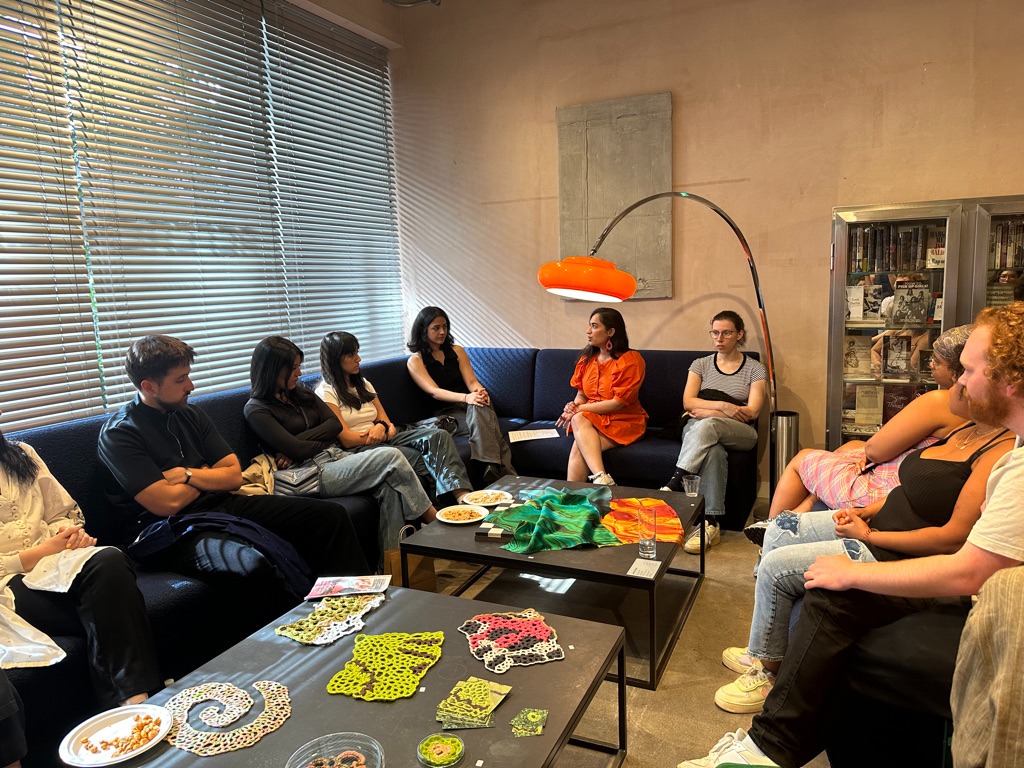
Technology is not naturally my friend. My dream is to have a Nokia phone and just meet people in person. If you catch me face-to-face, that’s where I thrive. But obviously, you can’t live without technology either. It has been essential in helping me build SAS and get it started. That’s also why the physical aspect of SAS is so important to me. The events, the gatherings that happen every few months in different cities, the ambassadors - it all matters because community cannot only exist digitally.
It’s also why empowering the people within the team is so important. They are SAS. I might be the person with the Type A personality running around asking, “Where is this? Where is that? How are we organising this?”, but at the end of the day, they are the ones who bring it to life.
5. Diaspora is a complicated space, and I wanted to ask you about that because I think it holds a lot of contradictions. There can be a tendency to flatten, romanticise, or sometimes distance ourselves from the realities of a place.
Of course, the further removed we are from a place, the more narratives can shift, get simplified, or become disconnected from what is happening on the ground. Given that South Asian Salon works across both people who live in South Asia and those in the diaspora, how do you navigate those tensions? And has your understanding of diaspora changed through building SAS and through the connections you’ve formed?
Yes, absolutely. Actually, one of the reasons I started SAS was because I felt like I didn’t fully fit into the diaspora conversation. I don’t think there was anything inherently wrong or right about it - I just didn’t feel represented within it.
My understanding of South Asia comes from growing up there and still spending part of my year in India. That lived experience is very different from someone whose understanding of the region may have been inherited through their parents or grandparents.
But through SAS - through meeting people on my team who are from the diaspora, reading their stories, and especially through verticals like Re-culturing - I’ve actually learned to appreciate different versions of what it means to be South Asian.
Because we have travelled so far from our original relationships with land and place. We share histories of colonisation, migration, conflict, and political change, but now many people are generations removed from the regions their families came from. Their understanding of being Indian, Bangladeshi, Sri Lankan, or South Asian is often shaped by what their parents experienced and preserved.
And “preserved” is actually the right word. I know this from my own experience too. When I lived in the US, I romanticised home. I even wrote about it because when you are far away from something, and the reality around you is difficult, you almost need that idealised version of home to exist within you. You can’t survive by imagining that everything you left behind was also difficult.
So I think diaspora communities have their own relationship to South Asian-ness, and they have every right to that. That’s something I’ve learned through SAS - through conversations, through the people I work with, and through listening to their stories in a way I hadn’t before.
Of course, there are tensions between people in the diaspora and in the region. But I don’t think it is our responsibility to decide how someone else is allowed to identify. I think the role of SAS is to create space for people to tell their own stories. It’s not about me having an opinion on someone else’s relationship to culture. It’s about listening. It’s like expecting someone from North India and someone from South India to have the same understanding of what it means to be Indian. That doesn’t make sense.
I think that’s the balance: loving the collective, loving the community, while also making space for people to exist as themselves. We don’t have the right to define what South Asian identity means for everyone else. That is something we have to build together.
And that is at the heart of SAS - the idea that all these different versions of South Asian identity can exist together. There isn’t a right or wrong answer. It’s about having the patience to give someone else the space to speak, and more importantly, to actually listen.
6. And returning to the archive itself, many of the stories you collect are deeply connected to memory, identity, and inheritance. What is something from your own upbringing that you find yourself returning to repeatedly, whether consciously or unconsciously, through your work with South Asian Salon, your ideas around decolonisation, and the broader work you’re doing now?
I think it’s interesting when you spend almost ten years trying to decolonise your own thinking and then look back at your upbringing through that lens.
I can’t say that everything I do comes directly from my childhood. Of course, there are certain tendencies and ways of seeing the world that come from growing up in a particular community and environment. But I think one thing I’ve developed through this process is the need to constantly question myself.
Not in the sense that I’m always trying to be politically correct, because I genuinely believe no human being is without fault. Just because I’m brown, or because I work around decolonisation, doesn’t mean I have all the answers. There are things I’ve had to unlearn, and there are still things I’m learning.
That’s something I carry into every space I enter - whether it’s storytelling, collaborating with another community, or working on an event. It’s not about coming in saying, “This is my perspective, and this is the right way.” It’s about recognising that my idea has value, but so does the other person’s perspective. I want to listen, think about it, research, and be open to changing my understanding because I don’t always have the answer.
I think sometimes the ability to second-guess yourself is actually really important.
7. What do you think - now that you’ve launched the education platform with South Asian Salon - South Asian creatives are seeking today that previous generations weren't able to access?
Access to mentors and role models they can actually speak to - not just people they read about in books or see from a distance.
They want to be able to have nuanced conversations about what it means to create work around culture and identity. I didn’t have that when I was starting. I think there’s also a need for well-researched resources and content around these subjects - not just a Wikipedia page, but something that allows people to actually engage with the complexity of a topic.
Those are the kinds of questions I’ve been asked: wanting that one-on-one space where someone can say, “It’s going to be okay.” There is something powerful about seeing that someone else has already done the work, that someone has approached these difficult or nuanced questions around culture before you.
It took me a very long time to reach the point where I felt comfortable making this kind of work. When you’re a student, you want to experiment and learn, but you don’t always want to challenge everything or “rock the boat.” It takes time to build confidence in yourself and your practice before you feel ready to do that.
So when I mentor younger students, especially those under 18, I tell them to rock the boat. I tell them to question why they think the way they do.
That “why” question is really important to me because that’s where the decolonising work begins. If you can understand why you believe what you believe, you’ve already started doing a lot of the work.
And of course, building a platform also means constantly balancing the idealism of what you want to create with the reality of sustaining it.
8. What do you think till now has been the hardest lesson while growing South Asian Salon? And where do you see the platform going from here?
You can’t do everything at once. As much as I have that tendency to run at 100 miles an hour and try to change the world in one go, I’ve learned that the idea is never the difficult part. The difficult part is maintaining it.
It’s very easy to start a new vertical. It’s much harder to sustain it - to maintain a structure, maintain people’s interest, continue giving people something to return to, and do all of that without losing your authenticity. I think one of my biggest lessons has been learning to slow down.
Because if your foundation is strong, if your structure is strong, then you can continue building. A lot of that comes from doing the work in advance and creating systems that allow something to exist beyond the immediate moment.
When I was in college, I worked at Vogue, and that was where I learned how far ahead publications operate. Everything runs four or five months in advance. Seeing that process really stayed with me. On the other hand, I also worked at an art gallery where they had a blog, and content would go up occasionally without that same kind of structure behind it. It made me realise that for something to last, it needs a framework.
So, where SAS is going now is hopefully towards becoming a sustainable community with an incredible archive. We started with in-house writing from the wonderful 28 people who were originally on the team, and now we’ve expanded to accepting submissions from across the world. The writing we receive has been incredible.
And yes, I did leave my job to focus on SAS full-time because I genuinely believe it can sustain itself. From the beginning, I’ve been very clear that SAS will not be a nonprofit, it will not be an NGO, and it will not depend on Western funding, arts council funding, or charity models.
It’s important to me to prove that an organisation that is committed to giving voice and visibility to creatives of colour can also be financially sustainable. Those creatives deserve to be paid. The people on my team deserve to be paid. Hopefully, someday, I will deserve to be paid too. But the structure needs to stand on its own - that is, when it has truly succeeded.
In my mind, I cannot build a decolonised organisation that is entirely dependent on the same systems it is questioning. So the commercial side of SAS, which we began developing in January 2026, is about creating models where industry supports creatives rather than extracts from them.
We’re also moving into education. The educators programme launched in August is something I’m incredibly excited about because I’m an educator at heart. I’m interested in exploring what mentorship looks like today - what one-on-one education can be, what structures are needed, and how we can create more meaningful access.
We’ll be working with a cohort of 20 educators from around the world across different fields, spending 6 weeks thinking through what mentorship can look like, and then connecting them with students to see how that model develops.
Alongside that, we’re building a platform where all these aspects can exist together. Instagram has been amazing, and the website has been important, but if SAS is ultimately about connecting creatives to creatives, creatives to industry, and industry to industry globally, then we need a space that allows those connections to happen more intentionally.
So that’s what we’re building right now. We’ve built the community. We’ve built the archive. We’re building the education programme. We’re developing a platform where everything can live. We have events happening around the world, and we’re also building relationships with industry organisations, studios, and institutions working in the creative sector - to create more access for South Asian creatives.
The hope is that SAS becomes a platform connecting creatives with each other and with opportunities globally.
9. And looking back at your younger self, the student, designer and storyteller who was just beginning her journey, what do you think would surprise her most about the life that you've built today with this platform?
That it actually happened - that I saw it through.
In a way, it feels like my stubbornness, which I’ve often thought of as irrational, just ended up manifesting into something I couldn’t have planned, or even fully imagined. I don’t think there’s any version of me that could have predicted this exact shape.
I’ve always had a love for stories, storytelling, publications, gatherings, observing people, and travelling. And somehow all of those interests have ended up converging into one space. I couldn’t have guessed that at the time.
So yes, it feels incredible. And I would genuinely tell people to hold on to whatever that stubborn thread is in them. You don’t really know where it will lead, but it does lead somewhere.
10. And finally, of course, you know what's coming for the last question: What's your favourite South Asian sweet, and is there a story attached to it?
Mine has to be besan ki barfi.
There was this orange box that used to arrive at home every winter, around Diwali. It was made by a woman called Mrs Modi, back then she was just someone making a few boxes at home, and now she’s become a brand.
That besan ki barfi was something else. It genuinely tasted like happiness. It still does, in a way.
For me, it’s tied to celebration - Diwali, new clothes, visiting family, all of that seasonal joy.



.jpg)