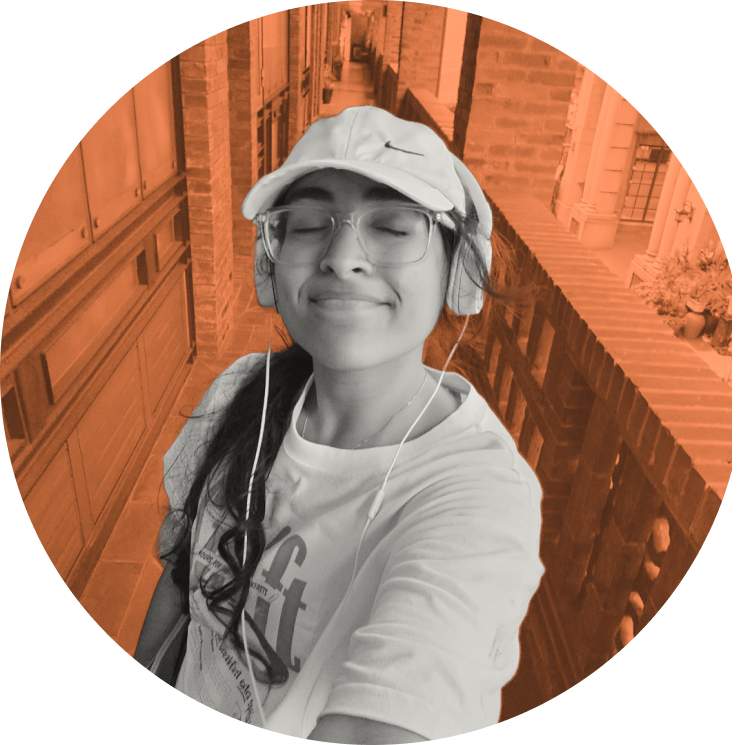
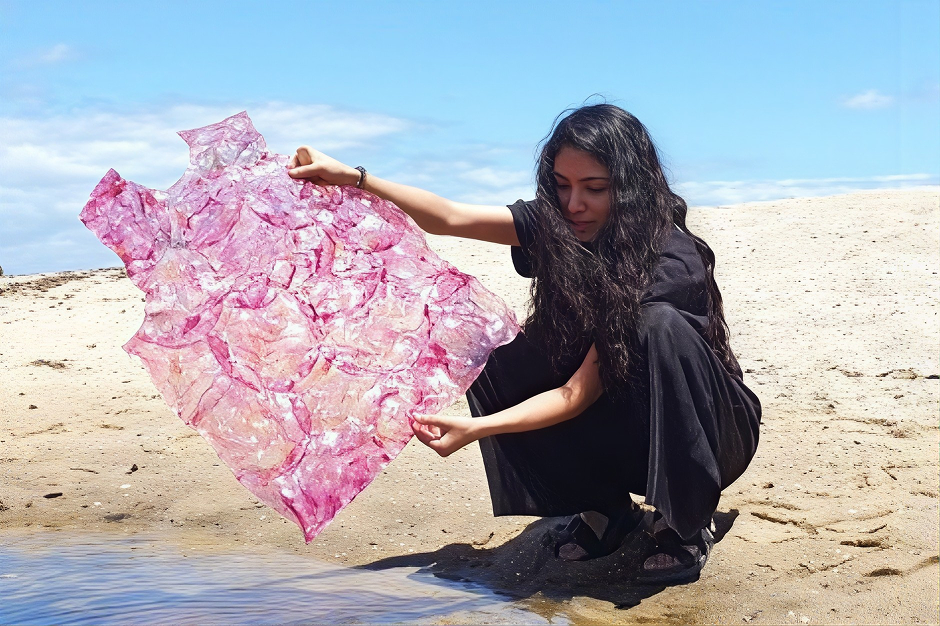
During her childhood in Maldives, topics regarding the climate and overpopulation were discussed and this continued on whilst she did her BA in Industrial Design at RMIT, where she was introduced to further topics such as sustainability, product lifecycle, waste, materiality, inclusivity and community. These themes are heavily integrated into everything she designs, whether it be artefacts or systems. The idea of using existing waste materials and the concept of makeshift are ever present in her work.
Would you like to talk about your work in the sense of if you were to describe your own artistic practice? So how would you describe that?
I would say it's like intuitive makeshift sculptures. I do a lot of research by talking, going out to islands and talking to craftspeople. My work is predominantly building an archive of Maldives in case we lose our land in future from my point of view, so we have a record of it. But not only that, I realized that a lot of craft, it's dying within their generation, because it's always been based within certain islands, and it will be passed down within families. So most people my age or younger, they don't want to continue that, which is in their own right, they don't have to do that.
But I want to record these stories and their practice because I think a lot of the times in Maldives, our history wasn't very well documented. That's also why I decided to go out and research and talk to people myself. And that's what I want to continue more of. A lot of my work is always focused on repurposing and reusing waste material.
You’ve done sculptures, product design and fashion design too. How has your journey been with your craft?
I did industrial design when I was 18 to 22, and I learned a lot about materials. And I've always found that in product design the issue has always been how do you prolong the life cycle? Because we're too deep into this throwaway culture and never recovered from it.
In Maldives, one object is used for five different activities. So I try to incorporate the same approach in the sculptures I make. It can be a freestanding sculpture, but then it can also be an object used for another activity, or it could be part of the body, like a fashion piece. So I don't want it to be one kind of idea.
It can be fluid, just like how historically in the Maldives the motto is "make do with what you have," because on the islands there's hardly any resources unless it's imported. But they really found ways to create things out of everyday objects, which I found fascinating. And I think we can do more of that.
That’s how I got into product design after that. I was in Australia and we did a student exchange in India for six months, so I went to the National Institute of Design. I hung out with a lot of fashion students, and traveled a lot — went to Rajasthan, went to these printing, hand-block places. And I think that's maybe when I started having an interest in fashion. But I've always wanted to be an artist since I was really little.
I think I wanted to do fine art when I had just graduated from high school, but my parents were like, "you have to do a well-paid job." And here I am now, trying to be an artist — so it didn't really matter. I don't regret doing product design though, because I think it taught me a lot about materials and life cycle, and even service design — like the well-being of people.
How does your process look — how does it get into the flow phase of fusing different materials together?
I think it's because of my product design degree. For my final year project I explored bioplastics. In 2012 there wasn't much shared knowledge about it like there is today. So I took a risk trying to create something, and it ended up working out. Ever since then I've had an interest — I'm always drawn to found objects.
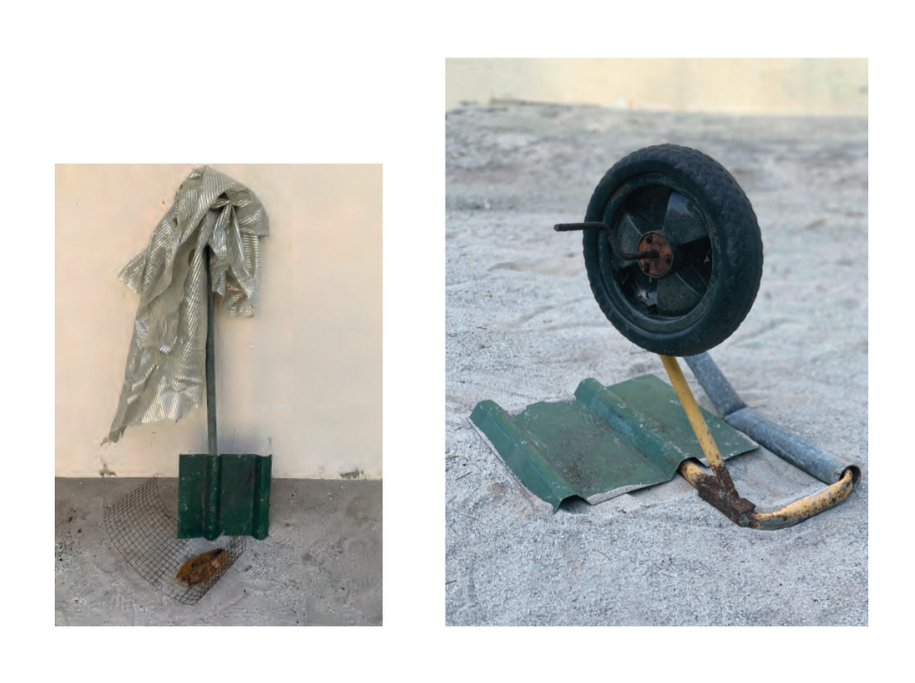
In Maldives, whenever I go home, we always do a beach cleanup on the island, because every morning since I was a teenager there'd be lots of rubbish that comes onto the shore. And I'm always like, "oh, I can use this — how can I use this?" And then I'll think of different ways.
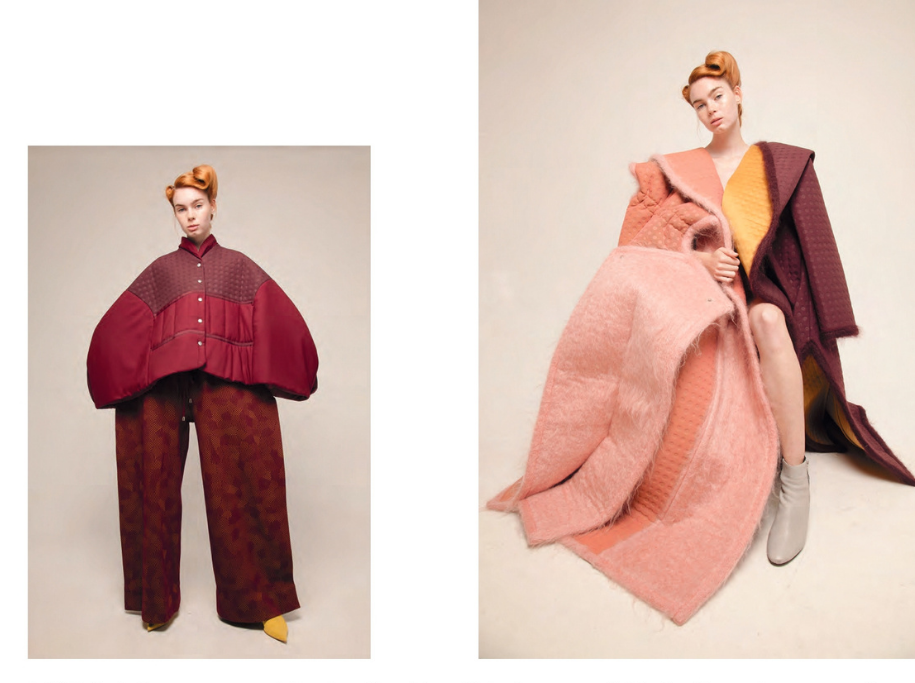
I did fashion design too, so maybe that's why I was making apparel and garments. But even when I did fashion, what I made turned out to be sculptural, because I used furniture fabric — I didn't want it to be actually wearable, it was more of a sculptural piece. I don't think I knew it at the time, because sculpture was probably something that existed always but I just didn't know what it was until I did my master's in fashion design, about four years ago, where I realized all these things, even if it's a different material, they always seem to be very sculptural.
You've also traveled quite a bit — Maldives, Australia, India, and you've been working in London for about 12 years. How do you feel connected to Maldives?
I moved to Melbourne from Maldives when I was eight, in the 90s. I stepped away from my culture until I was 30, and I only realized that when I was doing my master's at RCA. Even though my parents always spoke to us in our language, my sister and I always spoke back in English.
Basically, in the 90s there was still a lot of migration happening and a lot of racism — the White Australia policy had only ended at the end of the 1970s, so people of colour only started coming in after that. I think I was dealing with a lot of racism as a kid, from friends' parents, neighbours, everywhere. It was a culture shock moving from Maldives to Australia, and as a form of survival I just withdrew completely. That's why my final master's project is called How to Be a Wallflower — that's just how I got by.
When I was 30 I was like, "oh wait, why did I do this?" One of my friends still works with asylum seekers, refugees, immigrant children, and she said it's the same thing — a form of survival, of trying to get through. It took me a bit to accept why I did that, because I felt kind of ashamed when I realized it.
Ever since then, from when I was 30, I started researching — first having conversations with my parents, my relatives. I don't know if it's a cultural thing in the Maldives, but you respect your elders, you never really ask, and they never really share stories from their past. I remember asking my dad and my mom so many questions — "what was your childhood like?" — and they'd say "I don't remember." I think my dad had a harder time — he kind of lost his childhood, and doesn't want to talk about the past, because maybe it was really hard and not something he wants to relive.
I realized when I talked to a lot of my aunts and uncles, they didn't really like to talk about the past either. But one of my aunts shared a lot about my great-grandma, who I didn't know much about, and it explained why my mom's side is the way they are, because of how my great-grandma used to treat them. It's very interesting — I think it's good to ask questions and find answers in any way you can. It doesn't have to be through conversations, it can be through talking to other people and building research that way.
Do you feel more connected to your roots now?
Yeah, I do. I go back twice a year now if I can. Whenever anyone asks me where I'm from I always say I'm from the Maldives, and I always say I'm a "fake Australian." I feel like Maldives is my home. I can speak the language, but at a grade-three level. Every week I make one Maldivian dish to eat, so I kind of miss the home food. I feel more in touch through all my research and the project — the last six years or so. But I think it'll be continuously learning, finding more information and building on the archive I'm trying to make.
I'm very curious about the kind of conversations you've had with your grandmother, and I want to understand the dynamics you shared with your mother and father — since you were an immigrant, and they were also adjusting to a new country. How was that dynamic between you and your parents?
I think both of my parents faced a lot of racism, but they still held on fully to their culture and roots. When you move, it's called integration — trying to keep your own identity but also let in and accept parts of the new culture. It's a hard thing to do. I think my dad would get annoyed and upset by the racism he had to deal with, but my mom handled it differently, she kind of ignored it and forgets things easily — she'd be like "oh yeah, I think that happened," whereas my dad would say "I really didn't like that, that was not okay." Very different views. I relate more to my dad's views — we're more similar that way. I also think your emotions drive your artwork — for me, they do. I'm driven by a lot of different feelings that certain subjects bring up.
Would you like to talk about any special project that was really close to you — one that really stirred a lot of feelings?
I think it's the Wallflower one, because it was about addressing my own identity and questioning it, questioning my shame. It was kind of hard to start, and kind of scary and nerve-wracking, because they're big topics. But once I dealt with it and accepted it, it was fine. It came 360 to me wanting to be an artist since I was a teenager — it took me such a long time to get there, but I wouldn't change that journey, because I've learned so much from all the aspects I was able to take from. I don't know if my work would have been different had I not had these experiences, this education, or even exposure to other people — because it's the people you meet throughout your life, in certain countries, or even university.
Do you have any funny or interesting childhood memories where looking back you think "how could I have done this?"
I was actually a very extroverted kid when I was in Maldives. I was way too extra, way too extroverted. I was on TV, I hosted different TV programs. My cousins used to do that, so that's how I got into it. I wasn't very good, but I had so much confidence and I didn't care. There was a dance I did on live national TV. It exists in an archive, but I'm glad I don't ever have to see it.
It was the most embarrassing dance. I saw it as a teenager and thought "I can't believe I did it." I would say I'm kind of introverted now — I think if I hadn't moved from the Maldives, I wouldn't have had to face or deal with things that made me more anxious and cautious. I overthought a lot of things since moving to Melbourne. One of my fashion design projects was actually about dealing with anxiety and the masks we wear — that was the start of looking into my identity, and then the next thing was Wallflower.
How do you zero in on materials — do you keep gravitating toward certain ones?
Honestly, intuitively. One of my mentors pointed out that there's a similarity to what I do, in a different way — I need to look into that a bit more. But the way I present things isn't random — I'll spend hours figuring out which way, following my intuition until it becomes conscious. It sounds silly, but that's how I do it. Maybe other people have a methodical approach, but mine is intuitive.
In my Wallflower project it was about fitting objects together — it meant where I fit in life, or within relationships, where's the link, where's the meeting point. That's how I've always done it — this hat can also be this chair, it doesn't have to be one fixed thing.
The shapes and forms I use are extremely organic — that chair design can change, it doesn't have to stay the same. There's also a similarity between this and my bioplastics project from the year before — I'm just drawn to how objects interact with one another. It doesn't have to be a sculpture, it can be an extension of the body, a bag, a garment. I also like to write poems as a way to present my work — I wouldn't say I'm the best at it, but it's a way to process what I do, and it all relates.
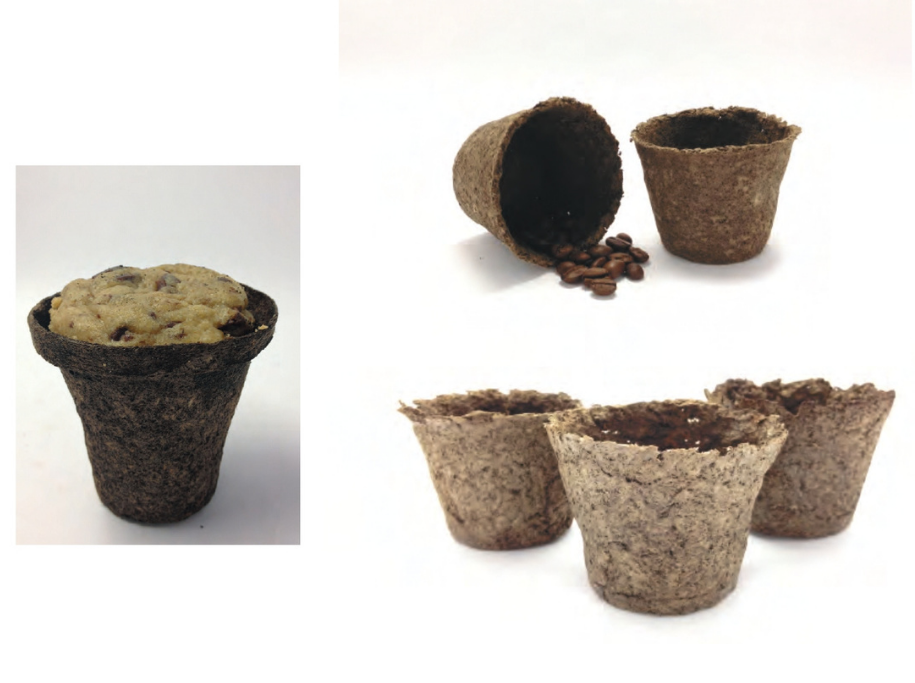
The rice paper project was all an experiment — it was called Mold-a-top, Dissolve-a-top — it doesn't last. Then there's my fashion design work, and the coffee cup project from 2012, where I went to Melbourne cafés, collected used coffee grounds, and came up with a prototype for a coffee cup that now exists, which is good.
There's an underlying conversation in your work about sustainability and climate, because of the organic materials — is that intentional?
It is intentional. The coffee cup one was about sustainability, focusing on the product and its end-of-life cycle and how to prolong it. All my bioplastics projects are about impermanence too — you can't control bioplastic, depending on temperature it'll warp, there's no controlled outcome. With my clothing, those are more permanent pieces I can't change, but I use furnishing fabrics, so they're heavier and not usable as everyday garments.
How much time does it take from conception to delivery?
Sometimes I do quick exercises — when I go home I stay on a farm island where there's a workshop, and every day there's new waste that comes onto the shore, plus the island's own waste. I'll walk around the whole island, even if I've been there many times, start picking things up, end up with a whole pile, then separate it into metals, plastics, and start doing quick exercises just to see what the outcome is. Sometimes I overthink and feel too much pressure, so this is a way to counteract that. Actually, these speedy sculptures end up being really good — some chairs I made, I made in an hour. It was meant to be a quick exercise, but I ended up wanting to explore the idea further, and that's where I'm at now.
You mostly create statement or sculptural pieces — do you see yourself going mainstream, in terms of making things for selling purposes rather than installations?
Last year I wanted to make a small product to try to sell — to be financially independent rather than relying on working for someone else. I've noticed that a lot of the hotels in the Maldives have very Western interiors — paintings or sculptures, maybe sponsoring one artist here and there, but most of what I've seen isn't very Maldivian. I wanted to refine an interior design piece and approach them to sell or buy it, but also presented in a way that calls out how they promote the Maldives without really representing it.
There's a lot of Maldivian artists' work that could be exposed and taken on by hotels instead. I know a lot of people who visit the Maldives complain they're stuck on the resort and want more of a local island experience. So it's about how to tap into that market — I've been thinking about it, I need to refine the idea before I pursue it.
Being from South Asia — do you think there's a strong Western influence on design and design sensibilities in Maldives?
I don't think so, actually. I think Maldivians take pride in their culture and craft. A lot of the artists and filmmakers I follow very much don't follow Western teachings of design, which is good — because especially now every single place looks the same all over the world, a cafe looks the same everywhere. But the artists and designers in the Maldives maintain something distinct — maybe someone won't understand it because it isn't presented in the way they expect, but who cares, that's their work, and it's a different way of seeing and understanding something.
I see a lot of Maldivian creatives express themselves really well — even in music, which is still very much Westernised in the Maldives, most growing up would copy Bollywood songs or rock music rather than writing their own.
Did you have any influences or role models growing up?
I never really had celebrities as role models, but I had artists whose work I loved. Two I really like are Ai Weiwei — my favourite artist ever, exiled from China, his work is very political — and Theaster Gates, an African-American artist who does a lot of sculpture across different mediums. But I think my actual role model would be my dad. I don't know that I'd call other people role models exactly, but they're people I get inspiration from — different pieces of them I'm inspired by and try to bring out in myself. I have mentors from RCA — one I meet every year, and I really value her feedback and perspective, since she's understood my work from the start through to who I am now. I also look at my peers and my community as inspiration, most of the time.
How do you deal with negative feedback?
You always get negative feedback. At RCA we had to swap teachers once, and the new one had no context on me or my work. I showed my work and he didn't understand it, and because I do listen to other perspectives, it made me question myself as an artist — "maybe this isn't good, maybe this is stupid." I talked to my friends and mentors, and they told me not to listen to every single thing everyone tells you — you need to remain strong in who you are and your work, and not get swayed. There will always be people who don't understand it, but that's okay — you're not producing work for them, you're producing it for yourself.
How do you find a balance between the financial and creative sides of your work?
It's been hard here — that's part of why I'm moving back, to save money and focus on producing a strong body of work to take forward into future exhibitions. I've talked to a lot of creatives here who are part-time in another job alongside their art, and they find it very hard to find the balance — the day job can be soul-sucking depending on what it is. Most of my earnings go toward rent and bills. I have a studio I share with three other people, which is affordable, but I'm not really using it — it's mostly just storing materials at the moment. There is some subsidised funding in places, but there's less of it here in London compared to other countries — art funding here is very much barely there. It's hard to be a full-time artist until you've got exhibitions and momentum going, and reaching that takes a lot of discipline, hard work, and a lot of after-hours effort — and even then it's still really hard.
It's a difficult space to navigate, and I don't think it's just on the individual — it has a lot to do with the system, not just the person. I don't think the system supports creatives, especially here in London — you almost have to come from a wealthy background to fully be an artist, unless you're lucky enough to have funding.
Last, but not the least. What’s your favourite south asian dessert?
Wattalappam and jalebis!