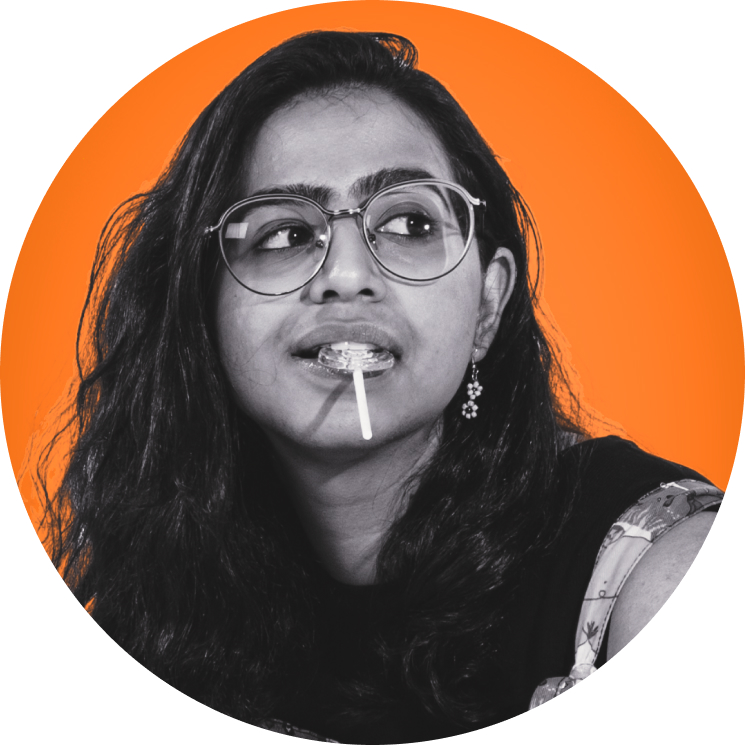
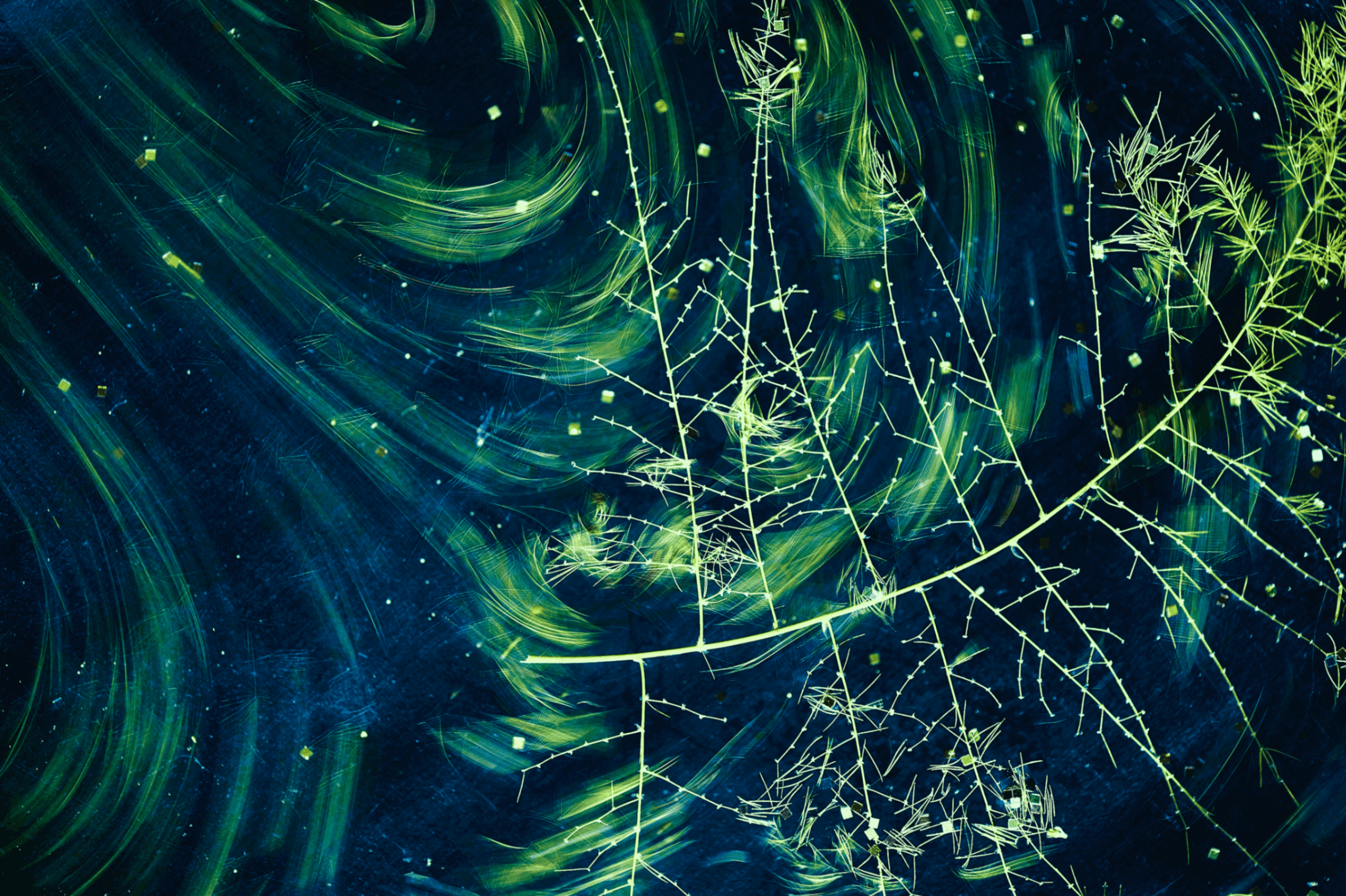
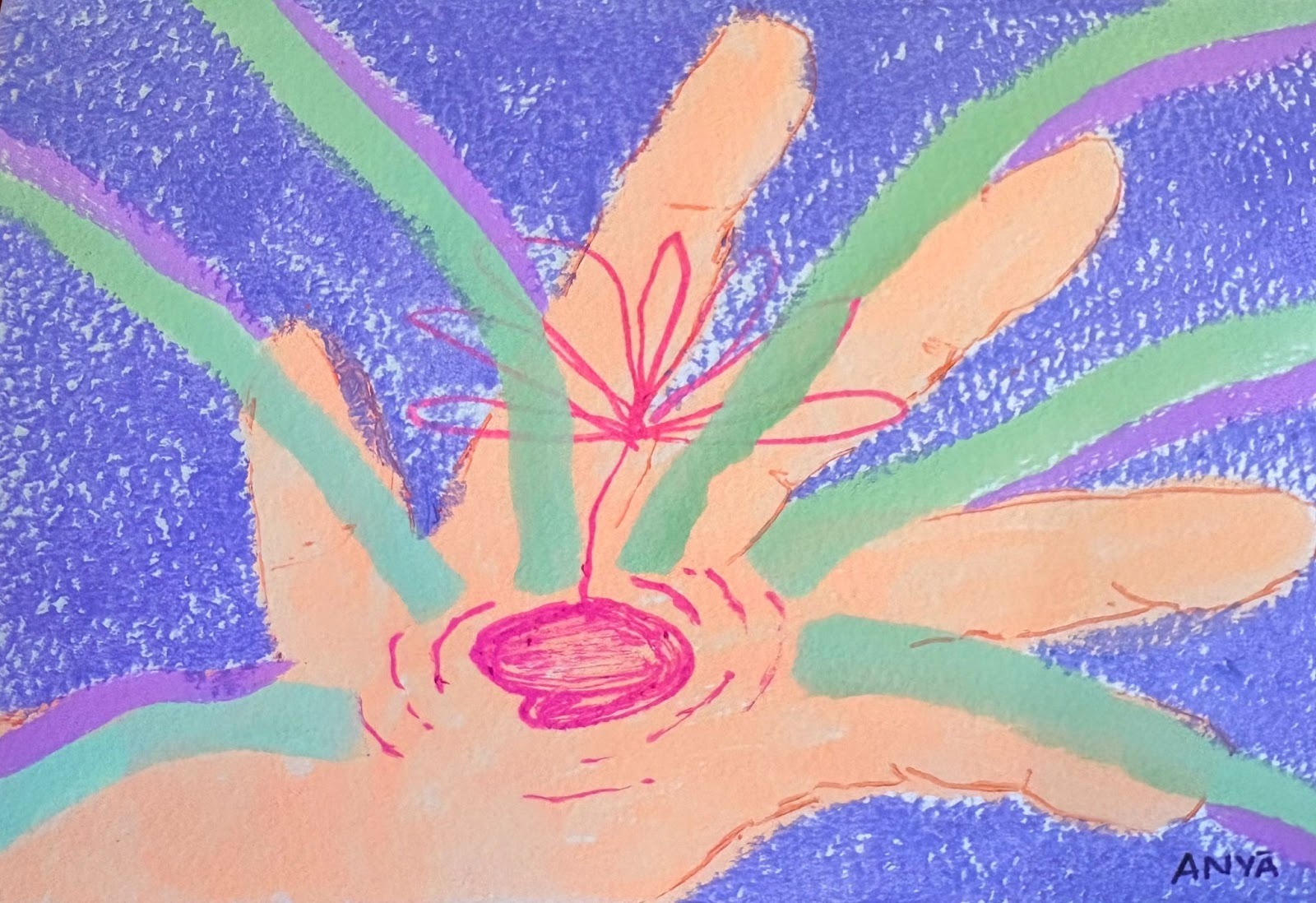
Through The Bloomhouse, Anya Studios explores business as a vessel for care and meaning-making—especially for bodies and minds that move differently. Across mediums, Anyā works as an experience artist and soft systems alchemist, creating both objects and ways of moving through the world. Their work holds a steady belief that wonder and imagination can carry us through collapse and into new forms of becoming.
1. Tell us about your background; what inspired you to start your creative journey?
I’ve always struggled to describe myself as just one thing, and I expect this is a universal experience amongst creatives who dabble in many things and refuse to be flattened into a monotonous state of being. I like to think of myself as more textural. Even when I was younger, I was constantly dabbling in several crafts, but the one that kept returning to me was abstract painting. I never quite understood why realism didn’t feel intuitive, but abstraction came like second nature, almost like I was channelling something. It was only later that I learned I have synesthesia, which suddenly made sense of why the world has always appeared to me texturally and energetically rather than literally.
My creative life then expanded into photography, but even those images were still, quiet, abstracted, and rooted in witnessing. Now my practice has evolved into something much more multidisciplinary, encompassing painting, photography, experience design, play, community building, and even business-making. I finally settled on being someone who bridges the gap between people’s inner and outer worlds to create meaning. I create a lot of experiences for people; some are whimsical, and some are shared spaces for collective journeys that exist to be present in the micro-moment.
Across all the forms of my practice, the thread has always been the same: self-expression, presence, and helping people connect with themselves.
2. Let’s talk about Pathfinder and The Bloomhouse - the unusual, but powerful meeting point of art and business - where did that aspect of your practice emerge from, and what do you hope to achieve with it?
For the longest time, I felt deeply uncomfortable with the language of traditional business narratives and the way it doesn’t make enough space for care, imagination, for people with softer visions of themselves and the world, and for a different pace of existence or expression. It was extremely disconnected from how artists move through the world - with empathy, deep observation, emotional attunement, and imagination - all skills that make them brilliant, and all skills that the business world desperately lacks. For example, I have always been told that what I do is digital marketing, which is such a one—dimensional way of looking at it! The best marketers are actually not marketers because marketers follow a formula in a book, but the best people know how to go out there and engage with people on an empathetic level.
Because I’m neurodivergent, I spent years quietly noticing people and storing patterns in my brain, and over time, it became a kind of internal “rulebook” about human behaviour. Then I realised that “marketing” is really just a connection with another human being, sensing someone’s energy, desires, and intentions, and artists do this naturally!
Pathfinder grew out of this realisation. It’s a softer, slower, more imaginative space for “business making”, where we actively shape the way we want to work, rather than force ourselves into traditional structures.
Bloomhouse takes it a level further as the greenhouse version of that: a studio of practice where we explore the conditions we need to thrive despite changing conditions outside. It is a place for parallel play and growth without formulas or templates, but with co-gardening, experimentation, and discovering our own rhythms. My hope is that these spaces help creatives unlearn old rules and create new ones that honour their pace, visions, and lived experiences.
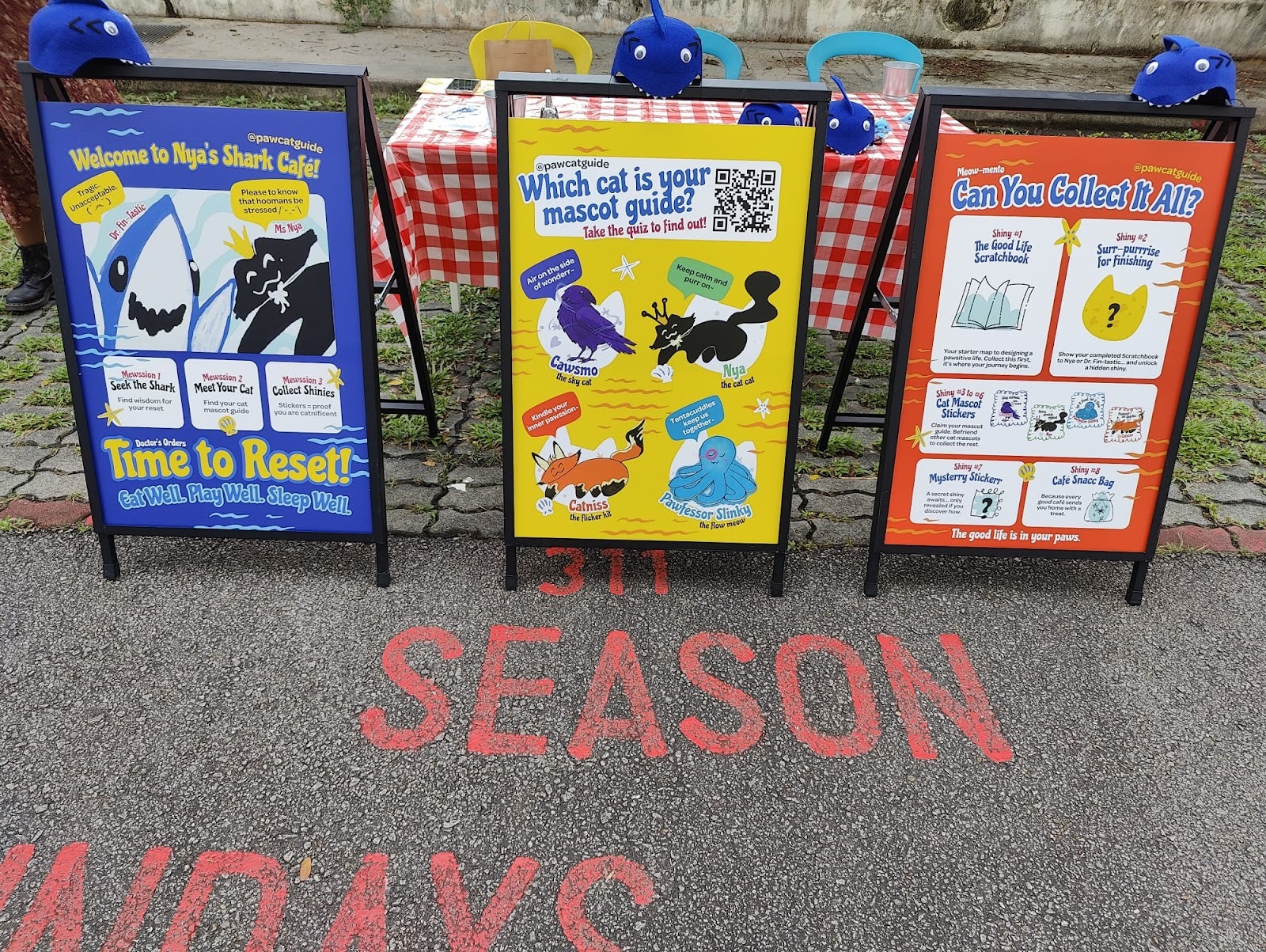
3. And now for something different — Paw Cat Guide! How was Nya (your cat boss) born, and how do you deliberately introduce play into your art?
I think I was in a lot of pain as a child. And in the midst of all of that, stories were what kept me going, safe and protected. Nya came from the parts of me that needed protection when I was a child. Growing up, stories and whimsical companions were my survival mechanisms; my leopard puppet, Lippi, was my closest companion for years until a therapist shamed me into giving away all my soft toys at 18. That moment planted a rule inside me: “If I have something playful or childlike, people will judge me.”
As an adult, Nya emerged when my inner child found a way back through whimsy and humour. She’s all my shadow sides wrapped in play. Through her, I can access healing gently without needing to consciously unpack trauma every time.
Play is not something I force into my work; it’s simply how my brain understands the world. Irresponsible, chaotic good ideas, the kind that we disregard, the kind that perfectionism boots out the door are the best ideas! Pocket Guide became the place where I test language, refine stories, and see what makes people erupt into joy, and watching people respond with delight affirmed for me that play is powerful and not frivolous.
4. I came across “pleasure activism” in your writing. I’ve always associated your practice with “sparking joy.” How has this philosophy shaped your creative journey?
Pleasure activism gave me language for something my body had always known. When you have a chronic illness, your body accumulates these micro-moments of pain, and during the pandemic, my body collapsed under the weight of years of this. I was bedridden with a mysterious illness and suddenly aware of how much of life was organised around the idea of friction. This is different from growing pains, which occur when we're intentionally trying to build muscle or when we're actively engaging with the discomfort of learning something new and being terrible at it, and working our way through to the other side. All of that is super helpful and important, but it is the other kind - struggle, hustle, grit, pushing through pain as if pain were proof of worthiness - that seemed not to sit well with me.
Because of my synesthesia, I feel sensory and emotional tension very intensely, so navigating that level of friction became impossible. When I encountered Adrienne Maree Brown’s Pleasure Activism: The Politics of Feeling Good, something clicked: growth, healing, and meaning don’t have to come from suffering. They can come from ease, delight, and micro moments of presence and pleasure.
This philosophy restructured me from the inside out. Each time I do something, I try to choose a softer way through rest, whimsy, slowness, and joy. Over time, my inner architecture reorganised itself. It’s not about bypassing difficulty, but about refusing unnecessary suffering and reclaiming pleasure as a legitimate, powerful way of moving through the world.
5. A large aspect of your practice is about being neurodivergent and navigating burnout. What, in your opinion, are the biggest challenges creatives are facing right now?
There are two sets of challenges: external and internal.
Externally, the industry is built for a pace most bodies cannot sustain, especially neurodivergent or chronically ill bodies.
Things like having deadlines for grants and residencies, expectations for a steady output, especially in the age of social media and networking cultures built around sameness. There is a lack of accessibility even in a creative space because there is an inherited rule that for creativity to become a legitimate profession, it needs to follow the same playbook as any other industry. There is also this binary that either you “make it big” or you’ve “failed” and then need to “get a real job.” There’s no model for the content, sustainable middle ground, and when artists try to build that middle space, they get accused of “selling out.”
Internally, we carry rules about productivity, worth, normalcy, and what “good work” should look like. Things like this idea of having to still work 8-hour days, feeling “too different”, or being hard to market. And after years of being in survival mode, we struggle to access the initial desire that pulled us into the creative space in the first place. I was watching Hot Wings once, and Lupita Nyong’o mentioned that the world prepares you to be a starving artist, but never a successful one. The deepest work is, in fact, unlearning these internal systems and replacing them with structures that steadily and genuinely support us.
A lot of Anya Studios, Pathfinder, and Bloomhouse were imagined as different Anya-shaped companions. I realise now that we're all craving for a different way of being and doing, and the language to access that. Maybe we're not immediately ready to jump into the deep end and do that intense work. For example, if 9 to 5 is not at all an option for me, where does that leave me? I still want to interface with the world meaningfully and deepen my connection to it. As much as I don't want to climb the career ladder and the capitalism wheel, I still desire to be able to meet my needs and my community’s needs and create something a little larger than myself that can leave the world a little better tomorrow. I think that is the space my pleasure activism wants to sit in.
6. What are your aspirations for the South Asian creative community? What changes do you hope to see in the next few years?
I want more spaces where we can define success on our own terms.
I want more softness in how we build careers, more community-led experimentation, and more artists who feel resourced enough to prioritise desire instead of survival. Bloomhouse is my love letter to this future; an incubator disguised as a greenhouse.
I also hope we normalise rest as resistance, play as wisdom, and pleasure as a legitimate creative force.
7. What advice would you give to emerging creatives, especially those from underrepresented backgrounds?
I have three compact pieces of advice:
Find love and hold on to it.
Love from yourself, from a pet, from a neighbourhood cat, from the stars, from a blooming flower - love is everywhere. It softens bitterness and protects you when the world feels hostile. And I think for artists who are using that to connect, people tend to gravitate towards you.
Find your voice across mediums.
You don’t need to master every craft, but let your senses play. Whether it’s a zine, a collage, a photograph, or an experience, your signature essence should be recognisably you. That gives you fluidity to navigate whatever the future asks of you.
(the most difficult one!) Make friends with money.
Most artists have a love-hate or a hate–hate relationship with money. I reframed money as love, so if I’ve already learned to accept love around me, then money is also an energy I can learn to receive. Changing your money stories is essential for sustainability. Get curious about what’s blocking you and gently reframe it for yourself.
8. What projects are you currently working on, and where can people find your work in the coming months?
Currently, my biggest offering is “The Courage to Let Yourself Be Seen”, a free/pay-what-you-wish experience that exists as a webinar, transcript, and audio version. It explores why so many artists shrink away (not as a choice, but as a reaction) and how to shift into a more resourced way of showing up by getting curious, witnessing, and knowing what are the stuck points that are holding us back.
Longer-term dreams include:
• PlayLab, an artist incubation program for work that lives in the “in-between”, a playful way to orient one’s art towards the slightly more commercial side of things so they can monetise it and engage with the public as a brand or an entity.
• In that vein, I’d like to slowly expand Bloomhouse into deeper community practice and eventual artist retreats for us to gather and find the optimal conditions for us the grow and thrive.
• A dream of mine is to create a Miyazaki-inspired nature-based theme park that delves into inner alchemy the deeper you explore.
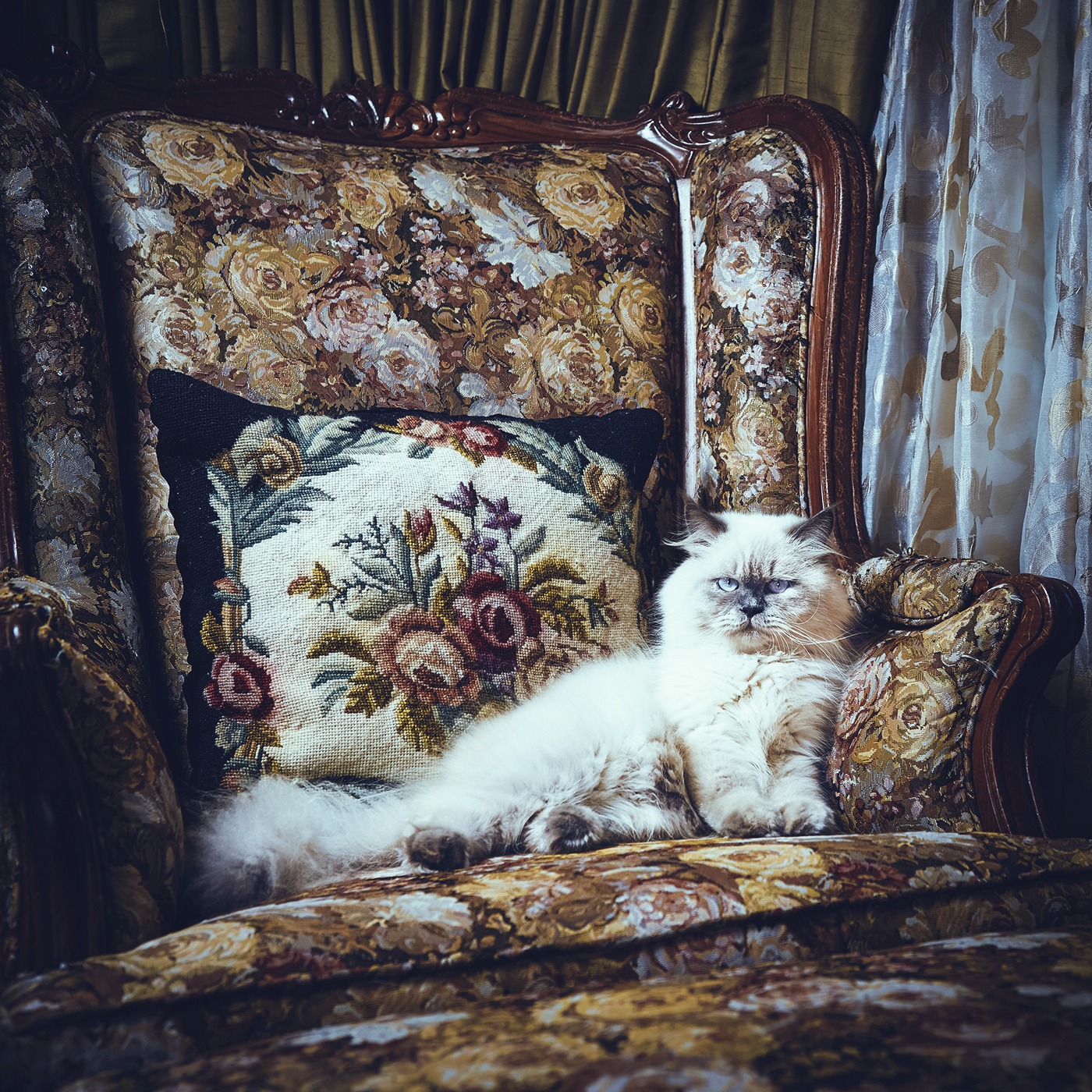
• MewX - think TEDx, but with cats (for humans)
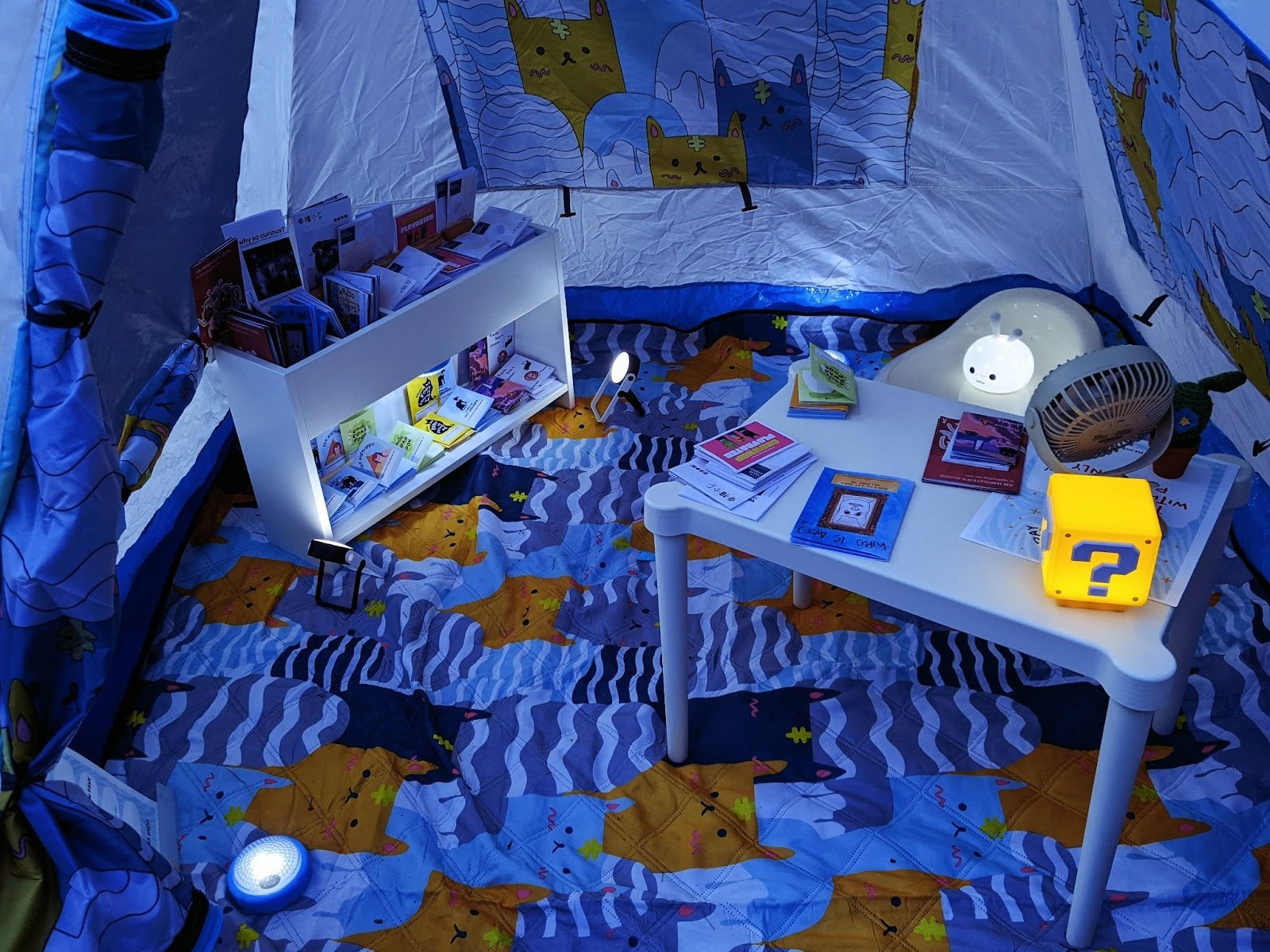
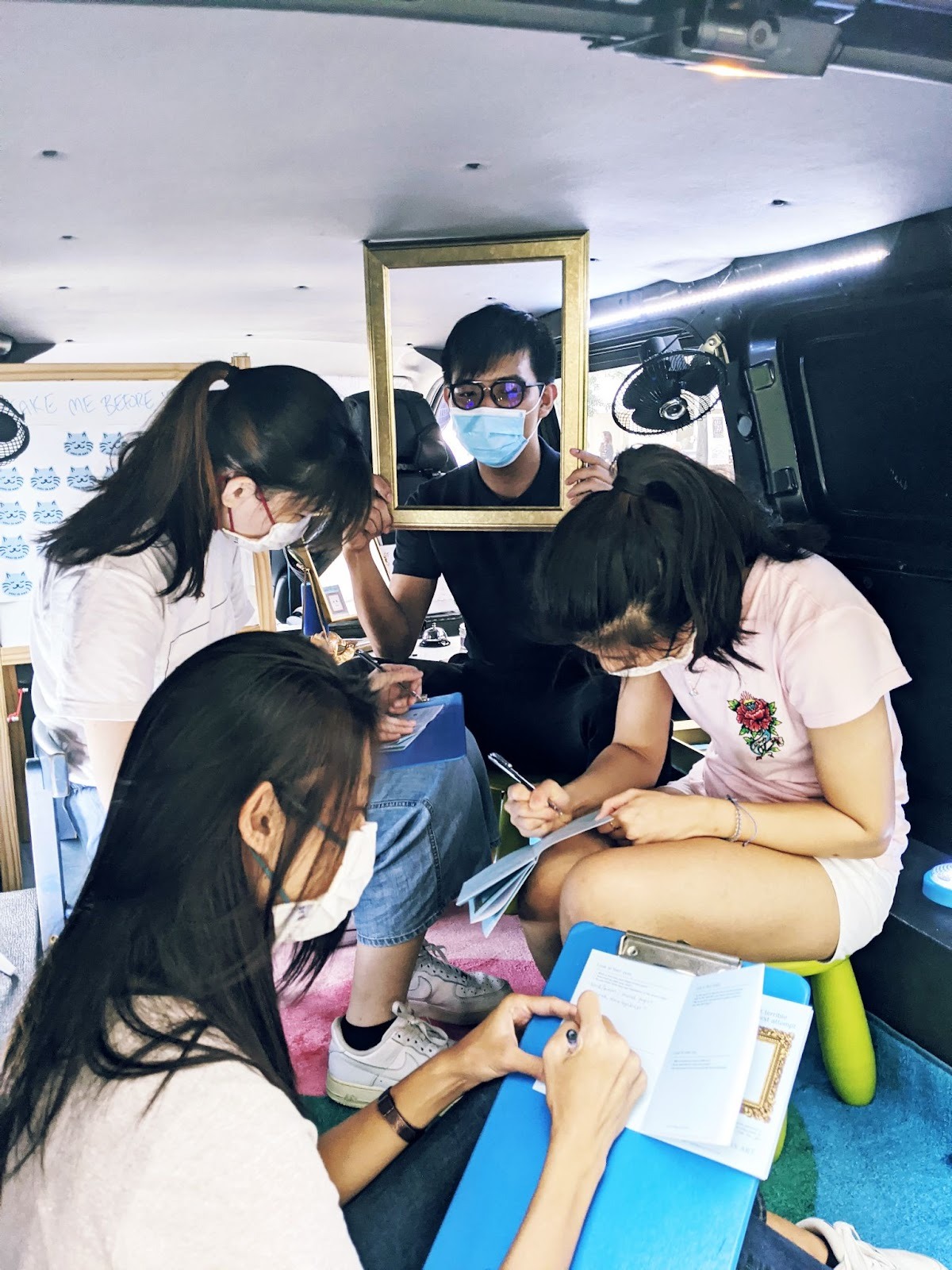
• I am definitely going to continue creating Nya pop-ups that offer experiences and zine-making.
This year is also a big transition year (hello, moving house!), so everything is unfolding gently.
9. What is an artist stereotype that you secretly live up to?
I have been told that I am “very indie.” My response to that every time is How dare you… But fair enough!
10. And finally, what is your favourite South Asian sweet?
Dharwad Peda. It is a tiny sugar bomb of pure joy.



.jpg)