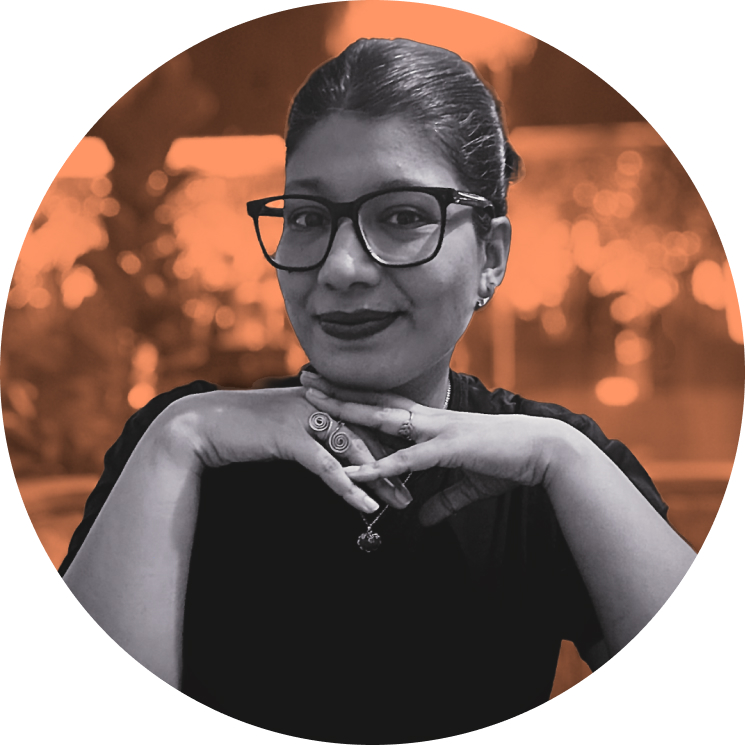
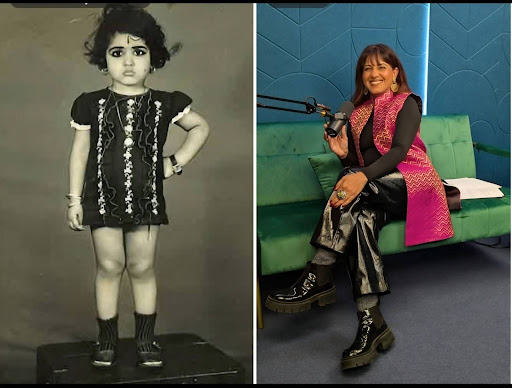
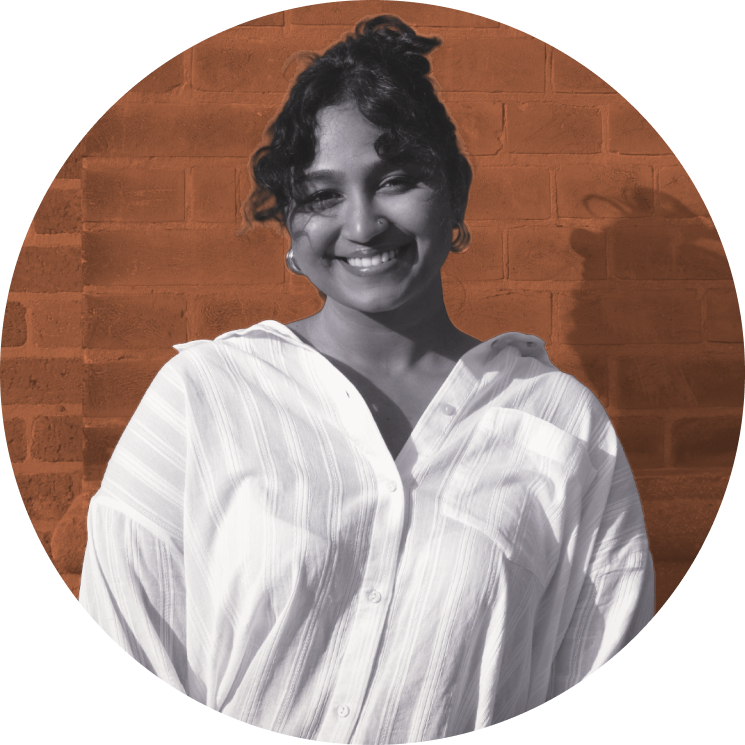
Her podcast Masala Podcast has won 6 British Podcast Awards, an Audio Production Award, and the Spotify SoundUp 2018 award, and has appeared on billboards in New York, London, Dublin, Cardiff, and Glasgow. Sangeeta has been featured in BBC Radio, The Guardian, Metro, Cosmopolitan, Stylist, Eastern Eye, and Huffington Post. She also created Masala Monologues, a series of writing workshops and theatre shows in the UK and the US. Her book is available on the Bad Daughter Website.
Are there any gestures or rituals that help set you into your creative process?
For me, creative writing happens very early in the morning. When I was writing the book, I would wake up around five and start working by 5:30 or 6, continuing until about noon or one. That window is when my writing brain feels most alive. I wake up and begin with a short meditation. I light a small diya, ring a meditation bell, and that’s how I start my day. No matter what I’m working on—writing or creating in other ways—it’s the first thing I do. The lighting of a diya makes my practice a sacred one.
I think, as creatives, there’s something powerful about uninterrupted time and the simple pleasure of routine. One step leads to the next, and it sets something bigger than you into motion.
You mentioned you have started visiting Kerala frequently. How has returning to Kerala shaped your relationship with your roots and your sense of self?
For me, coming back to Kerala has been a process of deep reconnection. It’s where I was born, but for a long time I resisted it. Over the past three years, though, I’ve returned more often, and it feels like a part of my soul connects here. Kerala, in particular, holds that connection for me.
Reconnecting with my roots also opened me up spiritually. I was never really spiritual before—I’m Hindu, but not practising in that sense. Returning and reclaiming my roots created space for that part of me to emerge. I feel a connection with the divine now, and it’s become an important part of my life. Until three years ago, that wasn’t the case at all, so this is all quite new for me.
You’ve often been “the first”—to move out, start a career, live abroad. Independence often comes with isolation. Did you ever have to choose between your freedom and belonging? How did you navigate that?
It hasn’t been easy. I knew that the price of having my own life and using my own voice would be a lack of belonging. I don’t really belong anywhere. I don’t belong in the Indian system, and I don’t fully belong in the Western system either. That’s the price you pay.
I talk about this openly and vulnerably in the book. One of the earlier chapters begins with me sitting on a plane just after my father died in 2020. I was in the U.S., delivering a series of workshops at UC Berkeley, when COVID hit California. There was talk of shutting everything down, so I had to get on a plane—while carrying grief, fear, and uncertainty all at once.
I remember sitting there and realising I had no one to call. No one to talk to about this huge grief I was carrying. And in the book, I write about a voice in my head that said, well, this is the choice you made. It wasn’t a kind voice. It wasn’t comforting or supportive.
That lack of belonging is the price we pay for the choices we make. But would I go back and change anything? No. I would make the same decisions again, every single one of them. I don’t know any other way to be.
Because whatever choice you make, there is always a price. If you follow the system—marriage, expectations, doing what you’re supposed to do—you often end up shutting down your own voice. And there’s a price for that, too. Either way, you pay. The choice is ours: which price are we willing to live with?
How did you navigate all of these? Particularly, when there was no vocabulary or role model to guide you?
I followed an inner voice—that’s all I had. I grew up in 1980s India with no books, magazines, or language for what I was feeling. There was just this voice saying: this isn’t okay, you don’t have to accept it.
But something inside me—just a voice—kept saying: you’ve got to challenge this. This is not okay. You don’t need to accept it. And I think a part of me always knew. It always fought. It always asked questions.
Everything around me, everyone around me, was saying, you’re crazy—why are you doing this? What is wrong with you? My own mother, my relatives, the aunties, the neighbours—they were all like, what’s wrong with this girl? Eventually, I started wondering the same thing.
But I didn’t have a choice. I had to be this person. Back then, girls didn’t leave home, so I stayed—and fought: against marriage, for the job I wanted, the clothes I wore, the life I chose.
We were told that a girl leaves her parents’ house in only two ways—through marriage or death. It’s bullshit, but that was the world I grew up in.
So yes, it’s a complicated answer, or maybe it’s a very simple one—take it as you will. I always knew. That didn’t mean it was easy. It was very, very hard. Emotionally, it was deeply difficult, because I was fighting with my family, with my parents.
But that’s how I knew.
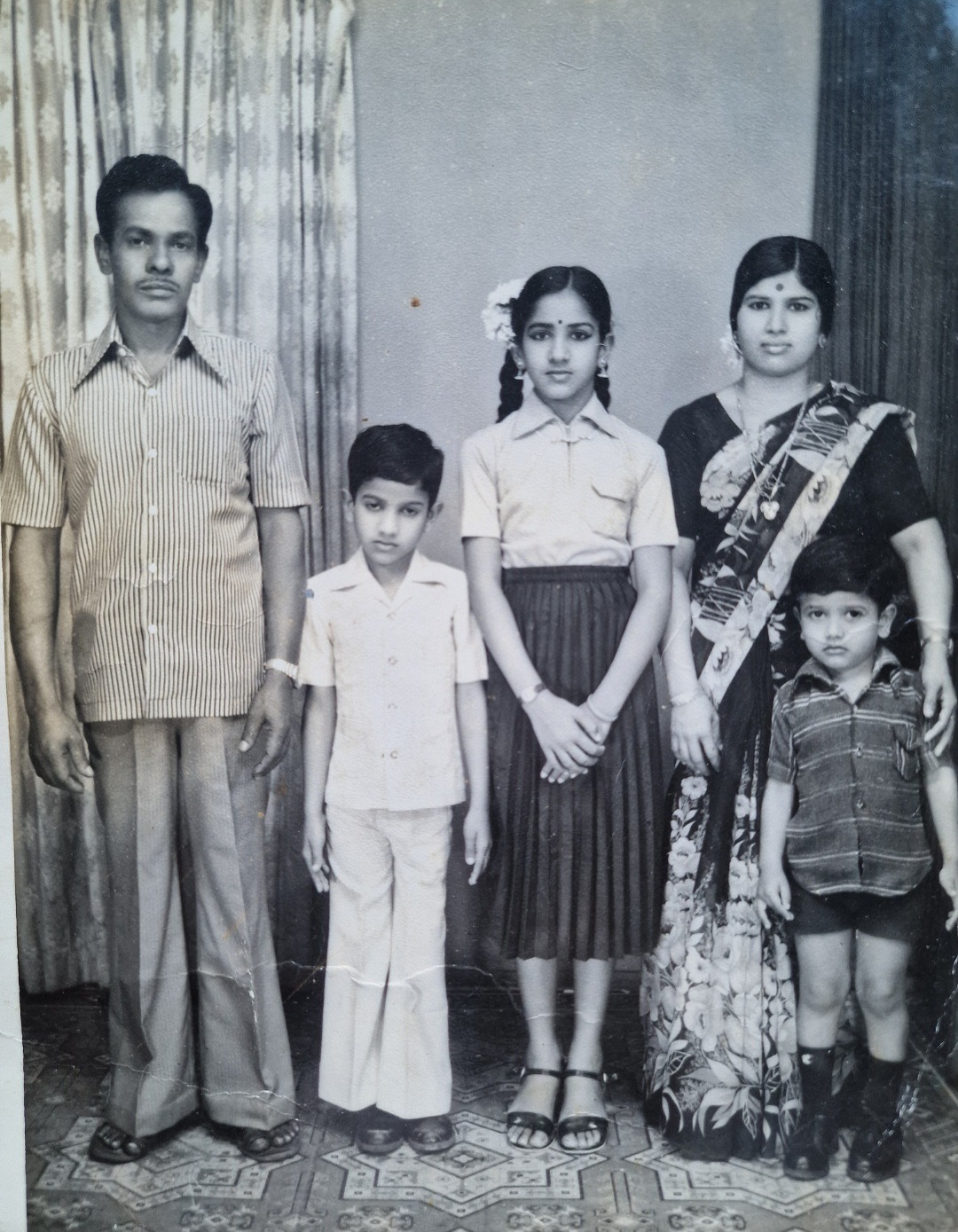
Credit: Sangeeta Pillai
What inspired you to write Bad Daughter and start the Masala Monologues?
On a personal level, my journey has always been a feminist one, even before I had the language for it. I grew up in India at a time when feminism wasn’t something we talked about. Watching how women were treated—especially my mother, who endured an abusive marriage because she lacked financial independence—shaped me profoundly. It made me determined to have my own income, my own agency, and a voice in my own life. I rejected the prescribed path of marriage and motherhood that was pushed on women then—and still is today.
Since I was the first woman in my family to get a job and to go to university. Moving to the UK twenty years ago offered more rights and opportunities, but within South Asian communities, many patriarchal ideas remain frozen in time. From the outside, it may look like progress has been achieved, but there are still deep inequities—pay gaps, healthcare disparities, and systemic inequality—that continue to shape women’s lives.
This is what led to my work—Masala Monologues, the workshops, and the podcast. Much of what I do is about permitting women to question culture. Culture isn’t fixed; it’s fluid. It should allow us to ask questions, to take what serves us now, and to leave behind what doesn’t.
For a long time, my response was to reject my culture entirely—to see everything Indian or Keralite as purely patriarchal. But over time, I realised that culture isn’t black and white. Within it, I found powerful feminist figures—Devis like Kali—fierce goddesses who embody strength and agency. Kerala, in particular, has a long tradition of Devi worship. Through this, I began to see that the feminine and the feminist can coexist within our culture. You just have to look closely. That has been my journey.
How do you situate feminism within the current global moment, especially as narratives like “trad wives” and the “divine feminine” gain prominence?
I think there are two layers to this—the global and the personal—and they’re deeply connected. Over the past three years, there’s been a real pushback against women’s rights globally. It’s happening in different pockets, but it’s systemic and widespread. When women’s rights are rolled back, the progress of humanity itself is rolled back, and we see societies becoming more aggressive as a result. Whether it’s the U.S., India, Iran, or Afghanistan, there’s a clear shift underway.
When it comes to the trad-wife narrative, I often say this: if you want your own bank account, if you want to own property, if you want to travel, make your own money, and have autonomy over your life, then you are a feminist. That’s the textbook definition. If you want these things and then say, oh, I reject feminism, and I'm a trad wife, well, then pick what it is. You can't have both, right? There’s a real hijacking of feminism happening—one that pushes women’s rights backwards while celebrating the trad-wife ideal without acknowledging what women have sacrificed to earn these freedoms. Women have died for the right to vote, to own property, and to access reproductive healthcare. You can’t enjoy those rights and then pretend they came from nowhere.
How was the process of pitching the book? Especially with your South Asian context in a Western market?
South Asians are the largest ethnic minority in the UK—about seven per cent of the population. There are roughly 2.75 million South Asian women in the UK alone, with similar numbers in the US and Canada. And yet, industries like publishing simply don’t see us as a viable audience. That’s incredibly frustrating, because there’s a huge, hungry audience looking for stories, content, and representation—but they’re invisible to decision-makers.
When I was pitching Bad Daughter, my agent and I pitched widely. I had three agents chasing me; I signed with one, worked on the proposal, and we sent it out. We were rejected by 39 UK publishers and 15 US publishers. The feedback was always the same: “It’s a brilliant story, but we don’t think there’s a market for this.” I vehemently disagree. There is a market—they just don’t see it. We don’t exist for them.
Having worked in marketing, I find that baffling. If someone handed me those numbers and said, “Here’s a highly engaged audience that nobody is speaking to,” I’d call it a goldmine. You’d think publishers and brands would rush toward it—but they don’t. And that, to me, is one of the most telling and problematic parts of living and working in the West.
How did you navigate this system where profit is narrowly defined, and where, globally, some narratives—like those from the Global South—are sidelined while others are prioritised?
It has been challenging. And I see both sides. Living in the West has allowed me to create a huge body of work—I don’t think I would have had these opportunities in India. India is very much about who you know, whether you have connections in Bollywood or other circles. So in that sense, London has offered me incredible opportunities.
But it’s also limiting. The market here often doesn’t see the value of this audience or population. That really frustrates me. The book I’ve written is called Bad Daughter, but it’s for all women—not just South Asian women. Patriarchy affects all women. And in fact, readers have been white, brown, Black—they all respond the same way: “This book is amazing. I see myself in it.”
Yet publishers and many industries want to pigeonhole you: “You’re an Asian woman, so only Asian women will read this.” That’s nonsense. If you create something that truly resonates, people will connect with it, regardless of background. Limiting it to one segment ignores the universality of women’s experiences—and that, to me, is huge.
You’ve spoken about the cost of choosing your own voice, but through your work, you’ve also built a strong community - that in itself feels like a form of shared belonging. Is there a particular story that’s stayed with you?
One of the joys of doing the Masala Podcast, in particular, is the kind of feedback I get from listeners. I hear from so many women. There was an 18-year-old girl from India who wrote to say, thank you, I feel less alone in the world. I’ve had British Asian women tell me they make their husbands and brothers listen to the podcast so they can understand what it’s like for them, which I think is amazing.
But the most dramatic one was when I was travelling in Kochi, actually, about three years ago—same place I’m in now. A woman messaged me to say she was a huge fan of the podcast and asked if we could meet. We met, and she sat across the table from me and said, your podcast changed my life. And I remember thinking, that’s a really big thing to say.
She told me she was in an arranged marriage. She was married to a man who was gay, but the families ignored it and pushed the marriage through. Things became very difficult between them. At one point, he forced himself on her. She became pregnant and then lost the baby. It was incredibly traumatic.
She said that through all of this, she kept listening to the podcast. And one day, she plucked up the courage to leave. Now she lives in another city, has a job she loves, and has built a new life. And she told me it started there—with the podcast.
I mean, that stays with you. That’s the motivation. That’s the purpose. And I think belonging can take many shapes and forms. This—this is definitely mine.
In your podcast, you’ve spoken to so many women navigating different challenges. How do you incorporate intersectionality—like caste, financial independence, disability, or cultural background—into your conversations? And have you noticed any similarities in experiences around different intersections?
The themes and guests have emerged organically. The podcast is about taboos—sex, sexuality, menopause, mental health, anything people avoid talking about. For me, the only criterion is whether a guest is willing to talk openly and authentically. I’m not looking for celebrities or PR stories; I want honesty. Because this is how I talk.
Intersectionality comes up naturally. I’ve interviewed a disability activist, done three episodes on LGBTQ issues, and I cover anything people pitch that feels real. I don’t set out to tick boxes; I just want to talk about taboos and stories that matter.
And the similarities are striking. Whether it’s a music star in Los Angeles, an FGM activist in Bandra, or a TV star in Britain, it’s shocking how we struggle with the same thing.
How have you seen privilege—real or assumed—shape women’s experiences in the stories you’ve heard?
Privilege comes in all shapes and forms. Someone growing up in the UK might have access to good schools and healthcare, while someone in India might not. But while privilege plays a role, suffering is universal. Women face similar struggles across contexts. Wealth or status can protect you to a degree, but not entirely.
What has surprised me is how much we make of our circumstances. I grew up in a Mumbai slum with limited resources, while a second-generation South Asian in the US or UK might have had far more opportunities. And yet, it’s not just where you’re born—it’s what you make of it. I’ve faced very difficult things in my life, but I’ve chosen to find and live the life I want. It’s not a simple answer, but that’s how I see it.
Speaking of tabooed topics - sexuality and sensuality are such central parts of being human, especially for women. How has your relationship with them evolved? And has it also impacted the way you express yourself beyond sexual contexts?
Growing up in India at that time, the message I received was that sexuality equals shame. Women had no agency; sex was for men, and we were just passive participants. It took me decades of learning and working on myself to claim that my sexual agency is mine, that pleasure is my right, and that my body belongs only to me.
It’s been a 360-degree shift—from being taught that as a woman I’m weak and powerless, to understanding that my power sits within me. Sexuality is power. I’ve done work in Tantra, which teaches that your sexual energy is your root chakra—the fire that drives everything in life: work, health, passion. I’ve completely reframed how I feel about my body, my sexuality, and my power. I feel no shame about it anymore.
It has impacted me in a sense that I’m very straight-talking—I say it like it is. I don’t shy away from talking about periods, menopause, orgasms, vulvas, vaginas… I just see them as words like any other. I talk about them openly, and people might find that a little unusual, but that’s just how it is.
What’s interesting is that in many of our languages, we don’t even have words for these things. I did a series on Instagram a few years ago asking, “What’s a vagina in Hindi? What are periods in Malayalam or Punjabi?” We just don’t know, because so much shame is attached. Language itself shapes our sense of identity and what we carry into the world. If you want to change something, start with the words you use.
How do you see women today reclaiming their bodies and sexualities—and what complexities come with that process?
I think it’s great when women can own their sexuality and be fearless in talking about it. But the dangers come in, you know… like if you send a nude picture to someone you’re dating and it ends up somewhere else—that’s a violation. And in the modern age, with AI, deep fakes, and all of that, it’s really not great. And it’s almost always women who are targeted—why is there no deep fake of men? It’s objectification, pure and simple.
Where it becomes tricky is when we think we’re being liberal and open, but then we’re being manipulated. Our value is only seen through our sexual being, rather than as full humans. We have so much more—our minds, our bodies, our spirituality, our sexuality—so many layers. But social media, especially in the last ten years, has flattened that. Who we are is often reduced to how we look, how sexy we appear, what body type we have, and how performative we are online. And that’s not the only way.
We need to recognise that this manipulation exists. Men aren’t constantly posting pouting selfies or sexualized pictures—but women are expected to. It’s fantastic when women can own their sexuality and speak openly about it. And I think the start of that is having these conversations—challenging the assumptions and pressures we take as given. Because it doesn’t have to be this way. We are more than our bodies, more than just sexual beings. There’s so much to us—our minds, our creativity, our spirit—and we need space to express all of it. We must allow ourselves to inhabit every aspect of who we are, not just the parts the world chooses to see.
Let’s talk about power. You’ve described constantly having to fight, but your fight wasn’t always loud—it turned into something beautiful and purposeful. How do you see power?
This is very personal—to me, power is quiet. It’s not loud. It doesn’t need to announce itself. Power can enter a room, say nothing, and still shift the energy.
What we’ve been taught as power is very masculine—the biggest bully, the most money, the loudest voice, the most macho presence. And a lot of women have internalised that, believing that to be powerful we must become like men.
But feminine power isn’t like that. Power can be quiet. It can be loud. It can be angry. It can be soft. There are so many ways to embody it. Personally, I feel most powerful when I am the most grounded and the most still. I don’t need to explain myself. I don’t need to convince anyone.
The podcast is a good example of that. I speak slowly. I speak quietly. But it’s powerful. You can feel the shift. Something happens in the body—both mine and the listener’s. When the energy is centred, when it’s not leaking outward, it’s much stronger. The power isn’t outside—it’s inside.
And I think that anchor was always there. Even when I was a little girl. I genuinely believe it’s divine, because there’s no other explanation for why, in my family, I chose this path—why I chose to live this way, to speak these truths. I feel I was born to do this work. Even the hardest things in my life led me here. This was always the path.
That voice inside—it’s impossible to ignore. No matter what happens, it keeps calling. And yes, it led to something very beautiful. It really did.
I want to ask about your childhood. Any stories where you look back and think, “How did I even do that?”
There’s this one early chapter where I talk about refusing an arranged marriage. My family kept pushing, and one day this guy just turned up—without warning. My mother said, “Go get dressed.” And I came out in this really old nightgown. I smudged my eyeliner, making myself look absolutely terrifying. I was like, Fine, you want me dressed? I’ll show you how to dress. The poor guy was completely freaked out—which was perfect. Looking back now, I think, How did I even have the courage to do that at that age?
There’s another image I love. When I was about three, my family took me to a village photo studio in Kerala. Everyone kept telling me to smile, and I just refused. There’s this photo of me with my hand on my hip, looking furious—very much a “screw you” expression. I love it because it feels like a preview of what was coming. I think I was always like this.
That said, a lot of my childhood wasn’t fun. I grew up in the slums, with deep poverty, and with a violent father. There were nights we went to bed not knowing if my mother would survive. That’s an incredibly hard thing for a child to live with. So it wasn’t an easy childhood at all—it was very painful.
But I also see now how it shaped me. It took me seven years to write this book. And when I finally finished it and read it end to end, I remember thinking, My God—what a life. Not in a way I’d ever allowed myself to feel before. Because when you’re living it, you only see things in fragments. Putting it all into one narrative—from the beginning to where I am now—was powerful.
I looked at it almost objectively and thought, This is a really unique life. Someone who grew up in the slums ends up on billboards in New York. Along with all the healing, the spiritual experiences, the things that even I sometimes think, Did that really happen?—and it did.
It’s a profound, messy, inspiring story. And for the first time, I could actually see that for myself.
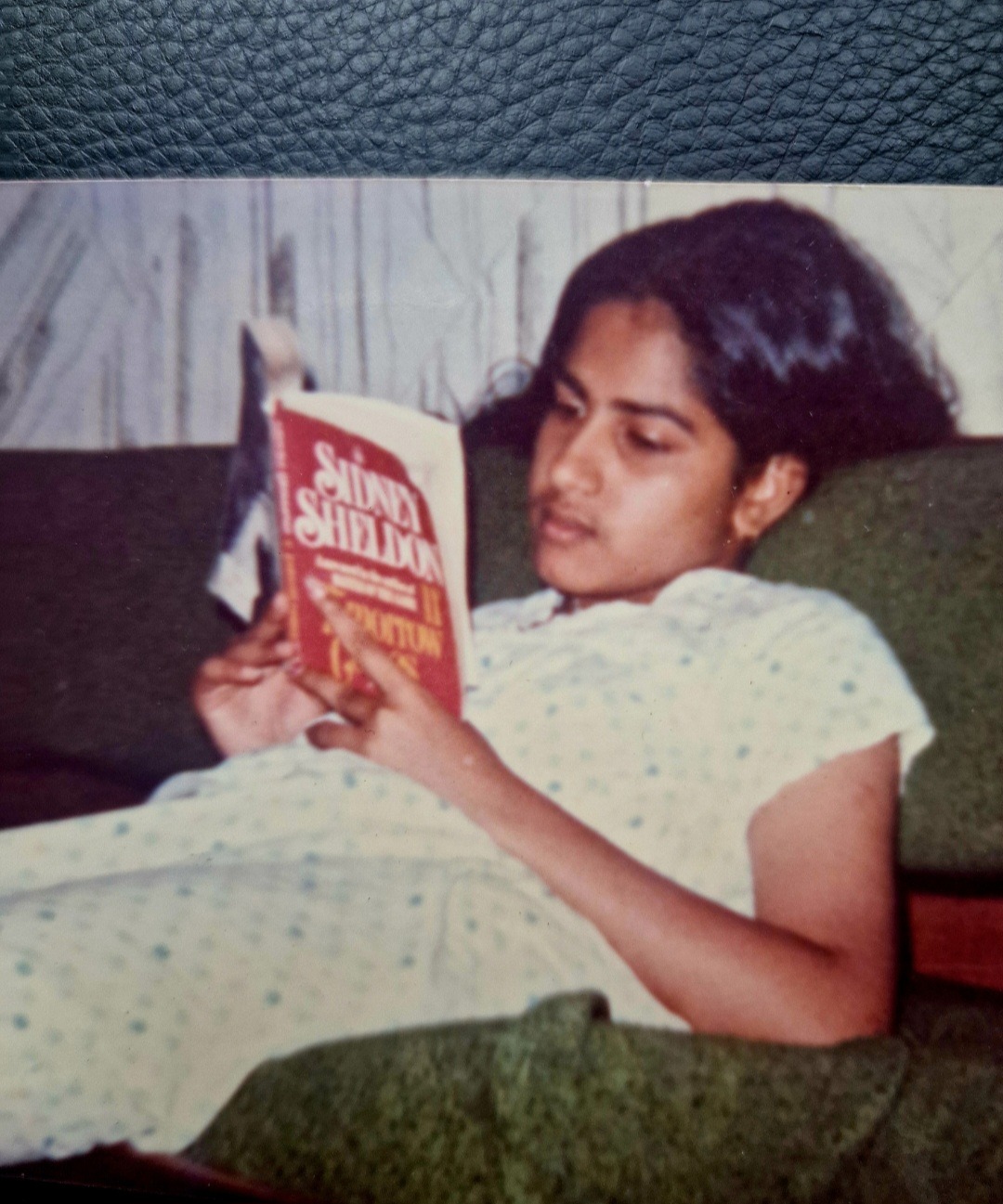
Credits: Sangeeta Pillai
You’ve really lived so many lives in one! How do you feel now, at this point in your life?
That’s such a profound thing to say, and I completely agree! Sometimes I feel like I’ve lived four or five lives in one lifetime.
I’ve lived a very traditional Kerala village life. Then a Bombay life. Then an advertising agency life. Then a London life. Then, a life shaped by mental health and trauma. Then a life as a successful podcaster. Then a deeply spiritual life.
It feels like an adventure to me—a very wild, crazy journey. The image that comes to mind is a roller coaster. And it keeps changing. In my life, every five or six years, everything shifts completely.
Right now, I feel like I’m on the cusp of another change. I don’t know what that change looks like yet, and that’s both exciting and terrifying. But I’ve learned that this is how my life works. I’ve had to become so many versions of myself.
When I became a podcaster, I didn’t even know what a podcast was. When I started writing a book, I had no idea how any of that world worked. I became a Londoner. I lived a Bombay life. I stepped into each version as it came.
And now, once again, I can feel something shifting. I don’t know what it is yet—but I know it’s coming.

Credit: Sangita Pillai
Finally, what’s your favourite south asian sweet?
I love food—full stop. I’m a huge foodie. Favourites are fish curry and rice, Kerala, South Indian, or Goan dishes. I always joke: if I were being executed, my last meal would be prawn curry, rice, aloo fry, papad, pickle, and dessert. I’m a dark chocolate person, but I also love desi sweets—pedas, barfis, and especially a good besan ladoo.
Bibilography
Pillai, Sangeeta. Bad Daughter. 2026. https://baddaughter.co.uk/
Pillai Sangeeta. Masala Podcast. https://soulsutras.co.uk/




.jpg)