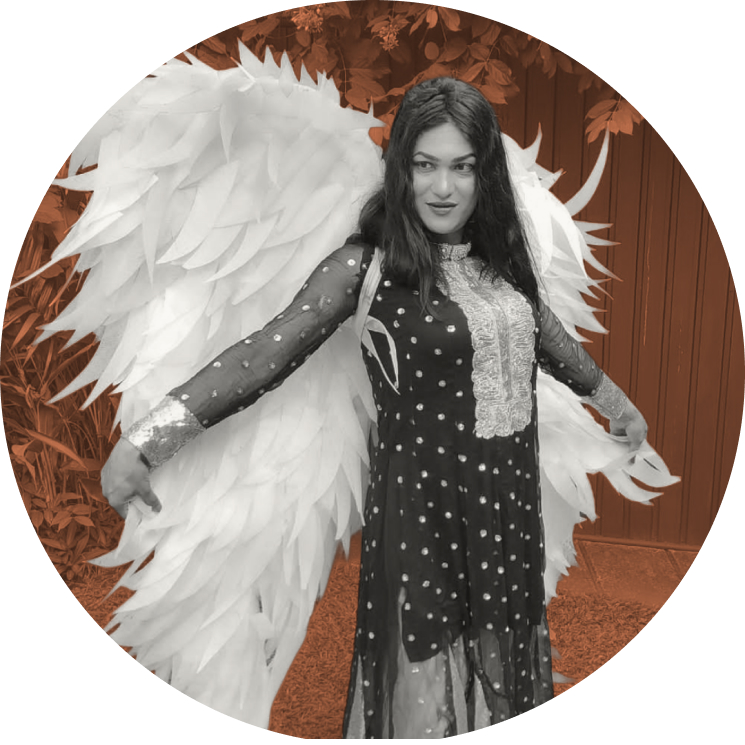

At a typical performance, the music begins softly from a speaker on the ground beside me. People start gathering, slowly and cautiously. Some keep their distance. Some whisper to each other. A few look directly at me with curiosity, while others avoid my gaze completely.
Before I move, I feel the tension in my body.
Performing as a transgender artist is a constant negotiation with the public. It creates risk for the performer, already made vulnerable by their gender identity, by a violent system.

Peshawar sits close to the Afghan border and carries the weight of decades of war, displacement, and political conflict. It is also a deeply conservative city where public space is carefully watched, and gender roles are tightly enforced. Bodies like mine, transgender, visible, and expressive, are not expected to exist openly here. Khyber Pakhtunkhwa, a province where Peshawar is located, is frequently reported as having the highest rate of violence against transgender people in Pakistan, with over 150 killings reported between 2015 and 2025.
So when I step into a public space to perform, I am stepping into a conversation with these multiple contexts. Peshawar’s transgender community is among the most marginalised in Pakistan, and over the years, the Khwaja Sira community has built an economy around performing for public celebrations like weddings. Because otherwise, trans communities face severe housing insecurity, familial rejection, and extortion. For many of us, this is not just cultural expression but a means of survival. At the same time, it also carries expectations and stereotypes that can limit how we are seen and understood.
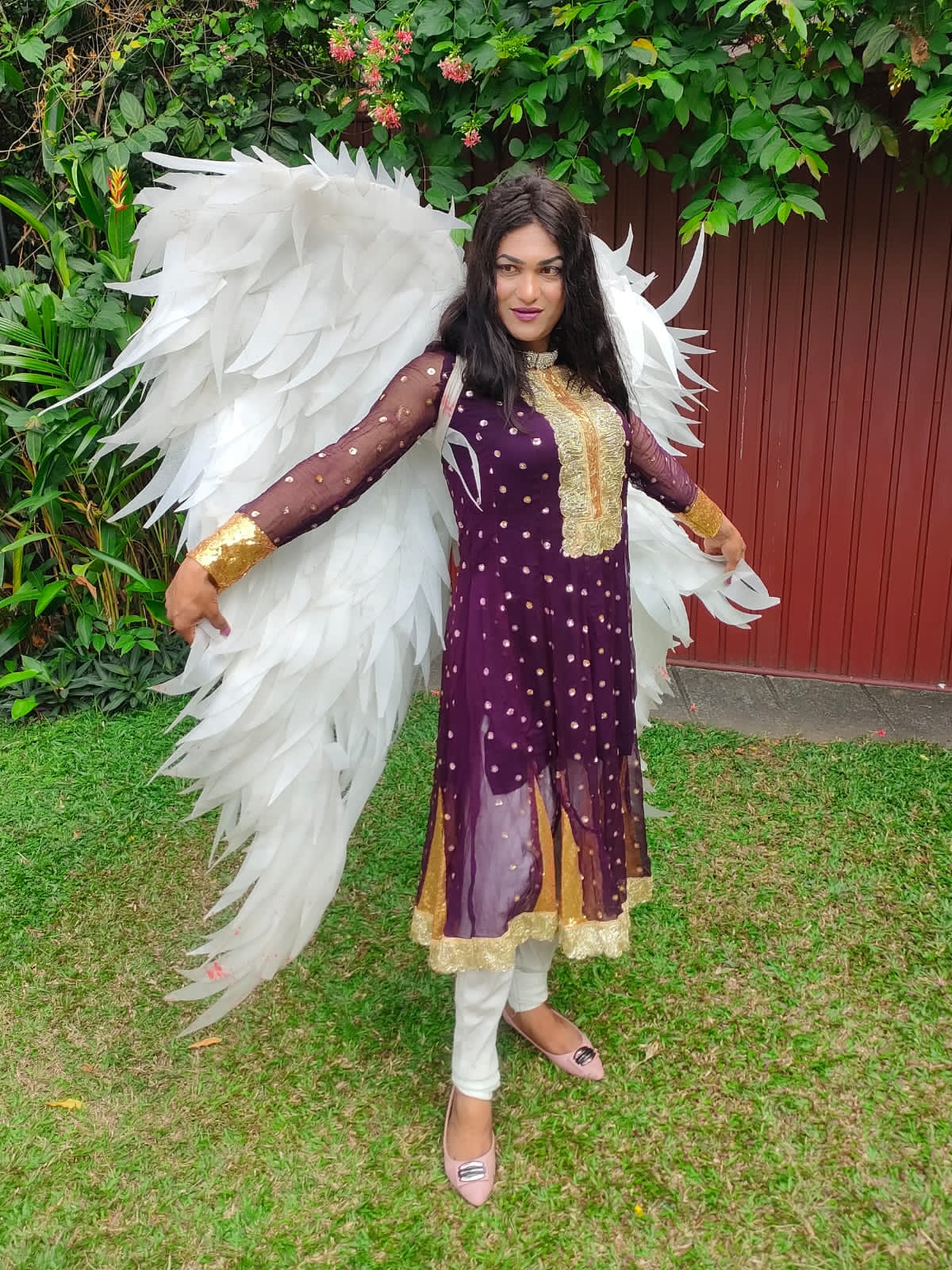
When I perform, I am therefore not only participating in this tradition but also reflecting on it—navigating the space between identity, survival, and resistance. My body carries both the weight of these realities and the possibility of reimagining them.
My work as a transgender artist and activist has always existed between art and survival. Through dance, theatre, and embodied storytelling, I try to create moments where people can pause and see us not as stereotypes or threats, but as human beings with stories, pain, and dignity. Performance is how we assert ourselves in spaces that are governed by heterosexual and patriarchal systems.
My work as a transgender artist and activist has always existed between art and survival. I began performing at a young age, initially to support myself as a Khwaja Sira. What started as a necessity gradually became a space of expression and reflection, where I began to understand the power of performance beyond survival.

Over time, I expanded my practice from traditional dance into theatre and storytelling, using performance to share lived experiences that are often silenced. Through these forms, I try to create moments where people can pause and see us not as stereotypes or threats, but as human beings with stories, pain, and dignity.
Performance, for me, is both inherited and reimagined—it comes from a long history within my community, but I also use it to question and reshape how we are seen.
Visibility as violent
In 2025, we were performing street theatre in Peshawar, and the crowd gathered slowly around me in a small open space near a market. At first, there was laughter— some of it playful, some of it mocking. I could hear murmurs in Pashto asking who I was, why I was dancing here, and whether this was allowed. For a moment, I wondered if the crowd would turn hostile. This is not uncommon.
But as the music continued, something shifted. A few people moved closer. The laughter softened. Someone clapped quietly to the rhythm. It was a small change, almost invisible, but in that moment, the space felt different. Moments like that remind me why performance matters.
In a place where formal advocacy often meets immediate resistance, art can open a different kind of dialogue. It allows people to witness something before they decide how to judge it. As an activist, I’ve learned over a decade of work that creative expression can reach where policy language cannot.

But that’s why I perform.
For the work I do, I have faced backlash from conservative groups. In many parts of Pakistan and South Asia, trans identities are often framed as “sinful” through rigid interpretations of religion and deeply rooted patriarchal norms that do not accept gender diversity. While Islam itself has diverse interpretations, in practice, many religious figures and local power structures use selective narratives to label transgender existence as immoral, which fuels stigma and exclusion.
This contradiction is striking because, legally, Pakistan has made some progressive steps, such as the Transgender Persons (Protection of Rights) Act 2018, which recognises the rights of transgender individuals. However, cultural acceptance has not kept pace with legal protections. In everyday life, transgender people continue to face rejection from families, barriers to housing, violence, and harassment in public spaces.
I have experienced this tension personally. When I began speaking publicly about transgender rights and refugee issues through my performances, I was accused by local clerics of spreading “sinful ideas.” There were moments when community members warned me to stop performing in certain areas, saying my presence was “against culture.” Even during wedding performances, spaces where our presence is traditionally tolerated, I have faced insults and hostility once I stepped beyond entertainment and into expression.
These experiences reflect a broader reality: that while transgender people may be visible in certain roles, they are not fully accepted as equal members of society. My work exists within this tension, challenging not only policies but also the deeply embedded beliefs that shape how we are seen.
I have received threatening messages online and offline, and my organisation’s office, the Trans Support Group, has been targeted because of our work supporting transgender people and marginalised communities. There have been moments when we had to limit our activities or shift locations to ensure the safety of our team and participants. These threats are not just personal; they are meant to silence our voices and discourage collective action. Yet despite this, we continue our work, knowing that visibility and resistance are necessary for change.
The stage, if it can be called that, is often just a patch of ground in a crowded street. But the stakes are real. Every movement of my body carries the possibility of hostility. And yet, the act of performing itself becomes resistance. There is a common narrative that transgender identity is foreign to our culture. Across South Asia, Khwaja Sira communities have long been part of cultural life as performers, storytellers, and keepers of ritual traditions. Historically, they held recognised roles in royal courts during the Mughal era and were often entrusted with cultural and social responsibilities. Over time, particularly during colonial rule, these identities were criminalised and pushed to the margins, reshaping how society perceives them today.
When I perform, I feel connected to those histories that are often overlooked or misrepresented in contemporary society. While Khwaja Sira histories are well documented, their dignity and significance are rarely acknowledged in how we are treated today. My performance becomes a way of reclaiming that connection—bringing past recognition into present visibility.
My work does not stand outside Pashtun or South Asian culture. It grows from within it. Dance, storytelling, and performance have always been part of our cultural life. What changes is who is allowed to claim the stage.
I often think back to the beginning of a performance, when the music first starts and the crowd begins to gather. That moment is always filled with uncertainty.
But I step forward anyway.
Because for transgender people like me, survival has always required movement, courage, and the willingness to claim space even when that space feels contested. In Peshawar, every performance carries risk. But it also carries a possibility. And so the dance continues.