


.png)
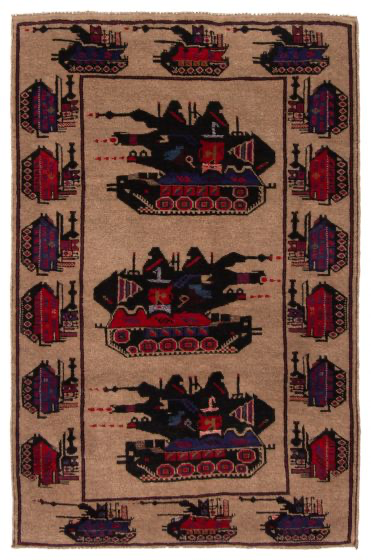
These are known as Afghan War Rugs (Qalin-e-Jangi or Qalin-e-Jihad). Emerging in the late 20th century, they adapted a centuries-old craft tradition to depict the conflicts that reshaped Afghanistan—from the Soviet invasion of 1979 to the US-led “War on Terror.”
Across Central Asia—from Iran and Afghanistan to Turkmenistan, Kazakhstan, Uzbekistan and China—carpet weaving has long been a shared cultural practice. Afghanistan itself was a major passage along the Silk Route that connected present-day Iran (erstwhile Persia) in the West to China in the East; Pakistan and India in the South East and Russia in the North through Turkmenistan, Kazakhstan and Uzbekistan. Countries across this region share a long history of making floor coverings or carpets, their intertwined histories and distinct identifiers making them coveted across the world.
This global demand was particularly observed after the rise of the Ottoman Empire in the 16th and 17th centuries, when these carpets began being exported to Europe. They continue to make up a significant portion of these countries’ exports to this day. Floral, geometric and religious symbolism in their iconographies remain fairly unchanged across the regions that produce them.
However, Afghanistan experienced a marked shift in its carpet-making industry in the 20th century owing to the violence and conflict in the region at the hands of both internal and external forces. This gave birth to the fairly modern and novel Afghan War Rug, a new visual language that emerged directly from the conflict
History of Rug Making in Afghanistan (Pre-Soviet Invasion)
The earliest carpet found in Central Asia dates back to 400 BCE, discovered in a grave in present-day Kazakhstan. In Afghanistan, the earliest records of carpet weaving date back to at least the 16th century. Nomadic tribes moved freely across the region during the peak of the Safavid Empire, when borders were fluid and loosely defined, and even earlier when the Silk Route was active.
Afghanistan therefore became a channel through which influences in rug-making—particularly from Iran—travelled from East to West and vice versa, borrowing and lending motif vocabularies, colour usage and layouts. These influences found their place in Afghan rugs as well, incorporated by local tribes into their traditional designs. While there are similarities with neighbouring regions, there is also a clear distinctiveness shaped by the original makers of these rugs—a tradition passed down through generations and expressed despite the many political, social and personal upheavals experienced in the region.
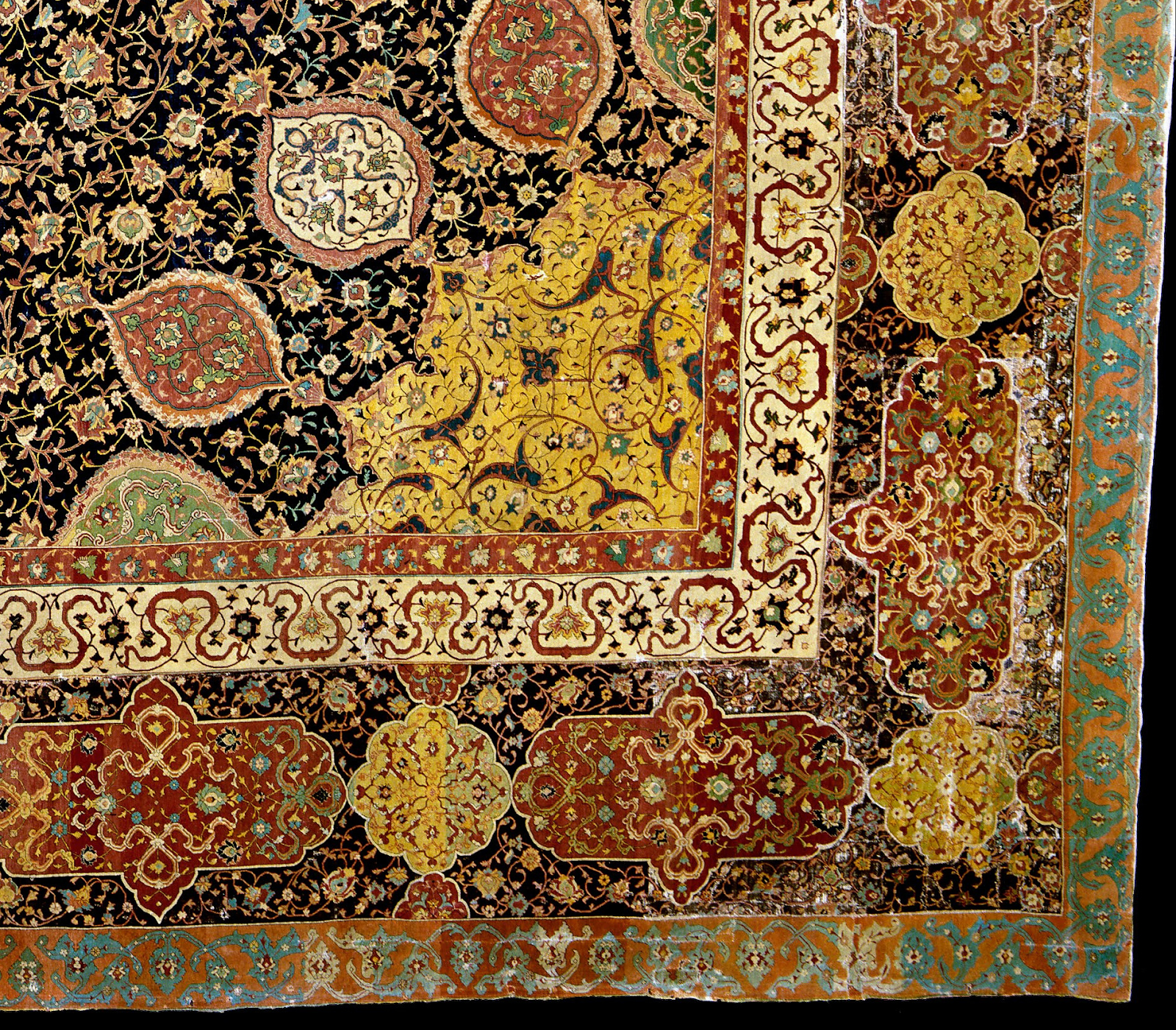
(Source: Essie Carpets)
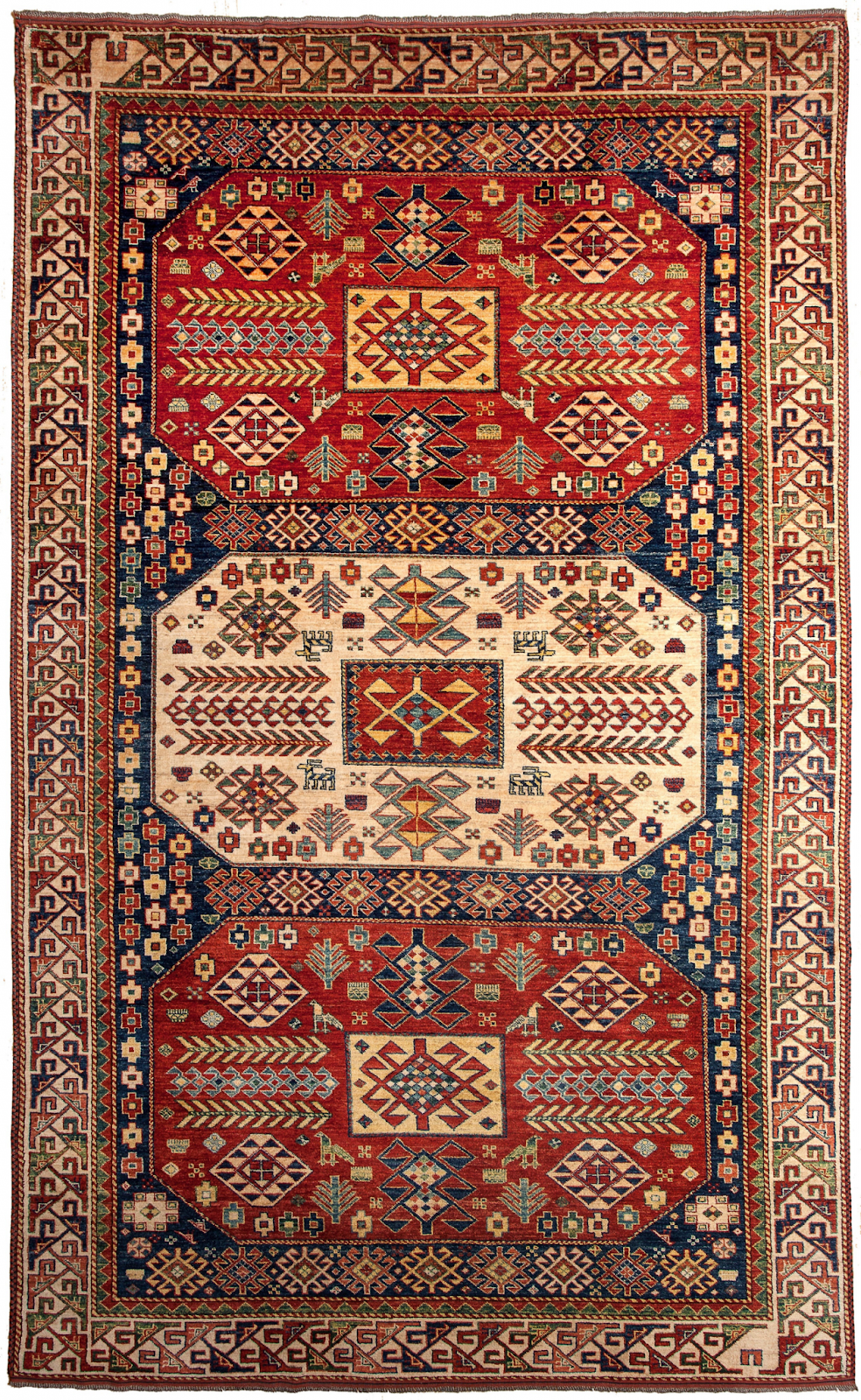
Afghanistan itself is composed of linguistically, culturally and ethnically diverse communities. While these groups share broader cultural ties, many operate independently and maintain distinct identities. Often pastoral, nomadic or semi-nomadic, several of these communities developed their own rug-making practices—each with specific knotting techniques, motif traditions derived from local flora, and dyestuffs sourced from their immediate surroundings.
Although commercial workshops existed in cities such as Kabul, Herat and Mazar-e-Sharif, tribal rugs were largely produced for domestic use. They were used in homes for warmth and decoration, with any surplus rugs traded or sold.
(Source: Cocoon Carpets)
Among the most prominent rug-making communities in Afghanistan are the Turkmen in the north and the Baluch or Baloch people in the south, both known for producing pictorial and highly geometric pile-knotted carpets. Hazara, Uzbek and Kyrgyz communities also wove rugs, though these are typically flatwoven without a pile, less pictorial, and often characterised by striped or geometric patterns enhanced with embroidery.
This article focuses primarily on the rug-making practices of the Baluch and Turkmen communities, as they are most closely associated with the emergence of Afghan War Rugs.
Technical Details and Making Processes of the Baluch and Turkmen Rugs
Traditionally, since the rugs were made for self-consumption, they were not very large. More importantly, the weavers’ nomadic lifestyle restricted the width of their portable looms. Sizes typically ranged from 2 × 3 feet up to 8 × 10 feet, with larger rugs rare in tribal homes and usually produced only in commercial workshops.
Sheep wool from Ghazni or Hazarajat—sometimes from the weavers’ own flocks—is procured, cleaned, handspun and dyed with natural dyes before weaving. Madder root and cochineal are used for red, indigo for blue and turmeric for yellow, while green is achieved by mixing blue and yellow dyes. Pomegranate and walnut skins are also used to produce dyes and finishes. Traditionally the warp threads are woollen, although stronger cotton warps are increasingly used today to ease production.
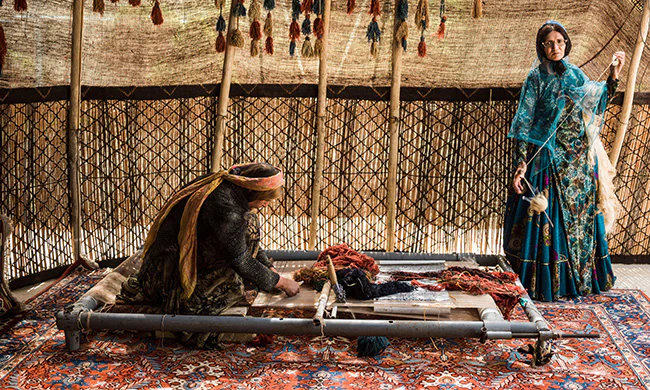
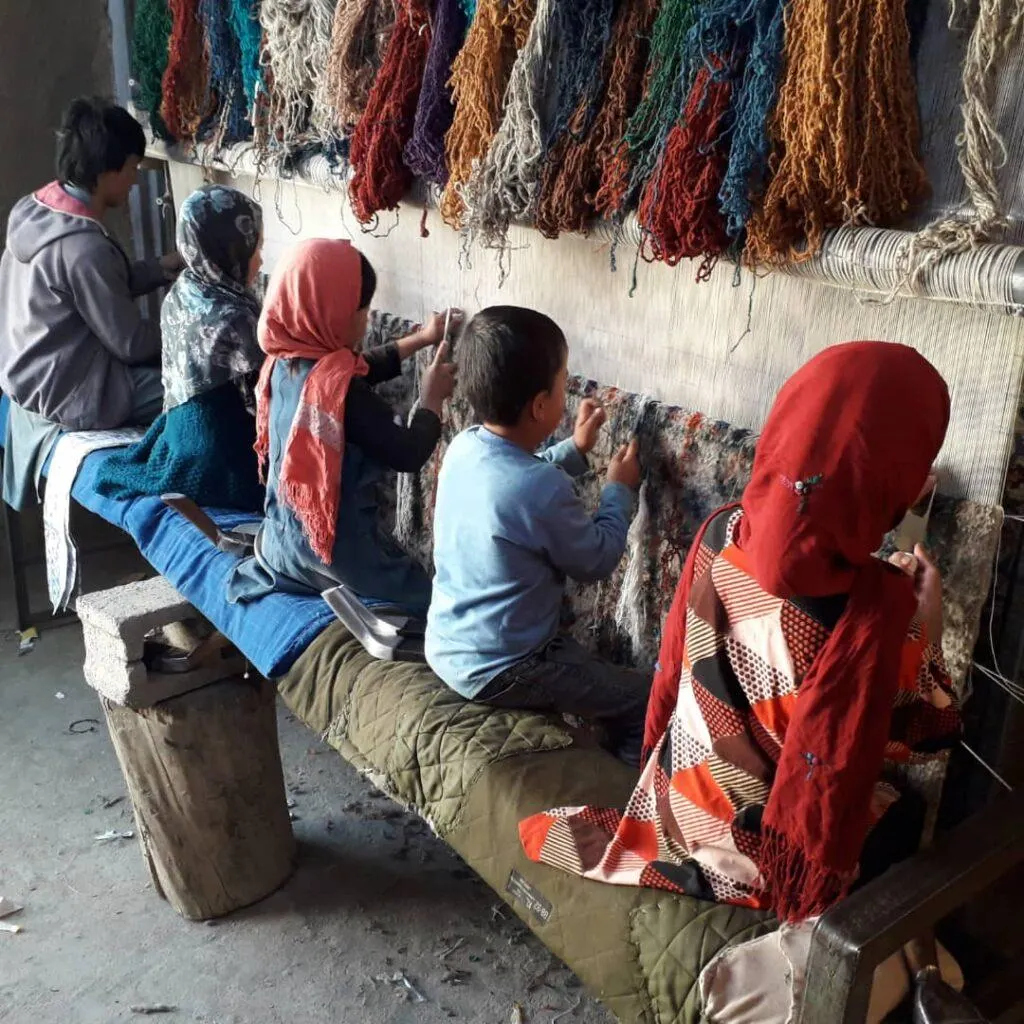
Once the materials are prepared, weaving begins. Except for sheep shearing, most weaving activities are carried out by women, while men are typically involved in trading the carpets once they are finished.
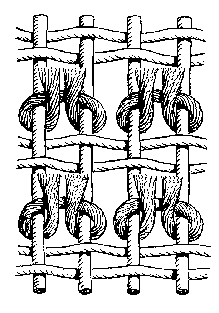
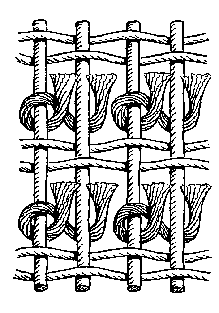
In terms of technique, both Baluch and Turkmen rugs are pile-knotted with double wefts and are usually woven on horizontal looms. Pile-knotting involves inserting a short piece of yarn between warp threads, which acts as a ‘pixel’ in the carpet. The ends of the yarn are left loose, forming the pile or surface. Several such ‘pixels’ make up each row of the carpet.
Between rows of knots, two continuous wefts are inserted and beaten down using a comb to secure the structure. Carpet-making is therefore a dual process of knotting and flat-weaving, resulting in the compact structure and highly ornamental surface characteristic of these rugs.
The quality of a rug is measured by counting knots per square inch (KPSI). Even coarsely woven rugs may contain 80–150 KPSI, while more sophisticated rugs can exceed 200 KPSI. The knots themselves also differ between communities.
(Source: Medium)
Baluch weavers use the asymmetrical Persian or Senneh knot, while Turkmen rugs typically employ the double-wrapped Turkish or Ghiordes knot. Once the carpet is finished, the warp ends are secured using a flat weave, or kilim.
After the rug is removed from the loom, commercial carpets undergo rigorous washing—sometimes for over seven hours—and are softened using brushes. They are then dried in the sun to bring out the abrash, or the subtle dual tones in the colours that give the carpets their rich, handmade appearance.
The pile is subsequently trimmed to create an even surface ready for sale. In some cases, the selvedge or edges of the carpet are straightened by fixing them onto wooden frames. While this remains the general process of making these rugs, it may vary slightly depending on the purpose and size of the piece.
(Source: Jacobsen Rugs)
(Source: Jacobsen Rugs)
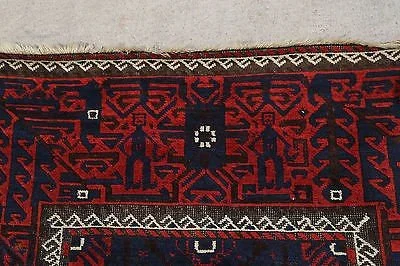
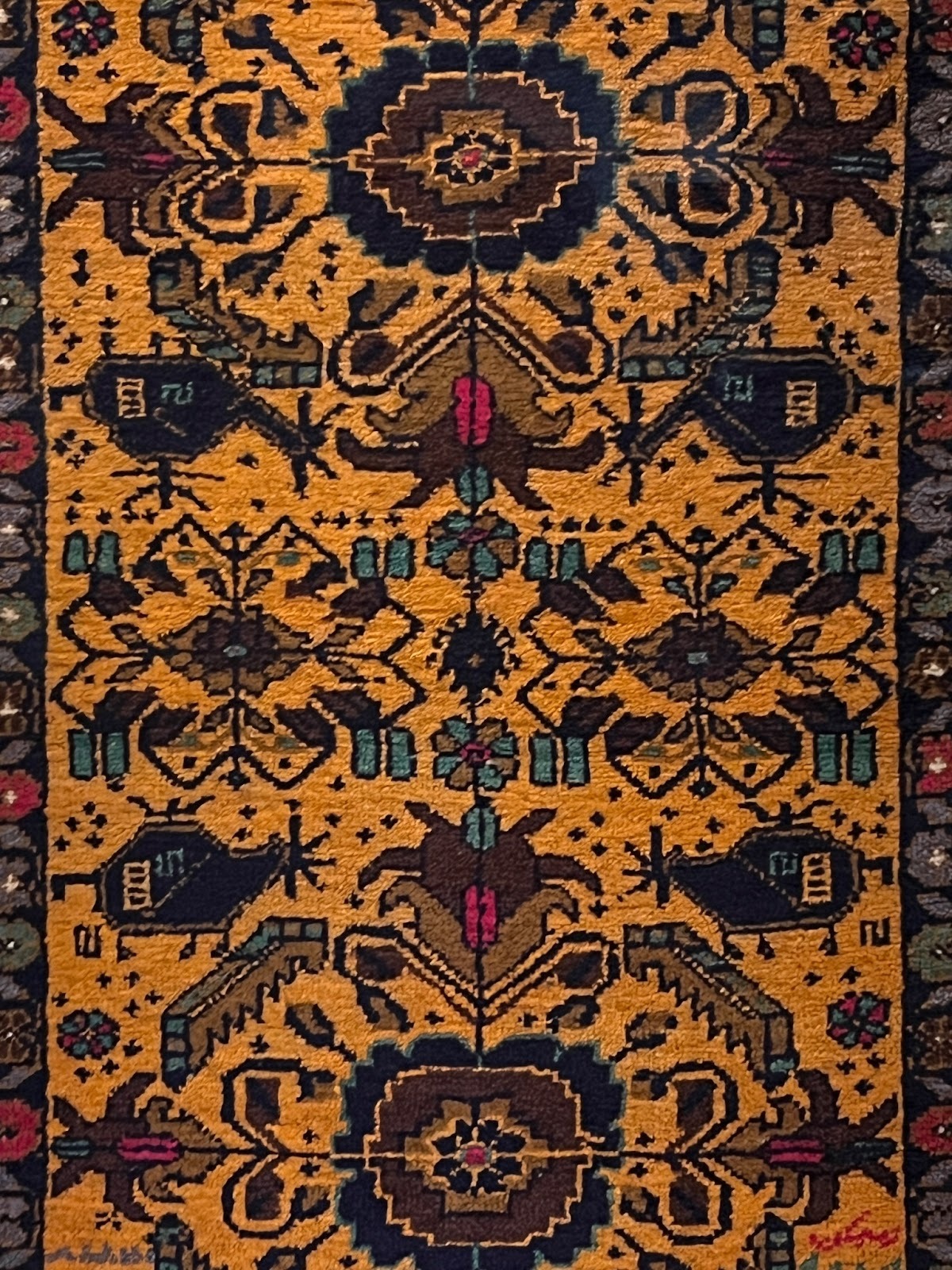
In terms of design, Baluch rugs are colourful and feature geometric, botanical or figurative elements. They are typically composed of gul motifs or medallions—either singular or repeated —enclosed within borders and rendered in shades of brown, blue, black, beige and red. Baluch weavers also produced prayer rugs, distinguished by a mihrab or central niche as a specific design element.
Turkmen rugs, by contrast, are identified by their red ground, limited colour palette and repeating abstract motifs.
It is widely believed that the first war rug was an adaptation of the Baluch style of weaving. While Islamic traditions generally discourage the depiction of animals, birds or humans in art, Baluch weaving has historically responded to its surroundings. Through contact with other cultures, it incorporated figurative imagery alongside geometric motifs within the central field.
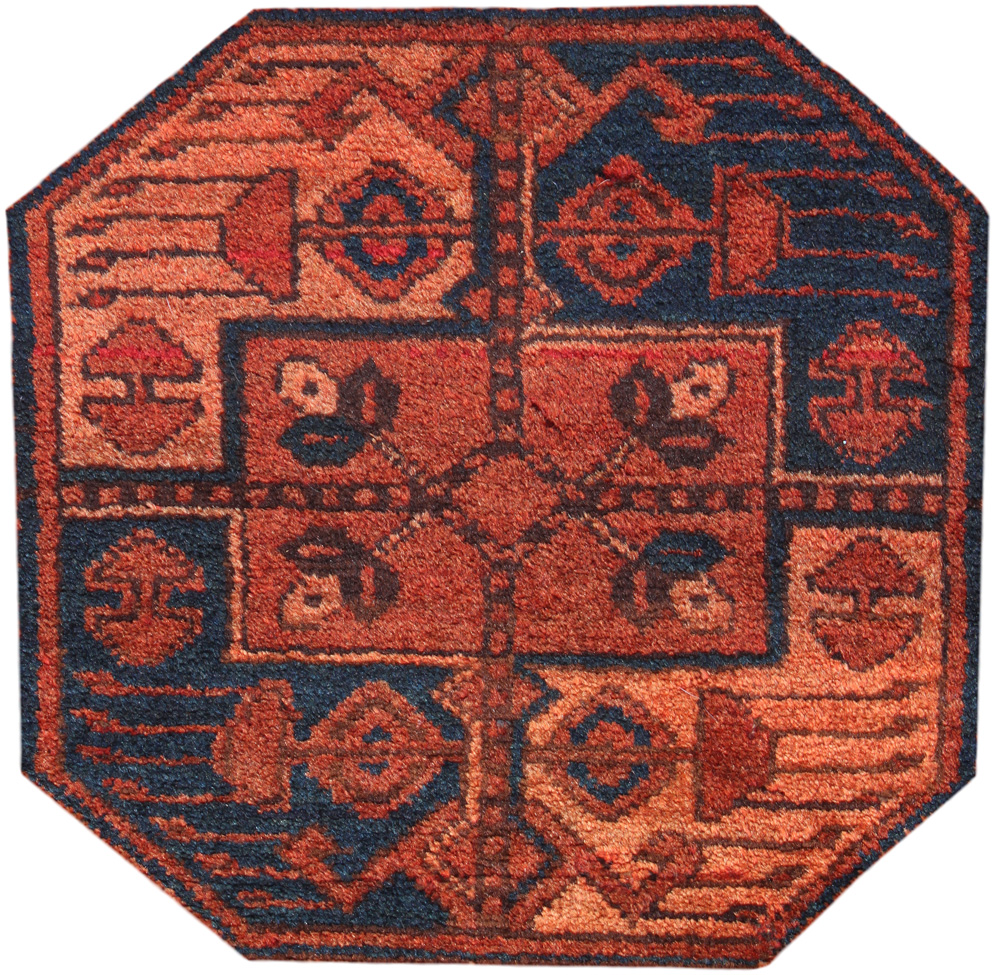
This flexibility and expressiveness is apparent in the earliest war rugs made, which are believed to be of Baluch origin and style.
The Soviet Invasion and major changes in the Carpet Weaving Industry
Afghanistan’s carpet industry saw a shift away from traditional iconography, as well as traditional making practices, soon after the Soviet invasion of 1979. However, this was not the first time a departure from tradition had appeared in the region’s weaving history. There are accounts of a Qarai rug from the 19th century showcasing Russian war imagery, and another from 1920 depicting a World War biplane. While significant, these examples did not result in a larger shift in motif language until the emergence of war rugs in 1979.

To put a complex geopolitical and social conflict simply, in 1978 a communist-led government took power in Afghanistan, a development that was at odds with the largely Islamic population of the region. This led to the formation of several Mujahideen, or rebel groups, who openly opposed the government. In 1979, Soviet troops invaded Afghanistan to support the communist regime against these groups. The conflict soon drew in global powers, with the United States and its allies funding the Mujahideen, and the struggle for power continued for the next ten years.
The Soviets eventually withdrew in 1989, but this did not bring stability. Civil wars erupted soon after as different groups attempted to seize control of the country. In 1996, the Taliban took power, and following the 9/11 attacks in 2001, US-led troops invaded Afghanistan as part of the “War on Terror,” remaining there until 2021. These events profoundly affected the lives and livelihoods of Afghan communities.
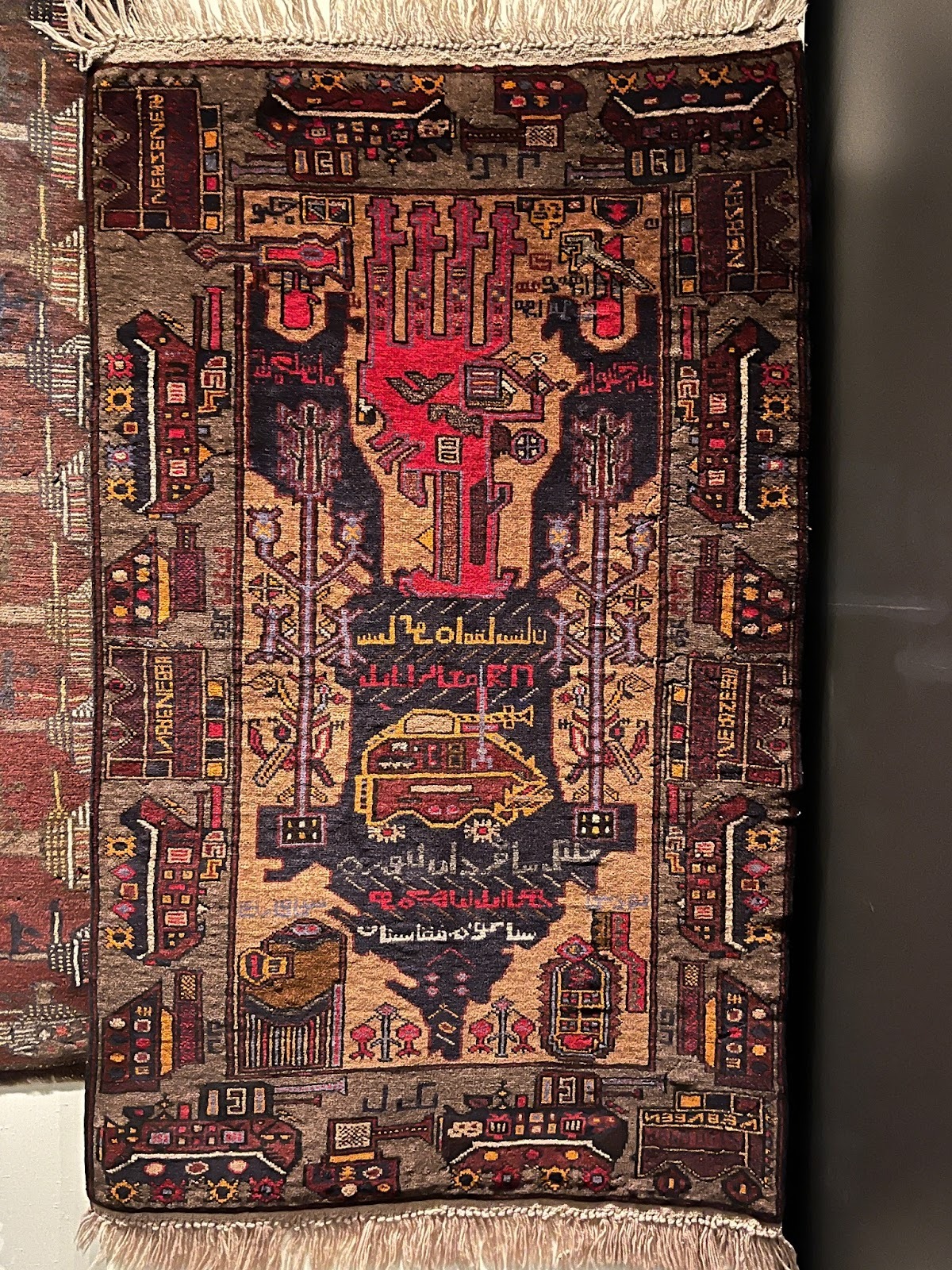
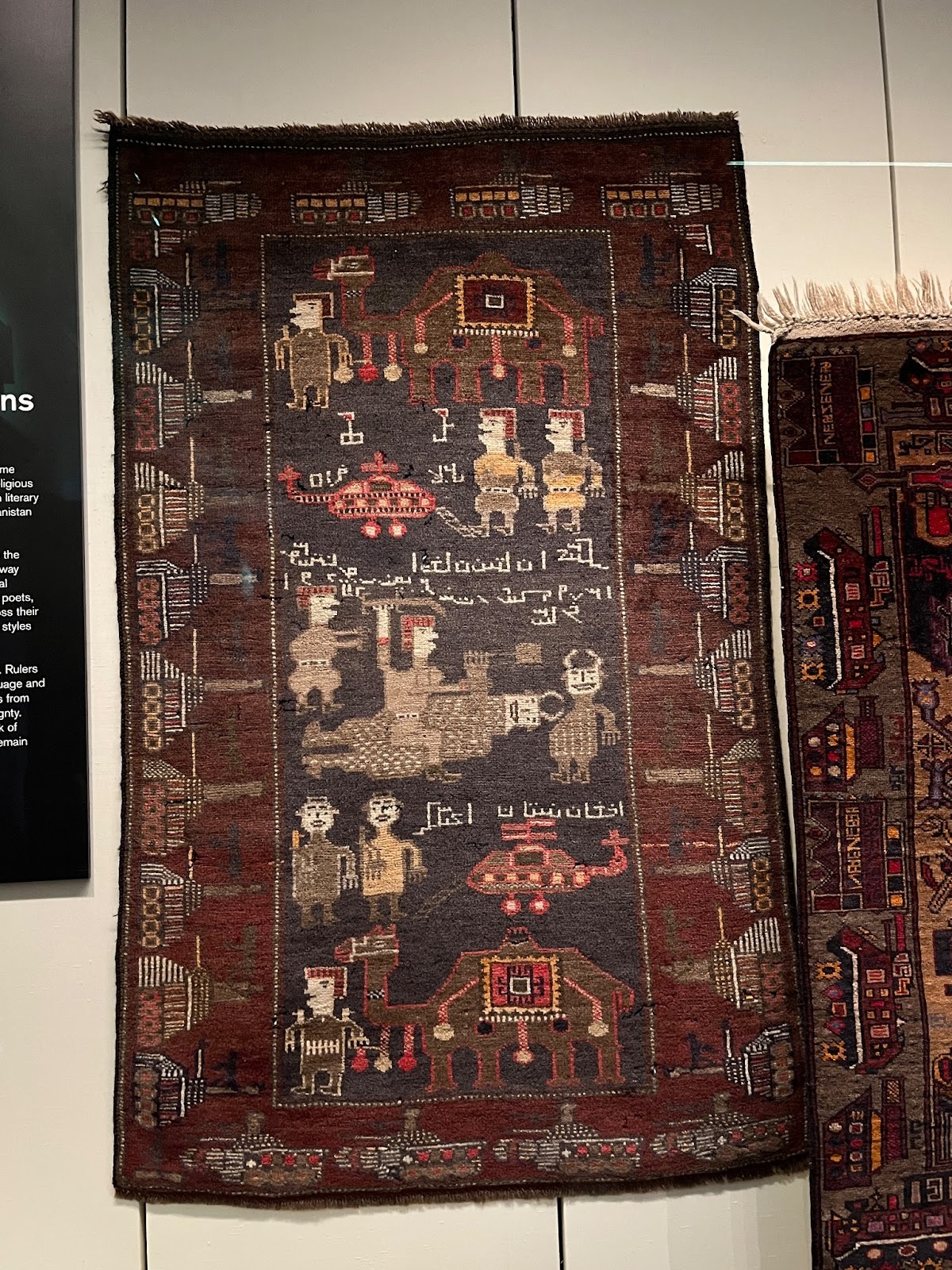
The rug-making industry in Afghanistan was transformed during this long period of conflict. The first war rug is believed to have been made shortly after the Soviet invasion of 1979, likely by a Baluch weaver, suggested by its traditional composition and the subtle inclusion of war imagery. Early war rugs adapted existing motifs: camels became tanks, flowers became grenades and birds became helicopters.
These designs likely emerged from a personal need on the part of the maker to express the circumstances and hardships surrounding them. What the weavers did not anticipate, however, was the growing demand for these rugs in international markets, which soon led to their commodification, particularly within private collections. As demand increased, supply followed. Although the earliest war rugs were likely a Baluch innovation, other communities also began producing them, responding to the expanding market—often mediated by traders and middlemen.
(British Museum, 2025)
The conflict of 1979 led to a mass migration of people from Afghanistan to neighbouring countries, mainly Pakistan and Iran, as communities fled the warfare. People from many ethnic groups, including Baluch and Turkmen communities, began living together in refugee camps set up in these countries.
In order to survive and regain economic security, weavers established workshops in these camps where different tribes worked side by side, exchanging ideas, motif repertoires and weaving techniques. Looms became vertical to save space, and rug production shifted from self-consumption to a more commercial model. Weaving for survival took precedence, and demand was driven by what fetched the highest prices in the market.
This shift came at a cost. Distinct tribal styles began to blur as market demand encouraged the production of rugs that appealed to buyers rather than preserving individual traditions. The growing market for war rugs helped sustain weaving communities in these difficult circumstances. Demand increased steadily as the rugs attracted the attention of collectors—particularly abroad—allowing traders to sell them at higher prices.
Early war rugs were not necessarily produced with foreign markets in mind. This is suggested by the abstract and stylised nature of early war imagery, and by the occasional use of Dari or Cyrillic text rather than English. Over time, however, the rugs evolved into forms more legible to audiences outside the region. Imagery became more realistic, traditional compositions gave way to maps and flags of Afghanistan and Russia, and broken English began appearing in the text.
This shift suggests that rugs depicting the conflict—often in overt and recognisable ways—became an important source of income for weavers. They were sold widely in markets across Afghanistan and Pakistan. Throughout the ten years of war with the Soviets, these rugs continued to be produced, until demand gradually declined after 1989, when the Soviet forces withdrew.
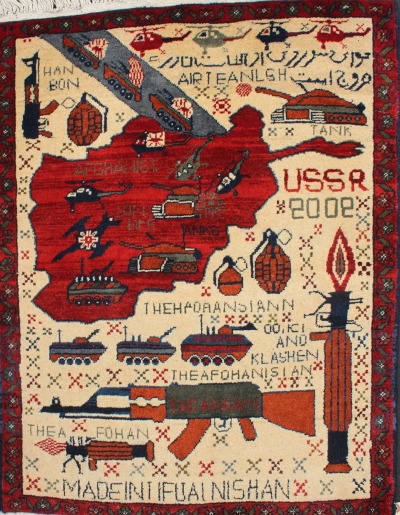
The most common imagery from this period appears in rugs depicting the Russian exodus from Afghanistan, often following a templatised design. It is worth noting that demand for war rugs declined for several years after this period, even though Afghanistan remained steeped in conflict. The conflicts that followed were largely internal and did not involve foreign powers.
During this time, weavers returned largely to traditional imagery, producing far fewer war rugs as the carpet industry continued to serve as an important source of income. In 2003, Afghan rug-making was declared a ‘Masterpiece of Oral and Intangible Heritage of Humanity’ by UNESCO, a recognition that increased global awareness and helped raise the market value of these rugs.
It may be assumed that war rugs appealed to collectors and viewers seeking to understand the hardships of Afghan people, often from distant continents. They functioned both as objects of art and as carriers of stories—beauty produced in the face of violence and uncertainty. The very idea of these rugs was almost as compelling as the circumstances in which they were created.
Scholars remain divided on how to interpret them. Some argue that war rugs represent a commodification of suffering, produced to satisfy a voyeuristic curiosity about conflict. Others defend them as pragmatic objects that allowed weavers to survive economically in highly uncertain and dangerous times. There are also arguments linking cloth and conflict more broadly, suggesting that societies with strong textile traditions often respond to periods of violence by expressing those experiences through craft.
What remains missing—and widely acknowledged as missing in many of these discussions—is the voice of the weavers themselves. The distance between the makers and the market is significant, with production and distribution largely controlled by traders and middlemen. As a result, the intentions of the weavers remain largely unknown.
What is known, however, is that as carpet weaving became one of the few surviving industries, women, children and men were compelled to work long hours under precarious conditions. This shift is visible in the quality of war rugs produced during the peak of their demand. As less skilled labour entered production, knot densities declined, the wool became coarser, rugs became smaller and easier to transport, and the imagery and compositions grew increasingly rudimentary.
It may be argued here that ‘fineness’, quality and beauty cannot be expected or achieved when the luxury of time is taken away from the maker. It may be suggested that this era in Afghanistan led to an entirely new style of weaving, one that optimised for speed and survival, rather than aesthetic finesse. This is further exhibited in the war rugs woven post 2001.
(Source: Lowdown Magazine)
War Rugs Post 9/11
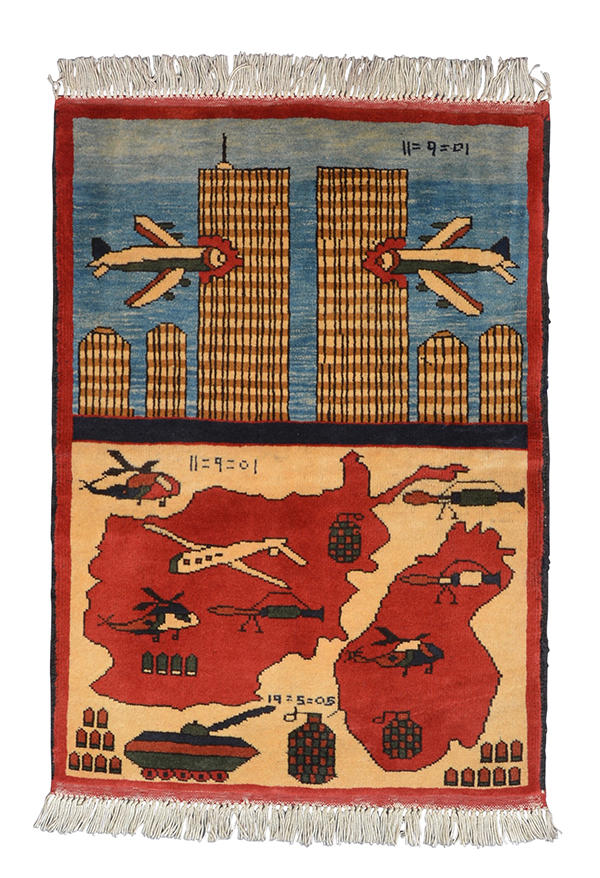
After the 9/11 attacks in the United States in 2001, Afghanistan once again came under intense international scrutiny. When US troops invaded the country, the production of war rugs resumed, albeit in a new, more graphic form. These rugs became highly pictorial and graphically accurate—an important selling point—and were often more colourful than those produced during the Soviet war. The use of natural dyes became rare, as did the inclusion of traditional imagery and layouts.
The weaponry and vehicles depicted in these rugs evolved alongside advances in military technology. English text also became more common, often appearing exclusively, with phrases such as “War Against Terror.” Subjects ranged from narrative rugs showing the attack on the Twin Towers overlaid on a map of Afghanistan, to pictorial rugs featuring US aircraft, drones and missiles, and even compositions calling for peace between the two countries.
Two main groups purchased these rugs. The first were US and Canadian soldiers and diplomats posted in Afghanistan, who bought smaller, cheaper rugs as souvenirs from military bases. The second consisted of international collectors seeking larger and more elaborate pieces.
The rugs produced during this period have often been criticised for their perceived inauthenticity, described as carefully manufactured yet crudely produced objects—commodified takeaways from a troubled land. While such critiques may hold some validity, they leave little room for the realities faced by the weavers, many of whom were women and children working under the direction of traders rather than personal choice.
In a society disrupted by decades of conflict and limited economic opportunity, producing what sells can become a matter of survival. And so, a new phase in the history of Afghan war rugs emerged. When US troops withdrew from Afghanistan in 2021, demand for these rugs declined once again. Nevertheless, they continue to be produced and sold on online platforms and in international markets, circulating as material reminders of a conflict that has gradually receded from global attention.
War Rugs Today, and the Carpet Industry in Afghanistan
After years of war, displacement, destruction and uncertainty, Afghanistan now struggles to regain its place as an active participant in the global economy. In 2023, the Ministry of Industry and Commerce sought to boost carpet production, particularly after its sharp decline in 2021 following the Taliban’s return to power. Weavers and traders have largely reverted to producing and selling traditional designs, which appeal to broader markets beyond niche collectors.
As an offshoot of this industry, substantial developments in the visual language of war rugs tend to emerge only when the global spotlight turns toward Afghanistan. This can be read as a strategy by traders and businesses to capitalise on existing exports by attracting an additional customer—the museum curator or collector. It may also be assumed that the sale of war rugs alongside traditional designs generated greater revenue, ultimately benefiting the industry as a whole. In the absence of international attention, however, the industry adapts once again, finding other avenues for survival.
The existence of war rugs as distinct commodities—and as products of unrest—offers a striking example of craft shaped by circumstance, adapting to commerce and becoming a means of survival. While their makers remain largely faceless and nameless, their contribution to visual and material culture is undeniable. Perhaps the most intriguing aspects of these rugs remain the unclear origins of the first examples—likely acts of personal expression—and the transformations they underwent once commerce began to shape craftsmanship, revealing tangible links between international demand and local supply.
War rugs also play on a powerful emotion: the curiosity and human impulse to empathise with people living in a war-torn country known in modern times largely through its turbulent history. The response is equally human—to feed this curiosity and, when other options for survival become scarce, to capitalise on it. In this way, war rugs become craft responding to the world in real time, a testament to its dynamism.
Craft traditions are often perceived as static or unchanging. War rugs challenge this notion by using tradition to produce highly contemporary imagery. Born out of extraordinary circumstances, they remain a striking example of human resilience and the enduring relationship between people and their craft.









.jpg)