1. Tell us about your background; what inspired you to start your creative journey?
I'd like to think I was always creative. From childhood, I’ve been involved with some sort of creative hobby: sculpting, drawing, painting, even a bit of music production, haha (though that didn't last long). For the longest time, I wanted to be a concept artist too. Coming from a South Asian family, it's tough to convince your parents to let you have a creative endeavor, so when it was time to pick majors for post-secondary studies, I ended up choosing computer science in hopes that I could potentially branch out later as a game designer.
One year into the program, and I got humbled fast. I used to draw digital art as an escape, and that's when a friend of mine really pushed me into looking at creative fields. At the time, I had no graphic design experience, I didn't even know such a major existed. After doing my research, I picked graphic design, and now I'm here!
2. How do you think being a third-culture kid (manifests in your visual language and design decisions?
It really only happens with pieces I make that are directly related to my culture. At the back of my head I've always wanted to make something for third culture kids (people who were raised in a different culture than their parents) like me. I’ve wanted to explore what Bangla typography could look like when paired with western design principles. Like a Bangla Swiss-style poster? But every time I do, I'm anxious about how the Bangladeshi community may respond, because even with experimentation, I still have to be mindful of respecting a culture. While I love my heritage and I'm proud of it, I don't want to make something that looks like a cheap, exoticised ornament. That's something that I always try to be wary of in my design decisions, especially since I'm a third culture kid.

3. What was the starting point for RITU? Was there a specific feeling or reference that drove the project, and how did that lead you to experiment with asemic typography as a form of expression?
Honestly, I think being surrounded by environments devoid of Bangladeshi representation was probably the starting point. That goes way back. When I moved to Toronto for college, for a long time, I didn't have many Bengali friends because you won’t find many South Asians in the arts. I think around my second year, we had an editorial project and I did something similar to RITU, except it was called something entirely different, with way worse grid and typography systems. I would say that was the initial seed for me to realize that there isn't much media surrounding us and our talents. There was another thing that really triggered it, and that was me talking to other third culture kids and noticing their disconnect from the language that our forefathers fought for. A lot of them were even forgetting how to read or write, which was heartbreaking. But I couldn't completely blame them, because there isn't a lot of accessible/fun media for them to grab or get involved with, I mean who would want to read a boring 500-page grammar textbook in a language they barely understand?
My work with asemic type was just a product of my research phases. I was looking into different type systems when I stumbled across a textured system called asemic typography (words with no semantic meaning) and funnily enough, a lot of the letter forms looked like Bangla. That's where I started experimenting with forms more and realized how much potential there is in Bangla, in terms of typography.
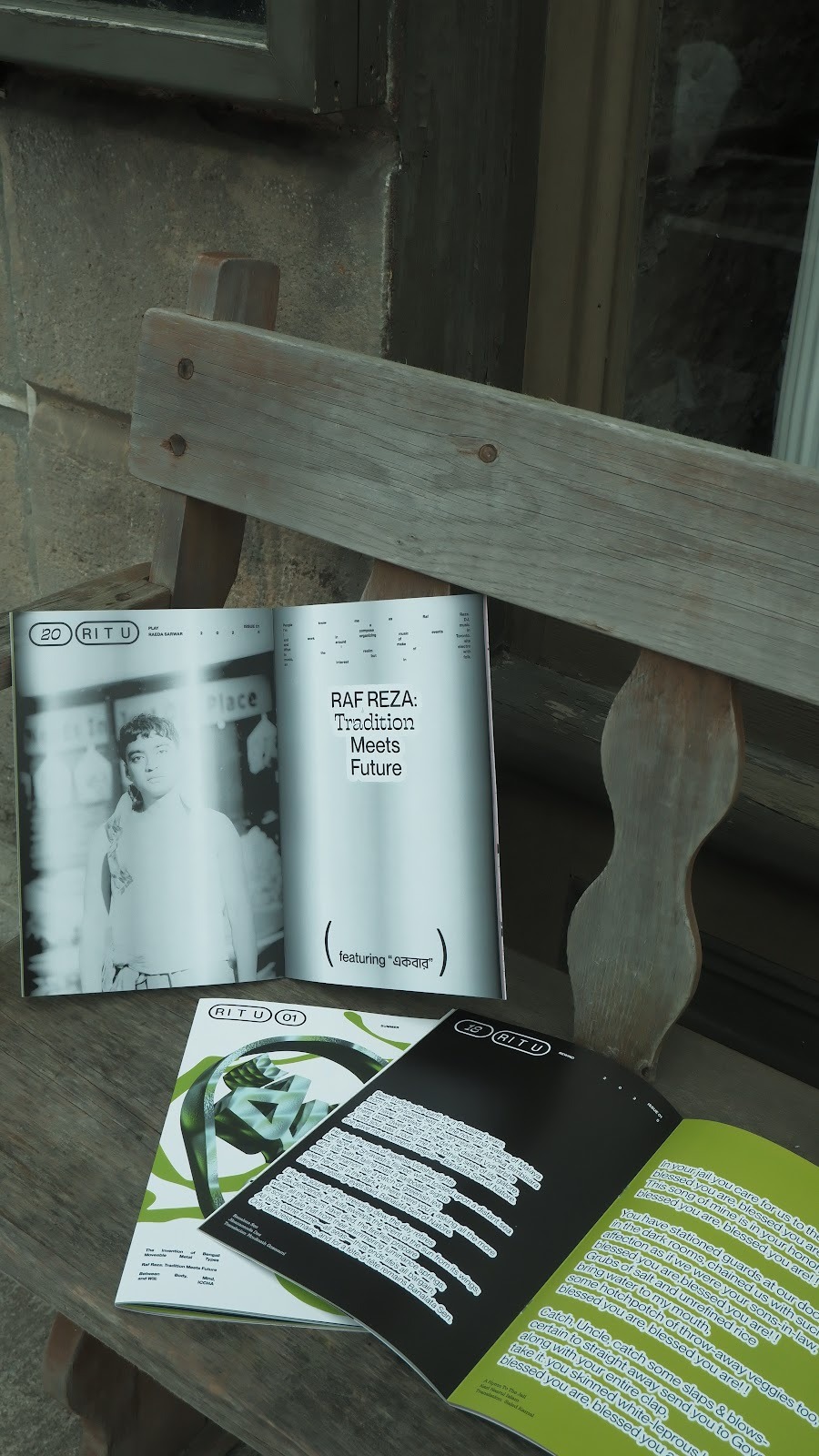
4. On your instagram, you mention that RITU is about rediscovering cultural roots that often feel forgotten or out of reach. How did creating RITU shift how you approach design or the kinds of stories you want to tell?
RITU was—and continues to be—a transformative experience. Working on it revealed parts of myself I hadn’t even seen before. It might sound cliché, but I came to truly understand the emotional power of design, how it can move people. One doesn't need to study the Gestalt principles or the seven elements of design to feel seen. Sharing the project online showed me just how deeply design can make voices heard and make people feel represented. That a lot of what we go through alone is actually a shared experience by Bangladeshis all over the world. It’s more than a tool for communication—it’s a medium for shifting perspectives, rewriting narratives, and in spaces where thoughtful design is scarce, even setting a new standard. There's so much we can do, so much talent to showcase. We just need to create the right stage for Bangladeshi people. And show them how much you can really do with print (also, if print is dead, then I am dead!).
5. What does the future of RITU look like? If you were to explore it further, have you imagined exploring forms other than a magazine?
Hehe, for now, all I will say is I've definitely planned a lot of things and I see this becoming much more than just a magazine. All in due time and hopefully with proper funding, but for now I would love to keep making better issues and try to find ways to make an immersive digital experience too, to make it accessible to everyone!
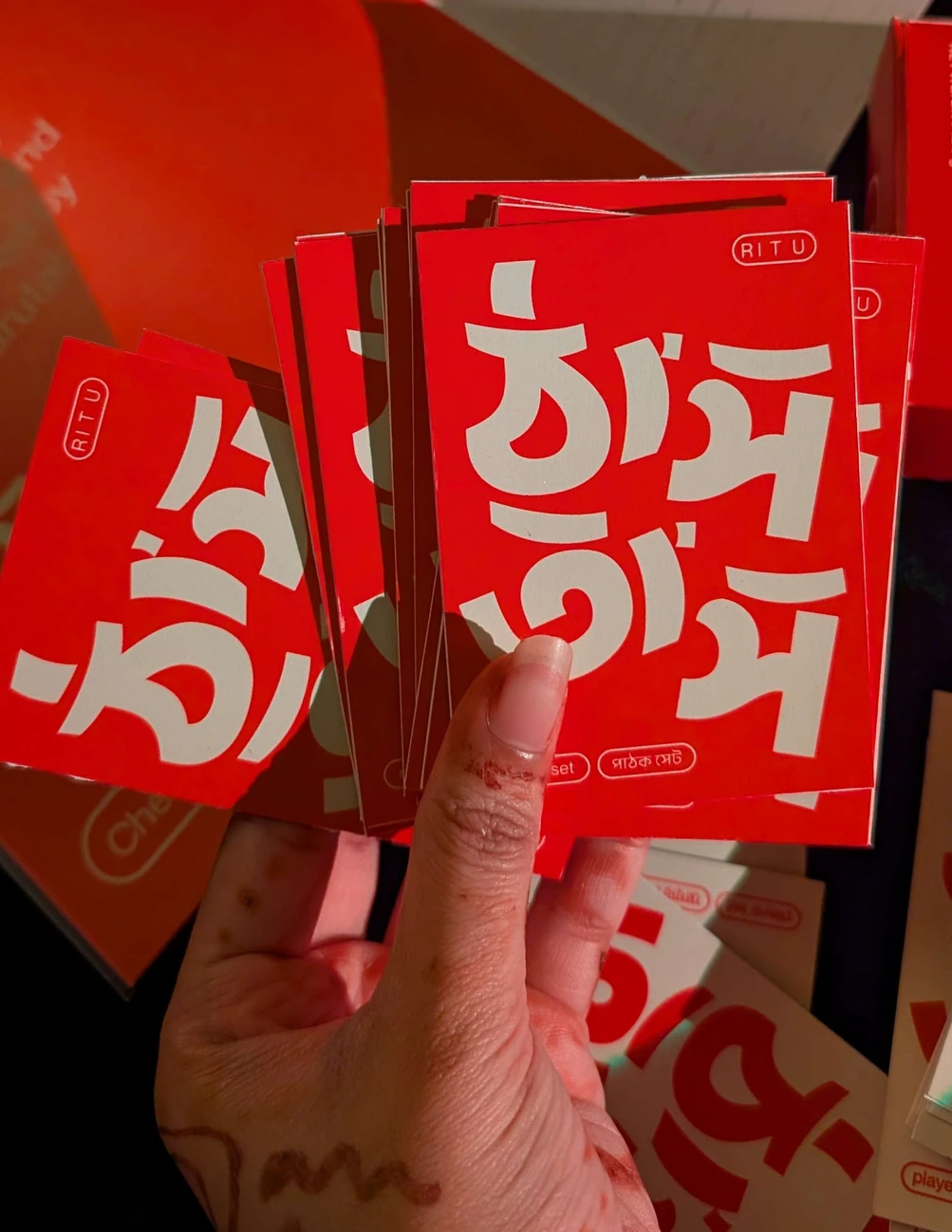
6. Thash Tash reimagines a traditional Japanese game to engage with Bangla poetry. What drew you to Karuta specifically, and how did you navigate the balance between cultural borrowing and cultural grounding?
The story behind this is a bit funny. When I was in the 8th grade, I used to religiously watch an anime called Chihayafuru, which is about Japanese Karuta. Years later when I had to come up with ideas for my thesis, I wanted to do something with Bangla poetry, and it all sort of suddenly connected - making a Bangladeshi game inspired by Karuta because Bangla has so much poetic media. However I really wanted to have our own twists to it, tying it with the six seasons and all, developing our own points system. That's also kind of why it's not fully out to the public yet because I want to refine the mechanics of the game more.
7. How do you think playfulness can be a tool for cultural preservation or revival, especially for diasporic communities disconnected from their literary roots?
Playfulness is something that invites people in, especially in branding. An example of this would be fast food chains, where branding is intentionally made playful so people feel more inclined to consume their products, and you see this in social media marketing too. The more playful your presentation is, the easier it is to welcome youth especially in diasporic communities because it can give them something to be able to relate to, so I guess it's a psychological thing. Culture, I would say, is sort of like branding. I might get some raised eyebrows for making this statement, but I don't mean it as a capitalistic way. It's an identity, a product of the surroundings you're raised in. I think that's so important in terms of revival, because as tech progresses, and new trends come and go, you need ways to keep the best of both worlds.
8. Any advice for students pursuing design for higher education? And how would that change for students going into their first year vs final year?
I think one thing that I've realized throughout my college years is that to really succeed in ANY creative endeavor, you need to submit to it. Creative careers almost become like a religion. School only does so much, the real stuff comes from within. You quite literally need to start living, breathing, consuming, sleeping creativity. It's like a muscle too, the more creative things you do, the better you will get at creative thinking.
For my aspiring designers, have a few successful designers you really look up to and really study their style. Ask yourself questions. What about their work stands out to you? Why? How do you think they achieved that graphically? Why is it working? Do some case studies! You have all the time in the world. Don't compare, study!
Also, I don't see a lot of people mentioning this but you literally are what you eat. Read books, stop watching brainrot and go consume something that actually edifies you. Read about the world, read about history, read papers and you'd be surprised by the places you randomly find inspiration from.
9. What ideas or experiments are you working on or itching to try post-grad?
FONT MAKING!I just can't wait to start. I want to make my own, crazy Bangla font. I also want to refine Thash Tash. There's so much I want to do, I wish I had three brains. I've been dabbling with motion graphics too and really want to up my game on that. Then there's RITU Issue 02 as well!
10. And finally, the most important question. What is your favourite South Asian sweet?
My mom's gajar ka halwa (carrot pudding).